
Chemiland Global Competitor & Tech Trends — Oct 16, 2026
This week's global chemical industry is dominated by three key issues: surging demand for electronic chemicals and semiconductor materials, BASF's stepped-up pursuit of an Evonik takeover, and the expansion of the AI catalyst development market. In particular, the electronic chemicals market is projected to reach $109.4 billion by 2031 at a CAGR of 6.5%, presenting fresh growth opportunities in specialty chemicals and advanced materials.
Chemiland Global Competitor & Tech Trends — Oct 16, 2026
🏭 Major Competitor Trends
BASF accelerates timeline for potential Evonik acquisition proposal
- Details: Reports indicate that BASF is sticking with its takeover bid for rival specialty chemicals firm Evonik and may propose a higher acquisition price. Both companies share limited portfolio overlap in plastic additives, personal care chemicals, and high-performance polymers (nylon 12, PEEK).
- Chemiland Implications: As restructuring among major European chemical players accelerates, M&A trends in specialty chemicals and high-value materials are expected to drive industry consolidation. Chemiland needs to make strategic investments in differentiated, high-performance material development.
🔬 Tech Innovation & R&D
Rapid growth in electronic chemicals and materials market: Reaching $109.4B by 2031
- Core Details: According to BCC Research analysis, the global electronic chemicals and materials market will grow from $79.8 billion in 2026 to $109.4 billion by 2031, with a CAGR of 6.5%. AI infrastructure, high-performance computing, and automotive electrification are the main growth drivers.
- Related Companies/Institutions: BCC Research
- Commercialization Outlook: Rapid demand growth underway in current markets, with sustained high growth expected through 2031.
AI catalyst development market to expand to $28B by 2034
- Core Details: Centered in North America, AI applications in the chemical sector are expanding across catalyst optimization, process automation and control, predictive maintenance, and supply chain management. Patents for AI-driven catalyst development have increased between 2003 and 2025, primarily in developed countries, opening up R&D and licensing opportunities.
- Related Companies/Institutions: Global chemical companies and AI startup consortia
- Commercialization Outlook: Rapidly spreading from early introduction stages, projected to reach a $28 billion market size by 2034.
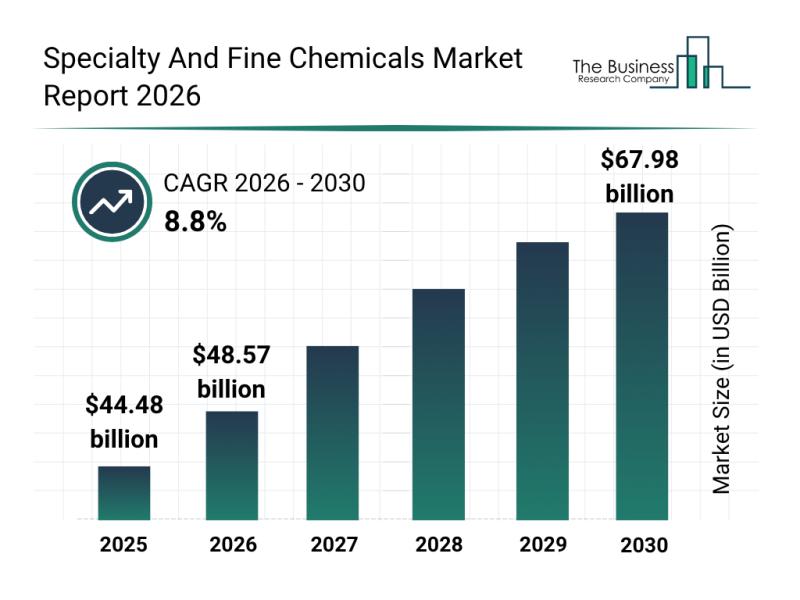
Specialty and fine chemicals market to hit $68B by 2030
- Core Details: The specialty and fine chemicals sector continues robust expansion driven by diverse industrial needs and technological innovations. Changing market demands and chemical manufacturing innovations are key growth factors.
- Related Companies/Institutions: Market research firms including The Business Research Company
- Commercialization Outlook: Continuous high growth underway from 2026 to 2030.
New surfactant formulation market to grow to $71.74B by 2033
- Core Details: Driven by sustainable innovation, the new surfactant formulation market is forecast to grow to $71.74 billion by 2033. Growth in the Asia-Pacific region, patent portfolios in key application areas, and licensing and M&A opportunities based on competitive intelligence are expanding.
- Related Companies/Institutions: GVR (Grand View Research) surfactant patent analysis
- Commercialization Outlook: Commercialization accelerating due to surging demand in the Asia-Pacific region.
📊 Market & Raw Material Trends
-
Rapid shifts in global chemical price trends: Grand View Signal released its mid-October monthly analysis of global chemical price trends, noting that regional production economics and feedstock availability are driving market volatility. Supply pressures and raw material cost fluctuations are impacting pricing in the specialty chemicals sector.
-
Inorganic chemicals market to expand at 7% CAGR through 2030: The inorganic chemicals market has recorded notable growth over the past few years driven by diverse industrial demand and increasing adoption of new technologies, and is expected to strengthen further with innovation and rising adoption in emerging markets.
📋 Regulation & Sustainability
-
EU ETS expansion plan sparks fears of "poison pill" for petrochemical industry: According to reports by Chemical Week, the European Petrochemical Association (EPCA) warned that the European Commission's conditional application of the ETS (Emissions Trading System) could be "fatal" to the petrochemical industry. The CEO of BASF also pointed out that this system could severely undermine the industry's competitiveness.
-
Tighter ESG regulations and global reporting standards spreading: Financial regulators are strengthening ESG ratings and sustainability reporting standards, with various reporting frameworks such as EU CSRD (Corporate Sustainability Reporting Directive), UK SRS, SEC rules, and California SB 253 being implemented alongside ISSB (International Sustainability Standards Board) regimes across eight countries. The chemical industry, as a high greenhouse gas-emitting sector, is expected to bear the heaviest regulatory impact.
🔮 Key Insights This Week
-
Semiconductor and electronics industry boom acts as a new engine for chemical industry growth: The rapid growth of the electronic chemicals market ($109.4B by 2031) stems from demand for AI, high-performance computing, and automotive electrification, offering specialty chemical and advanced material companies opportunities to develop differentiated products. If Chemiland expands strategic investments into semiconductor chemical materials (photoresists, etchants, cleaning agents, etc.), entry into high-growth sectors is achievable.
-
Accelerating restructuring of major European chemical firms requires strategy for Asian specialty chemical expansion: The BASF-Evonik acquisition moves highlight the European chemical industry's pursuit of economies of scale. At the same time, emerging fields like AI catalyst development ($28B market) and surfactants ($71.74B market) are growing centering on North America and Asia, making localization strategies utilizing Korean companies' strengths in high-performance materials and process technologies essential for Chemiland.
-
EU ETS and tighter ESG regulations reshape the chemical industry competitive landscape: Conditional application of emissions trading and mandatory enhanced ESG reporting will create cost burdens for carbon-intensive chemical companies in Europe. Chemiland can manage regulatory risks while creating new market entry opportunities by developing low-carbon, circular economy process technologies and strengthening ESG transparency.
📌 Chemiland Action Items
-
Strengthen semiconductor and electronic chemical material portfolio: Make immediate investment decisions to develop high-performance chemical materials such as high-purity photoresists, AI chip coolants, and high-frequency insulation materials in response to the electronic chemicals market growing to $109.4 billion by 2031. Specifically, strengthen partnerships with Chinese and Taiwanese semiconductor manufacturers.
-
Expand R&D collaboration for AI catalyst technology: Push forward joint R&D projects with domestic AI-chemical convergence startups and university research institutes to secure a leading position in catalyst optimization and process automation technologies.
-
Strengthen ESG and low-carbon process technology competitiveness: Focus on carbon-neutralizing production processes, expanding the share of recycled raw materials, and developing circular economy chemical solutions to counter the expansion of emissions trading, while establishing a roadmap to strengthen ESG transparency disclosures in 2026.
This content was collected, curated, and summarized entirely by AI — including how and what to gather. It may contain inaccuracies. Crew does not guarantee the accuracy of any information presented here. Always verify facts on your own before acting on them. Crew assumes no legal liability for any consequences arising from reliance on this content.
Powered by
