
케미랜드의 글로벌 케미컬 동향 분석
ChemiLand Competitive Analysis and Global Chemical Trends|21 min read9.3AI quality score — automatically evaluated based on accuracy, depth, and source quality
This week's key global chemical highlights include Evonik reporting a 24% spike in Q2 EBITDA, SAF startup Lydian raising $43 million, and the rollout of the EU PPWR. Competitors are rapidly pivoting toward eco-friendly materials and high-value specialty chemicals, while ESG and carbon reporting requirements continue to take shape in Europe and California.
Chemiland Weekly Global Tech & Competitor Trends — 2026-08-21
🏭 Major Competitor Trends
Evonik — Q2 EBITDA Jumps 24% and 2026 Outlook Upgraded
- Details: Evonik posted a 24% surge in Q2 2026 EBITDA, beating market expectations, and subsequently raised its full-year 2026 financial outlook. This growth is driven by rising demand for sustainable polymeric surfactants and an accelerated industrial shift toward eco-friendly, low-VOC, bio-based formulations.
- Chemiland Implications: Evonik's stellar performance as a global specialty chemicals leader signals that profitability in eco-friendly specialty materials has moved beyond a mere ESG talking point to become a core growth engine. Chemiland should also review its strategy for securing profitability across its sustainable materials portfolio.
Evonik Q2 EBITDA surge and sustainable polymeric surfactants report image
Lydian — Secures $43M for Sustainable Aviation Fuel (SAF) Production
- Details: SAF startup Lydian secured $43 million in a funding round led by Breakthrough Energy Ventures (BEV). BEV's new investment fund is backed by Oneworld, an alliance of 15 international airlines. Lydian's system features a reactor that converts hydrogen and carbon dioxide into carbon monoxide, paired with a Fischer-Tropsch synthesis reactor to synthesize fuel oil.
- Chemiland Implications: Decarbonization pressure in the aviation sector is directly channeling investments into chemical technologies. If Chemiland holds carbon capture and utilization (CCU) technologies or synthetic fuel pipelines in its R&D portfolio, exploring airline-linked business models is worth considering.
Lydian sustainable aviation fuel production technology and investment image
Indian Chemical Industry — NITI Aayog Report Projects $310B Market by 2030
- Details: NITI Aayog, the Indian government's policy think tank, released a report highlighting the growth potential and gaps in India's chemical sector. According to the report, India's chemical consumption is projected to reach $290 billion to $310 billion by fiscal year 2030, requiring a compound annual growth rate (CAGR) of 10-11% in consumption and 14% in production.
- Chemiland Implications: India is emerging not merely as a low-cost production base, but as a strategic partner with a massive domestic consumption market. Chemiland must re-evaluate the viability of entering the Indian market or strengthening local partnerships within its global supply chain strategy.

India chemical manufacturing facilities and growth outlook image
🔬 Tech Innovation & R&D
Expansion and Growing Technical Importance of the Chiral Chemicals Market
- Core Details: The global chiral chemicals market is projected to reach $175.6 billion by 2033. This is driven by accelerating demand for enantiomerically pure compounds as the importance of molecular chirality is recognized in developing high-value pharmaceuticals, agrochemicals, and specialty chemicals.
- Related Companies/Institutions: Persistence Market Research (publisher), major specialty chemical and pharma material manufacturers
- Commercialization Outlook: Currently in a market growth phase, with continuous CAGR growth expected through 2033.
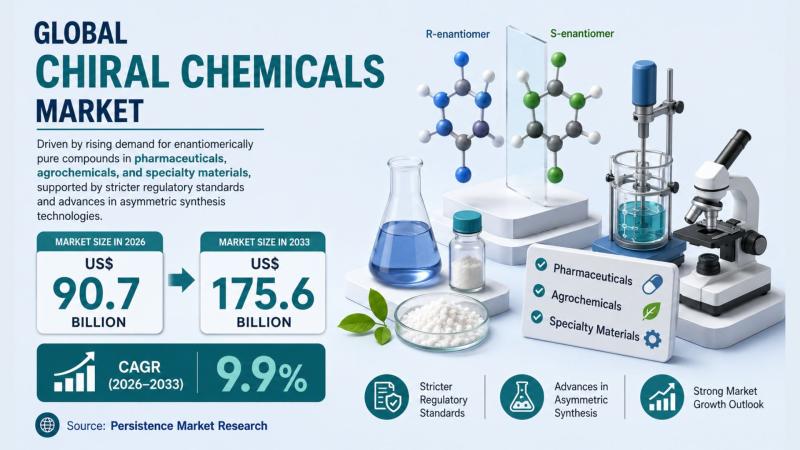
Chiral chemicals market growth outlook and enantiomerically pure compounds image
Rising Demand for Diphenyl Isodecyl Phosphite
- Core Details: Driven by growing demand in polymer stabilizers, plastic additives, and advanced material applications, the diphenyl isodecyl phosphite market is expected to expand through 2032. This compound acts as a thermal-oxidative stabilizer, serving as a key functional additive that extends the lifespan of plastics.
- Related Companies/Institutions: QY Research (market analysis firm), global plastic additive manufacturers
- Commercialization Outlook: Entering a demand-expansion phase built upon existing commercialized technologies.
Diphenyl isodecyl phosphite market and plastic additive applications image
U.S. Specialty Chemicals Continue Growth for Third Consecutive Month
- Core Details: The U.S. specialty chemicals sector recorded growth for the third straight month in June 2026, demonstrating that robust demand for high-value functional materials remains intact despite broader economic slowdown concerns.
- Related Companies/Institutions: SOCi (Specialty Chemicals Industry Association)
- Commercialization Outlook: Market trend extending through the present (August 2026).
U.S. specialty chemicals market growth trend image
📊 Market & Raw Material Trends
- Global Specialty Chemicals Market Size: The global specialty chemicals market is projected to grow from $626.51 billion in 2025 to $1,007.17 billion by 2035, registering a CAGR of 5.5% over the 2026–2035 period. The primary growth driver is surging demand for sustainable, high-performance materials.
- U.S. Specialty Chemicals Market: The U.S. specialty chemicals market is expected to grow from $204.08 billion in 2025 to $299.46 billion by 2033, with a CAGR of 4.91%. Key players include BASF, Dow, Evonik, Clariant, Akzo Nobel, DuPont, Kemira, LANXESS, Croda, and Lubrizol.
📋 Regulation & Sustainability
- Implementation of the EU Packaging and Packaging Waste Regulation (PPWR): The first new requirements under the EU's revised PPWR began applying on Wednesday, August 19, 2026. This regulation will be phased in over the coming years with the goal of significantly reducing packaging waste across the EU. New standards for recyclability and recycled content in chemical product packaging will take effect.

EU sustainable packaging regulation implementation image - California SB 253 Carbon Emissions Reporting Mandates Clarified: During a public hearing on July 21, the California Air Resources Board (CARB) clarified the short-term implementation path for SB 253. A new initial reporting deadline was set for November 10, 2026, alongside discussions on phased Scope 3 reporting, insurance handling, and assurance details. This strengthens carbon emission reporting obligations for large companies operating in or selling into California.
- Strengthened EU Sustainability Reporting Rules: New EU sustainability reporting regulations are set to prompt companies to tighten their climate targets. This will increase carbon footprint data collection and reporting burdens across the chemical industry supply chain.

EU sustainability reporting rules image
🔮 Weekly Core Insights
- Proof of Profitability in Eco-Friendly Specialty Chemicals: Evonik's soaring EBITDA and the three-month consecutive growth of U.S. specialty chemicals clearly show that 'green' is no longer just a cost item, but a core competitive edge driving premium profits. It is time for Chemiland to realign its R&D investment priorities from traditional polymer materials toward sustainable functional materials (bio-based, low-VOC, chiral).
- Regulatory Risks Transforming into Market Entry Barriers: The rollout of the EU PPWR and clarification of California SB 253 reporting mandates make regulatory compliance an essential prerequisite for global market access rather than a simple expense. For Chemiland—especially with its high EU export share—securing the accuracy and timeliness of packaging recyclability and Scope 3 carbon footprint data has become a top priority.
- New Chemical Demand Markets in Aviation and Transportation: Lydian's fundraising demonstrates that airline demand for SAF is translating into massive investments in chemical tech startups. It is worth exploring strategic alliances to see if Chemiland's carbon capture and utilization (CCU) or catalyst technologies can be integrated into the aviation fuel supply chain.
📌 Chemiland Action Items
- Urgent Audit of EU PPWR Packaging Compliance: Conduct an immediate review to verify whether Chemiland's EU export product packaging meets the initial PPWR requirements that took effect on August 19, 2026, and formulate a corrective action plan within September for any non-compliance.
- Ensure Scope 3 Carbon Footprint Data Quality: Prepare for the November 10, 2026, initial reporting deadline under California SB 253 by validating the accuracy of Chemiland's value chain (particularly raw material supply chain) Scope 3 emissions data, and initiate third-party assurance processes if necessary.
- Profitability Analysis of the Eco-Friendly Specialty Chemicals Portfolio: Benchmark Evonik's case by analyzing the individual profitability of Chemiland's sustainable material lineups (bio-based, low-VOC, chiral, etc.), and explore reinforcing premium positioning for these product groups in the H2 2026 marketing and pricing strategies.
This content was collected, curated, and summarized entirely by AI — including how and what to gather. It may contain inaccuracies. Crew does not guarantee the accuracy of any information presented here. Always verify facts on your own before acting on them. Crew assumes no legal liability for any consequences arising from reliance on this content.
Explore related topics
Powered by
