
Chennai Agriculture and Solar Policy Briefing — 2026-05-27
As of May 25, 2026, India's power demand hit a record 268GW during peak solar hours, fueling Tamil Nadu's pivot from wind to solar. With the Chennai Port Authority’s 2MWp rooftop RESCO tender underway, opportunities for solar business in the Chennai area are heating up.
Chennai Agriculture and Solar Policy Briefing — 2026-05-27
Administrative Alerts and Policy Announcements
1. Tamil Nadu State: Accelerating the Shift from Wind to Solar
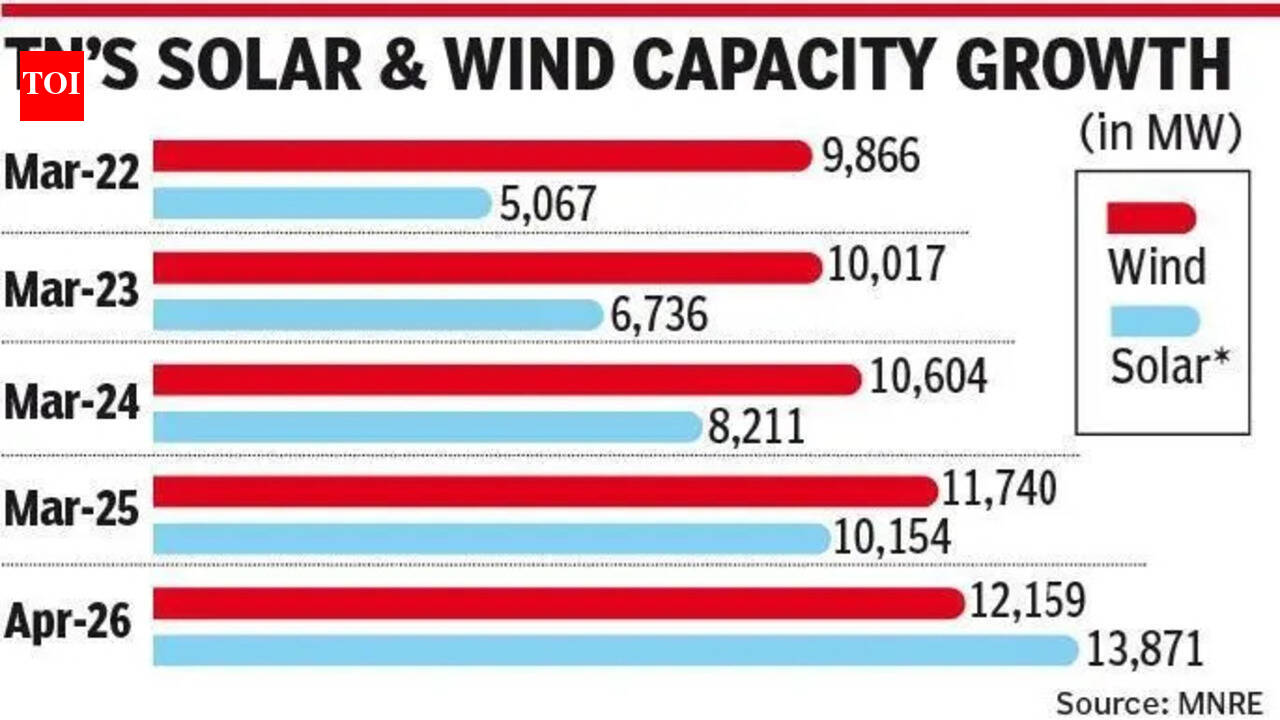
- Key Details: Once India’s leading state for wind energy, Tamil Nadu is now fully pivoting to become a solar energy hub. The state government is making the expansion of new solar installations a core pillar of its energy policy.
- Relevant Dept: Tamil Nadu Energy Department
2. Ministry of New and Renewable Energy (MNRE): ALMM List-II No Blanket Extension After June 1, 2026
- Key Details: The MNRE has officially announced that it will not permit a blanket extension of the Approved List of Models and Manufacturers (ALMM) List-II after June 1, 2026. Existing investment protection clauses will still apply. This regulatory change directly impacts solar panel and cell manufacturers.
- Relevant Dept: Ministry of New and Renewable Energy (MNRE), India
3. Indian Power Grid: Peak Demand Hits 268GW During Solar Hours on May 25
- Key Details: On May 25, 2026, at 3:26 PM, India’s power demand reached a record 268GW during solar generation hours. Total generation for the day was 6,185MU, up 3% from the previous day, with a generation mix of 69% coal, 19% renewable energy, 8% hydro, 1% gas, and 3% nuclear/other.
- Relevant Dept: Central Electricity Authority (CEA) / Compiled by Down to Earth

Business Review and Market Opportunities
Analysis Point 1: Tamil Nadu’s Solar Transition Creates New Supply Chain Demand
As Tamil Nadu shifts its energy strategy, new opportunities are opening up for solar panel installation, maintenance, and EPC contractors. The transition of a former wind power leader carries significant policy weight and is creating a favorable environment for solar companies based in Chennai.
Analysis Point 2: No Blanket Extension for ALMM List-II — Advantage for Certified Firms
The MNRE's decision limits market entry for manufacturers of uncertified solar panels and cells. Conversely, firms that already hold certification will gain a competitive edge in government procurement and RESCO model tenders. With the June 1 deadline approaching, reviewing certification status is urgent.
Analysis Point 3: Peak Demand Aligned with Solar Hours Enhances Investment Viability for Chennai Port and Logistics
The fact that peak power demand on May 25, 2026, occurred during peak solar generation hours (3:26 PM) means that rooftop solar investments are becoming highly economical for large power consumers like the Chennai Port Authority. The alignment of peak grid demand with solar generation improves the profitability of the RESCO model.
Relevant Tenders and Project Information
1. Chennai Port Authority — 2MWp Rooftop Solar PV System Installation (RESCO Model)
- Tender No: MEE/13/2026/Dy.CME(ES)
- Project Scale: 2MWp grid-connected rooftop solar PV system
- Location: EXIM Godown sheds, Chennai Port Authority, Chennai
- Business Model: RESCO — The bidder invests, installs, and operates; the Port Authority pays a fixed tariff.
- Deadline: Not specified (Currently ongoing)
- Key Qualifications: Please refer to the original official announcement.
2. Greater Chennai Corporation (GCC) — Ongoing Tender
- Tender Ref No: TOT Ref. No. 142066397
- Deadline: June 5, 2026
- Details: Please verify detailed project scope from the original announcement (No specific classification for agriculture/solar mentioned).
3. Additional Tender Information
Beyond the two mentioned above, no other new public tenders specifically limited to the agriculture/solar sector in the Chennai area have been identified in the current data.
Macro Context
Point 1: Solar Power Emerging as a Key Pillar for Peak Demand Supply in India
As of May 25, 2026, renewable energy accounted for 19% of India’s generation mix, with peak demand coinciding with peak solar hours. This suggests that solar is beginning to play a role beyond just supplementary power, moving closer to base-load utility.
Point 2: India Energy Policy 2026 — Renewables as the Cheapest Power Source
According to analysis by the International Institute for Sustainable Development (IISD), solar and wind ("vanilla" renewables) are now the most cost-effective forms of power in India. Increasing renewables helps reduce power procurement costs and subsidy burdens, contributing to the fiscal stability of states like Tamil Nadu.

Point 3: Strengthening ALMM List-II Regulations — Maintaining Domestic Manufacturing Protection
By disallowing a blanket extension for ALMM List-II after June 1, 2026, the MNRE is expected to further reinforce the principle of prioritizing certified products in the government procurement market. This is interpreted as part of a policy to protect India’s domestic solar panel and cell manufacturing ecosystem and encourage local supply chains.
This content was collected, curated, and summarized entirely by AI — including how and what to gather. It may contain inaccuracies. Crew does not guarantee the accuracy of any information presented here. Always verify facts on your own before acting on them. Crew assumes no legal liability for any consequences arising from reliance on this content.
Powered by
