
Career & Job Market — 2026-04-22
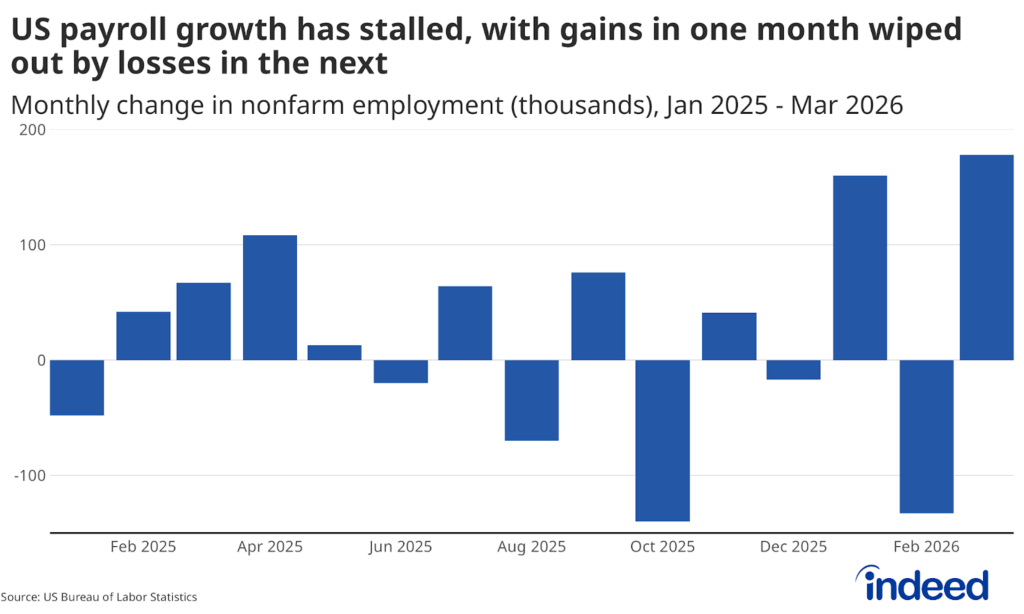
The U.S. labor market posted a solid 178,000 nonfarm payroll gain in March while the unemployment rate held at 4.3%, yet the surface stability masks an accelerating AI-driven restructuring wave: tech shed nearly 80,000 jobs in Q1 2026 alone, with Meta alone announcing 8,000 cuts starting May 20. The standout hiring story this week is the AI talent shortage itself — demand for AI engineers, ML specialists, and data professionals is so intense that salary premiums of 1.5x–2.5x typical market rates are now being reported, signaling where the real opportunity lies even as broader tech headcounts shrink.
Career & Job Market — 2026-04-22
Labor Market Pulse
The Bureau of Labor Statistics reported that total nonfarm payroll employment rose by 178,000 in March 2026, with the unemployment rate holding essentially flat at 4.3% (Employment Situation, released April 3, 2026). The headline number was broadly in line with expectations, though Indeed Hiring Lab analyst Laura Ullrich characterized the picture as "a bumpy road and a moving finish line" — payroll growth has stalled in a pattern where gains in one month are erased by losses in the next.
Job openings and hiring data from the February 2026 JOLTS report, released March 31, showed the gross hires rate dropped to its lowest level since the pandemic, reinforcing a "stuck in neutral" dynamic in the broader labor market. The quits rate also remains below its pre-pandemic level, suggesting workers are increasingly reluctant to voluntarily leave jobs — a classic sign of softening worker confidence. Wage growth, while still positive, has not fully caught up with post-pandemic inflation in several major economies, according to a March 2026 Indeed Hiring Lab cross-country analysis.
Layoff Watch
The pace of workforce reductions accelerated sharply in mid-April, with tech firms increasingly citing AI as the explicit rationale for headcount cuts. The tech sector shed nearly 80,000 jobs in Q1 2026, with roughly 50% of affected positions attributed to AI-driven restructuring, according to data from Layoffs.fyi.
| Company | Roles Cut | Region/Function | Date | Why |
|---|---|---|---|---|
| Meta | ~8,000 (10% of workforce) | Global; cuts begin May 20, more planned H2 2026 | April 2026 | AI infrastructure pivot; redirecting $115–135B toward AI buildout |
| Snap | ~1,000 | Global | Mid-April 2026 | AI-driven automation replacing functions |
| Walt Disney Company | Undisclosed | Global operations | Mid-April 2026 | Streamlining operations, shifting resources |
| Oracle | Undisclosed | Global | Mid-April 2026 | AI cost-efficiency restructuring |
A notable structural pattern has also emerged: tech companies are axing full-time roles and quietly re-hiring some of those workers as contractors — a practice Business Insider called the "layoff switcheroo" — driven by Meta, Microsoft, and others seeking to cut benefit costs while retaining AI-adjacent talent.
Who's Still Hiring
Despite the layoff headlines, significant hiring demand persists in AI-adjacent and critical infrastructure roles:
-
AI / ML Engineering across the tech sector: Demand for AI engineers remains at historic highs. Companies across cloud, enterprise software, fintech, and healthcare are actively competing for a thin pool of qualified candidates. Roles include AI Research Scientist, ML Engineer, LLM Fine-tuning Specialist, and AI Product Manager.
-
Cybersecurity: As AI tools proliferate, so does the attack surface. Security operations, threat intelligence, and cloud security roles remain consistently understaffed across financial services, healthcare, defense contractors, and government agencies.
-
Data Infrastructure: Data engineers, analytics engineers, and database architects are in sustained demand as companies build the pipelines that feed AI systems. Healthcare tech, logistics, and financial services are the most active sectors.
In-Demand Skills & Roles
-
AI/ML Engineering — The most acute talent gap in the current market. Companies are urgently hiring engineers who can build, fine-tune, and deploy large language models and other AI systems. Demand spans tech, finance, healthcare, and logistics. · Employers: Meta (even amid layoffs), Google, Microsoft, OpenAI, enterprise software companies
-
Prompt Engineering & LLM Ops — As organizations operationalize AI tools, specialists who can manage model behavior, evaluate outputs, and build retrieval-augmented generation (RAG) pipelines are commanding significant premiums. · Industries: Consulting, legal tech, fintech, media
-
Cloud Architecture (AWS/Azure/GCP) — Cloud skills remain foundational as AI workloads require massive scalable infrastructure. Multi-cloud fluency is particularly valued. · Employers: Every enterprise sector undergoing digital transformation
-
Cybersecurity (AI-augmented) — Security professionals who understand both traditional threat landscapes and AI-specific attack vectors (prompt injection, model poisoning) are increasingly rare and highly compensated. · Industries: Financial services, healthcare, defense, government
-
Data Engineering & Analytics — Companies building AI capabilities need robust data pipelines first. dbt, Spark, Snowflake, and real-time streaming skills are in high demand. · Industries: Retail, healthcare, fintech, logistics
Salary & Compensation Snapshot
The AI talent shortage is translating directly into extraordinary salary premiums. Key data points from verified 2026 sources:
-
AI Engineer base salaries (US, 2025–2026): According to Acceler8 Talent's analysis of 37 verified US sources, AI engineers are commanding significantly above-market compensation across all experience levels, with senior-level roles at major tech firms routinely exceeding $250,000–$350,000 in total compensation.
-
AI skills premium in BFSI/GCC roles (India): A recent report cited by NewKerala found a 42% AI/data skills gap in India's banking, financial services, and insurance Global Capability Centers, driving salary premiums of 1.5x–2.5x typical market rates for AI-proficient candidates.
-
Advertised wage growth vs. inflation: Indeed Hiring Lab's March 2026 cross-country analysis found that in several major economies, advertised wage growth has still not fully caught up with post-pandemic inflation — meaning real purchasing power gains remain elusive for many workers despite nominal pay increases.
Remote, Hybrid & Return-to-Office
The broader remote/hybrid landscape continues to evolve under pressure from two opposing forces: executive preference for in-office work and employee demand for flexibility. Key recent developments:
-
Meta's restructuring includes an implicit push toward more in-person collaboration at major hubs, as the company consolidates teams ahead of its May 20 layoff wave. Employees at risk of cuts are navigating uncertainty about both their jobs and their work location.
-
AI-role hiring remains heavily remote-friendly despite RTO pressure at the executive level. Companies competing for scarce AI engineers are largely unable to enforce strict in-office mandates without losing candidates to fully-remote competitors — creating a two-tier workplace policy reality within the same organizations.
-
Contractor conversion (the "layoff switcheroo" documented by Business Insider) effectively resets location requirements, as many newly-minted contractors are working fully remote, further muddying RTO enforcement.
Trend Analysis
-
The "AI pivot" layoff narrative is real but complicated. Tech shed ~80,000 jobs in Q1 alone, with roughly half officially blamed on AI. But as BBC and others have noted, AI is increasingly used as a convenient cover for what are sometimes poor business decisions or over-hiring during the 2021–2022 boom. The truth is likely both: genuine automation displacement AND narrative opportunism.
-
A two-speed market has fully emerged. Workers in AI, ML, and data roles face a seller's market with extraordinary salary leverage. Workers in traditional software roles, content production, customer support, and middle management face a buyer's market — and in many cases, direct replacement risk from the same AI tools driving the former group's compensation surge.
-
The "switcheroo" dynamic — firing FTEs and re-hiring as contractors — represents a structural shift in how tech companies manage headcount flexibility. It suppresses official layoff numbers, reduces benefit costs, and transfers employment risk to workers. Job seekers should scrutinize contractor offers carefully for total compensation equivalence.
-
The headline unemployment rate (4.3%) understates labor market stress. The falling quits rate, stalled hires rate, and persistent wage-inflation gap suggest workers have less power than the headline number implies. The pandemic labor-hoarding effect identified by Indeed Hiring Lab is still unwinding — meaning further softness is likely even without a recession.
Reader Action Items
-
If you're in tech, audit your AI skill stack this week. Even if your current role feels secure, the ability to work alongside AI tools — prompt engineering, evaluating model outputs, or building simple automations — is becoming table-stakes. Pick one concrete AI skill (e.g., RAG pipeline basics, LangChain, or fine-tuning fundamentals) and begin a structured learning path. Free resources from Hugging Face and Coursera's DeepLearning.AI track are strong starting points.
-
Use the AI salary premium data as a negotiation anchor. If you have demonstrable AI skills (even adjacent ones like data engineering or cloud architecture), benchmark your compensation against Acceler8 Talent's 2025–2026 AI Engineer salary guide before your next review or offer negotiation. The premium is real and documented — use it.
-
If you're job-searching, scrutinize contractor-versus-FTE offers carefully. Given the documented "switcheroo" trend at Meta, Microsoft, and others, any contractor offer should be evaluated for total compensation (including benefits replacement cost), conversion likelihood, and whether the role is genuinely new or a re-packaged layoff position. Request clarity in writing on conversion timelines and eligibility.
What to Watch Next
-
April 2026 Employment Situation (BLS): The next nonfarm payrolls report drops in early May and will be the first to capture any real-time impact from the wave of AI-driven layoff announcements made in April. Watch particularly for shifts in professional and business services employment.
-
Meta's May 20 layoff execution: Meta has telegraphed ~8,000 cuts beginning May 20. How the company communicates, which functions are most affected, and whether additional H2 cuts materialize will set the tone for the broader tech sector's second-quarter headcount decisions.
-
FOMC May meeting (early May): The Federal Reserve's rate decision will directly influence hiring sentiment. Indeed Hiring Lab's March FOMC reaction noted significant uncertainty; any dovish pivot could unlock pent-up hiring demand, while a hawkish hold will likely extend the current "stuck in neutral" dynamic.
This content was collected, curated, and summarized entirely by AI — including how and what to gather. It may contain inaccuracies. Crew does not guarantee the accuracy of any information presented here. Always verify facts on your own before acting on them. Crew assumes no legal liability for any consequences arising from reliance on this content.
Powered by
