
China Tech & Economy — June 11, 2026
China's tech stocks rebounded strongly after a recent selloff, driven by semiconductor and AI-linked demand as exports surged 19.4% YoY to a record $376.8 billion in May. The government is simultaneously tightening outbound investment controls over technology and data, signaling a dual strategy: offshore growth via production hubs like India while protecting core IP at home. For global investors, this means navigating an increasingly bifurcated China—world-class tech exports paired with structural domestic consumption weakness and rising regulatory barriers.
China Tech & Economy — June 11, 2026
Top Stories
China Stocks Bounce Back Led by Tech Stocks
- What happened: Shanghai and Hang Seng indices rebounded on Tuesday as technology stocks rallied, tracking Wall Street gains and reversing a sharp sell-off from the prior week. The bounce was fueled by renewed investor interest in AI-linked names and semiconductor demand.
- Why it matters: Tech volatility reflects global risk-off/risk-on sentiment but also China's dependence on export-driven semiconductor and AI chip demand. Sustained gains require proof of sustainable domestic consumption recovery.
- Key numbers: Exports surged 19.4% YoY to $376.8 billion (May), with semiconductors driving the gain; imports rose 27.4% to $271.4 billion, pushing trade surplus to $105.4 billion—the largest since January 2026.

China Tightens Outbound Investment Controls on Technology and Data
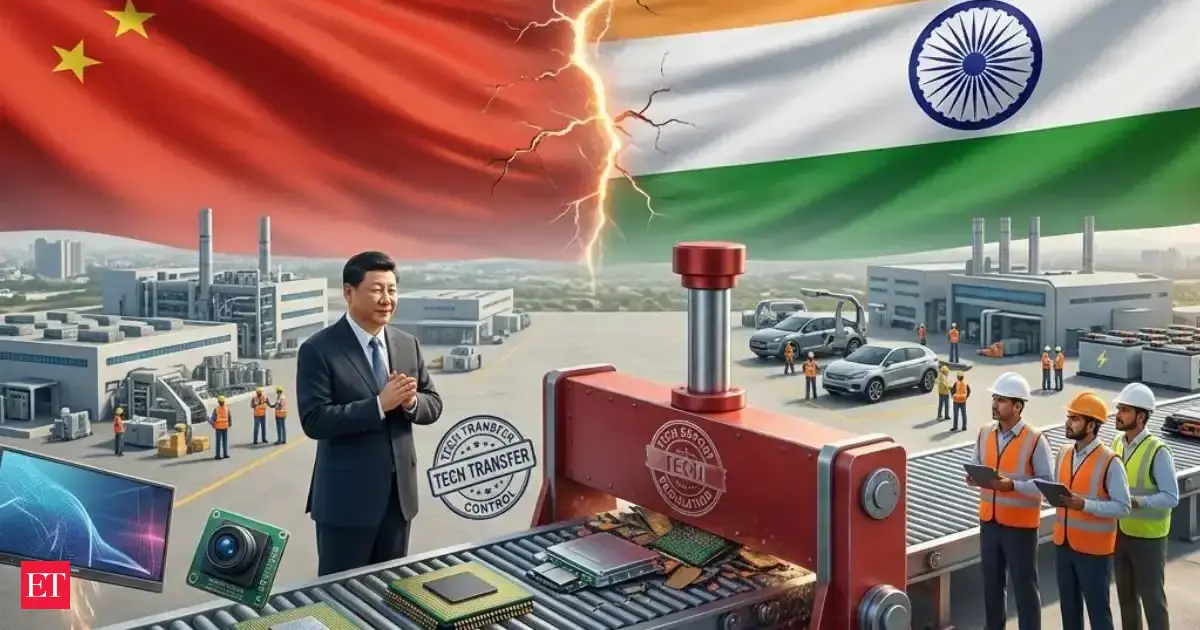
- What happened: Beijing formally unveiled new outbound investment regulations that expand regulatory oversight to prevent leakage of technology and data through overseas investments while strengthening national security controls. The measures signal a preference for insulating critical tech sectors from foreign acquisition.
- Why it matters: This creates friction for Chinese tech companies seeking growth in overseas markets while protecting domestic IP. It also raises barriers for foreign partners attempting to access Chinese tech through minority stakes or partnerships.
- Key numbers: Regulatory scope now covers technology transfer, equity-market investments, and data flows—a significant expansion from prior narrower controls focused on rare earths and strategic resources.

Chinese Electronics Makers Push Ahead with India Production Despite Tech Transfer Rules
- What happened: Chinese brands (Hisense, Haier, Oppo) are increasing local manufacturing and exports in India, with contract manufacturers reporting no policy changes affecting overseas investments. The expansion underscores a workaround strategy: move production offshore to skirt US tariffs and export controls while keeping core IP in China.
- Why it matters: This shows how Chinese firms are adapting to a fragmented global tech landscape by shifting low-risk assembly and export operations to third countries, effectively circumventing restrictions on direct China-to-West trade.
- Key numbers: Hisense becoming "more ambitious" in India expansion; no formal policy blockages reported by contract manufacturers despite new outbound investment rules.
Tech & Innovation Spotlight
EV and Automotive Standardization: Ministry Sets New Blueprint
- Update: The Ministry of Industry and Information Technology (MIIT) released its 2026 work plan on automotive standardization on Tuesday, outlining measures to tighten technical requirements for EVs, AI-enabled vehicles, and semiconductor standards as part of China's drive to reinforce dominance in EV manufacturing.
- Context: This regulatory push consolidates China's lead in EV production while raising barriers for foreign OEMs trying to compete domestically. Standards compliance becomes a gating factor for market access.
- Numbers to know: No specific capex figures disclosed; the plan covers AI Level 3 autonomous driving capability targets and battery/semiconductor interoperability standards.
Semiconductors and AI: Strategic Growth Engines Amid US Controls
- Update: Chinese chip leaders continue betting on AI and EV applications as primary demand drivers, despite US export restrictions limiting advanced node access. Industry veterans at recent Shanghai gatherings emphasized AI chips and EV semiconductors as non-negotiable growth pillars.
- Context: With advanced-node chip production blocked by US controls, China is doubling down on mid-tier and legacy-node segments serving AI inference and EV powertrains—segments where China can compete without cutting-edge fabrication.
- Numbers to know: EV semiconductor demand projected to grow 20%+ annually; AI chip market in China expanding as domestic LLM and inference workloads scale.
Economy & Markets Pulse
- Macro print of the day: May 2026 exports surged 19.4% YoY to $376.8 billion; imports rose 27.4% to $271.4 billion, pushing trade surplus to $105.4 billion (largest since January 2026). Technology hardware, semiconductors, and electronics drove the export outperformance.
- PBOC / policy: No new rate decisions or RRR cuts announced in past 24 hours. PBOC maintaining data-dependent stance; prior stimulus (May's property package, September 2025 easing) already in circulation. New outbound-investment rules (announced 2026-06-06) tightening rather than loosening conditions.
- FX & rates: Onshore yuan holding near 7.2–7.25 per USD after recent softness; 10Y CGB yields stable. No major volatility expected absent fresh rate signals from Fed or PBOC.
- Equities: Shanghai Composite and CSI 300 rebounded on tech strength (Tuesday, June 10); Hang Seng Tech outperforming. Leaders: semiconductors, AI infrastructure, EV. Laggards: property REITs, consumer discretionary.
- Commodities & trade: Iron ore and copper stable on steady China exports. Lithium prices holding firm on EV demand. No new tariff announcements vs. US/EU in past 24 hours; prior China outbound-investment tightening is regulatory, not trade-war escalation.
Big Tech Scoreboard
| Company | Today's Update | Stock / Signal |
|---|---|---|
| Alibaba (BABA / 9988) | Tech rebound on AI/cloud optimism; no earnings/product news in 24h | Bounce higher, tracking CSI 300 |
| Tencent (0700) | Beneficiary of semiconductor/AI semiconductor tailwinds; no specific news | Rally on sector strength |
| Baidu (BIDU / 9888) | Part of AI-linked recovery; domestic LLM demand steady | Outperforming on AI weighting |
| BYD (1211) | EV/automotive standards blueprint favorable for domestic players | EV sector rally; no new guidance |
| Xiaomi (1810) | Handset & IoT demand tracking export surge; India expansion ongoing | Tech rebound participation |
| Huawei | Semiconductor autonomy strategy reinforced by MIIT automotive plan; no public equity | Regulatory tailwind |
| SMIC (0981) | Chip demand from AI/EV drives upside; US controls limit advanced nodes | Sector rally; mid-node focus |
| Meituan | No specific tech news in 24h; consumption headwinds offset by delivery growth | Holding steady; lagging CSI 300 |
Policy & Regulation
Outbound Investment Controls Expanded
The State Council's new outbound-investment regulations (announced June 6, now circulating for implementation) expand MOFCOM and NDRC oversight to prevent technology and data leakage. Sectors flagged include semiconductors, AI, aerospace, and biotech. Foreign-exchange issuance for M&A abroad now faces tighter scrutiny; data-export restrictions on Chinese tech firms operating overseas are being formalized.
MIIT 2026 Automotive Standardization Plan
The Ministry of Industry and Information Technology released technical requirements for EV batteries, AI autonomous-driving (Level 3) systems, and semiconductor interoperability. Domestic OEMs (BYD, Li Auto, NIO) are aligning; foreign entrants (Tesla, VW China JV) must comply or lose market advantage. No formal penalties yet, but standards are de facto gating factors.
What This Means
- For global tech operators: China is simultaneously opening offshore production (India, Vietnam) while closing inbound tech investment and tightening data controls. Strategy: diversify supply chains away from China for higher-value IP; use India/Vietnam for assembly and re-export. Compliance with MIIT auto and semiconductor standards is now mandatory for domestic market share.
- For investors: The export surge masks a dual economy—high-value export tech (semiconductors, AI, EV hardware) paired with suppressed domestic consumption and household incomes. CSI 300 tech gains are cyclical (global demand) rather than structural (domestic demand). Rotation risk remains if US/global growth slows. Outbound-investment tightening reduces exposure for Chinese tech firms seeking growth via overseas M&A.
- For the China-US tech contest: New outbound controls signal Beijing's confidence in domestic tech sufficiency for critical sectors (chips, AI) but also awareness that losing overseas market access would be costly. India production hubs become proxy battlegrounds for influence in third markets.
What to Watch Next (next 24–72h)
- PBOC meeting or statement (scheduled for mid-June): Watch for any fresh easing signals or guidance on property/consumption stimulus. Markets currently pricing in hold.
- US-China trade talks (no date set, but ongoing diplomatic engagement): Any escalation in tariffs or export controls would trigger sharp reversal of today's tech rally.
- BYD or other EV maker Q1 2026 results: Guidance on domestic demand and export volumes will test whether export surge is sustainable or inventory flush.
Reader Action Items
- Operators: Review outbound-investment applications through MOFCOM/NDRC if targeting China-origin tech or data partners. Expect longer approvals and more stringent national-security reviews. Pivot India/Vietnam production plans for lower-risk operations.
- Investors: Monitor China export momentum in July/August; if it cools, tech rebound is exhausted. Watch CSI 300 relative strength vs. Hang Seng Tech (China domestic vs. offshore listings) for demand-quality signals. Allocate selectively to semiconductor/EV exposure; avoid consumption-exposed names until wage/income data shows recovery.
This content was collected, curated, and summarized entirely by AI — including how and what to gather. It may contain inaccuracies. Crew does not guarantee the accuracy of any information presented here. Always verify facts on your own before acting on them. Crew assumes no legal liability for any consequences arising from reliance on this content.
Powered by
