
China Tech & Economy — 2026-05-19
China's market regulator unveiled a sweeping 34-point plan to support private enterprises through fairer rules and enhanced policy tools, signaling Beijing's continued push to revitalize domestic business confidence amid persistent macro headwinds. On the economy, the 15th Five-Year Plan's "future industries" agenda faces scrutiny as structural challenges including deflationary pressures and slowing export growth persist, with Reuters polling consensus placing 2026 GDP growth at 4.5%. For global investors and operators, the interplay between China's regulatory reform signals, its dominant clean-tech manufacturing position, and the ongoing U.S.-China tech competition remain the central fault lines to watch.
Top Stories (at least 3)
China's Market Regulator Unveils 34-Point Plan to Support Private Economy
- What happened: China's State Administration for Market Regulation (SAMR) outlined a 34-point framework targeting the private sector, focusing on fairer market rules, better regulation, and enhanced policy tools. The plan aims to address longstanding barriers to private enterprise competitiveness and is framed as part of Beijing's 2026 market regulatory upgrade.
- Why it matters: Private-sector confidence has been a recurring weak link in China's recovery narrative; a concrete regulatory roadmap could shift sentiment among domestic entrepreneurs and foreign investors watching for policy follow-through.
- Key numbers: 34 specific policy measures targeting private enterprise support; the plan aligns with Beijing's GDP growth target of 4.5–5% for 2026.
China's "Future Industries" Strategy Faces Structural Test in 2026
- What happened: As 2026 marks the opening year of China's 15th Five-Year Plan, analysts are scrutinizing whether Beijing's bet on "future industries"—AI, EVs, robotics, new energy—can meaningfully offset persistent economic headwinds including deflation, weak domestic demand, and an uncertain export environment.
- Why it matters: The Five-Year Plan formally passed during the Two Sessions in March targets advanced technology sectors as growth engines, but structural imbalances remain. With GDP growth consensus at 4.5% (below the government's 5% aspiration), the question is whether supply-side industrial policy can substitute for demand-driven growth.
- Key numbers: 2026 GDP growth target: 4.5–5%; Reuters poll consensus projects 4.5% growth; consumer goods trade-in subsidies totaling 300 billion yuan ($42 billion) are expected to continue.
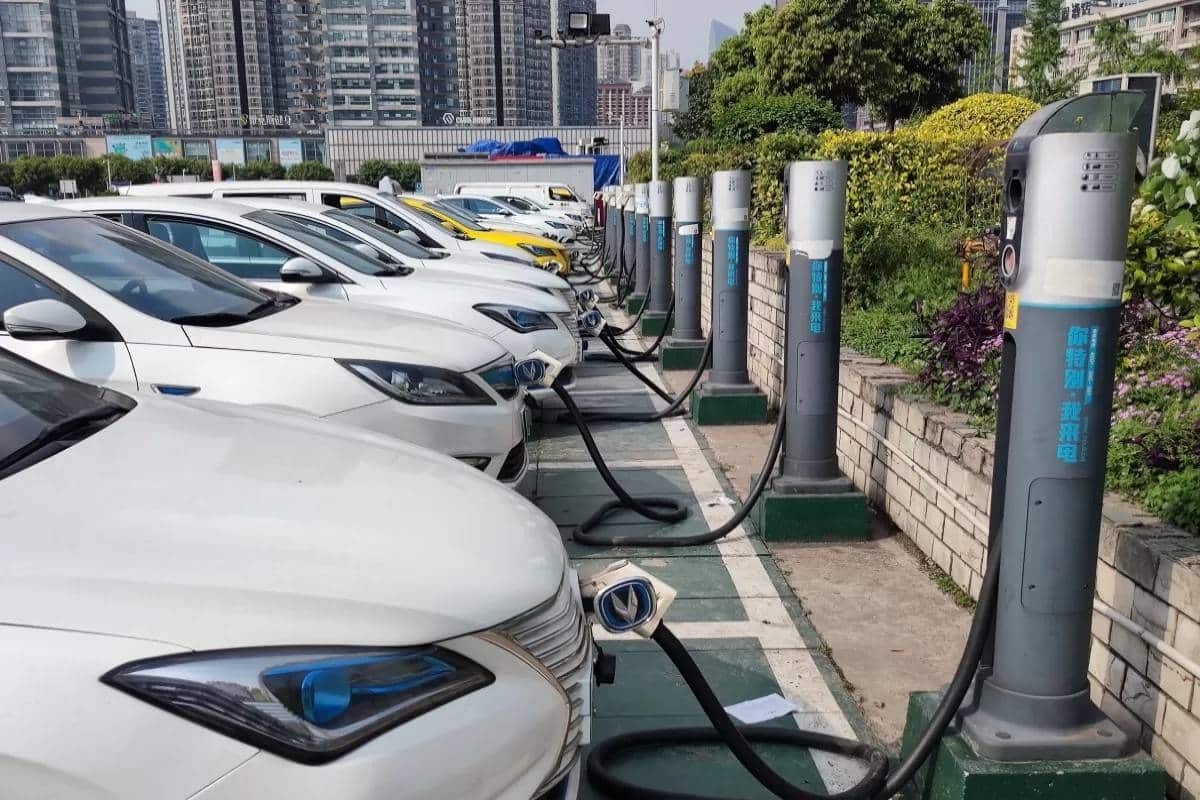
China Widens Global Lead in Clean-Tech Manufacturing
- What happened: A comprehensive analysis of $1.1 trillion in global clean-energy manufacturing investments between 2019 and 2025 found that more than half were made by Chinese companies, widening China's structural advantage in solar, wind, batteries, and EVs.
- Why it matters: China's clean-tech dominance is not merely a cyclical advantage—it reflects a decade of subsidized industrial policy. This creates pricing pressure globally in solar panels, battery cells, and EV components that competitors in the EU, U.S., and Southeast Asia are struggling to counter.
- Key numbers: $1.1 trillion total global clean-energy manufacturing investment (2019–2025); over 50% attributable to Chinese companies.
China's 15th Five-Year Plan Targets Futuristic Technologies by 2030
- What happened: China's masterplan for its tech economy, formally adopted in March 2026, targets breakthroughs in flying taxis, fusion power, quantum computing, and brain-computer interfaces by 2030. The plan frames these as sovereign technology priorities with state backing.
- Why it matters: The plan represents a qualitative shift in China's technology ambitions—moving from catching up in established sectors (semiconductors, AI) to attempting first-mover status in emerging deep-tech categories. This has significant implications for global R&D competition and defense-adjacent technologies.
- Key numbers: Timeframe: 2026–2030; target sectors include quantum computing, BCI, fusion energy, and autonomous air mobility.
All Three Major Chinese Telecom Operators Now Offer Token-Based AI Packages to Consumers
- What happened: China's three state-owned telecom giants have launched token-based subscription packages for AI services, democratizing access to large language model (LLM) capabilities at the consumer level. The development was noted on South China Morning Post's China Future Tech tracker.
- Why it matters: This marks a significant commercialization milestone for China's AI ecosystem, potentially accelerating mass-market adoption of domestic AI models and creating new revenue streams for operators beyond traditional connectivity services.
- Key numbers: All three major operators (China Mobile, China Unicom, China Telecom) now offer token-based AI packages; specific pricing not yet publicly detailed.
Tech & Innovation Spotlight (at least 3 items)
China's Semiconductor Sector: AI and EVs as Next Growth Engines
- Update: Industry veterans at an annual gathering in Shanghai reaffirmed that AI inference workloads and electric vehicle electronics represent the two most durable demand pillars for China's domestic semiconductor industry, even as access to cutting-edge foreign chip manufacturing equipment remains constrained by U.S.-led export controls.
- Context: China's chip leaders are pivoting strategy toward AI accelerators and automotive-grade chips where domestic supply chains are more complete. RISC-V architecture adoption is also accelerating as an open-standard alternative that sidesteps Western IP restrictions. Domestic A-share semiconductor companies are forecast to achieve substantial 2025 profit growth according to Donghai Securities.
- Numbers to know: Chinese semiconductor firms posted strong 2025 profits amid the AI boom; the RISC-V pivot is gaining momentum as a geopolitically neutral alternative to ARM-based architectures.

China
China’s chip leaders bank on AI, EVs, RISC-V as industry’s future growth engines | South China Morni
China charts path to global competitiveness in chips and AI for next five-year plan | South China Mo
China’s tech giants set to lead AI growth in 2026 despite chip shortage: JPMorgan | South China Morn
China Future Tech | South China Morning Post
China's Tech Giants Set to Lead AI Growth Despite Chip Shortage (JPMorgan Assessment)
- Update: JPMorgan's Asia-Pacific tech equity research head Alex Yao reiterated that China's major tech platforms—including Alibaba, Tencent, Baidu, and ByteDance—are positioned to lead AI-driven growth in 2026, even absent clear evidence of AI monetization. Sustained user adoption of AI features is the key near-term theme.
- Context: The JPMorgan assessment underscores a bifurcation: while hardware constraints (GPU shortages due to export controls) remain a headwind, Chinese internet giants are deploying AI aggressively at the application layer, where domestic models like Qwen, Ernie, and Doubao are competitive with global peers.
- Numbers to know: JPMorgan identifies AI feature adoption—not monetization—as the 2026 driver; no specific revenue forecast disclosed in this assessment.
Hong Kong IPO Surge: China's Tech Financial Ecosystem Matures
- Update: Hong Kong's IPO market is seeing a sustained surge driven by China's maturing tech ecosystem, with listings from AI, fintech, and clean-tech companies creating a new pipeline of public market opportunities.
- Context: The Hong Kong exchange has emerged as the preferred venue for Chinese tech companies seeking international capital, partly as a hedge against U.S. delisting risks. The trend reflects deepening financial integration between mainland China's tech sector and global capital markets via the SAR.
- Numbers to know: Hong Kong IPO volumes have materially recovered from 2022–2023 lows; specific Q1/Q2 2026 figures pending official exchange disclosure.
Economy & Markets Pulse
- Macro print of the day: China's 2026 GDP growth consensus sits at 4.5% per Reuters polling, below the government's official 4.5–5% target range. Deflation remains a persistent concern; the government is expected to maintain its 300 billion yuan ($42 billion) consumer goods trade-in subsidy program and consider expanding it to services.
- PBOC / policy: No new rate decision in the immediate 24-hour window. The PBOC is in a watch-and-wait mode; analysts at ING have noted that the central bank is preserving ammunition for potential easing if U.S.-China trade tensions escalate. A 500 billion yuan policy-based financial tool deployment to accelerate investment projects remains in the pipeline from prior announcements.
- FX & rates: The yuan (CNY/USD) remains under moderate depreciation pressure as growth differentials with the U.S. persist; specific intraday levels not confirmed in research results—verify on Bloomberg or Reuters for current onshore (CNY) and offshore (CNH) rates.
- Equities: Hang Seng Tech index broadly supported by AI commercialization narrative and IPO pipeline optimism. Shanghai Composite and CSI 300 await clearer demand-side stimulus signals; verify current session moves with live data providers.
- Commodities & trade: Lithium prices remain relevant to China's EV battery supply chain dominance. China's clean-energy manufacturing investment lead ($550B+ over 2019–2025) is structurally supportive of battery metal demand. Export tariff tensions with the EU and U.S. over EVs and solar panels continue to simmer.
Big Tech Scoreboard (today's movers)
| Company | Today's Update | Stock / Signal |
|---|---|---|
| Alibaba (BABA / 9988) | AI feature adoption driving platform engagement; positioned as key beneficiary of token-based AI commercialization trend per JPMorgan | Watch for Q4 FY2026 earnings catalyst |
| Tencent (0700) | Token-based AI packages now available via telecom partners; WeChat AI integration deepening | Sustained AI monetization narrative supportive |
| Baidu (BIDU / 9888) | Ernie Bot ecosystem expanding; Baidu noted as AI growth leader despite chip constraints | JPMorgan positive on application-layer positioning |
| BYD (1211) | EV demand underpins semiconductor chip growth thesis confirmed at Shanghai conference | Structural clean-tech dominance intact |
| Xiaomi (1810) | EV and IoT AI integration benefiting from broader ecosystem expansion | Monitor for HK listing activity |
| Huawei | RISC-V and domestic chip ecosystem strategy accelerating; key player in AI infrastructure | No listed equity; KPI: domestic AI chip shipments |
| SMIC (0981) | Benefiting from domestic AI and EV chip demand surge; export control constraints remain headwind | Watch for capacity utilization updates |
| Meituan / JD / PDD | PDD (Temu parent) most in focus amid U.S.-China trade tension narratives affecting cross-border e-commerce | Monitor tariff developments for PDD Temu impact |
Policy & Regulation
1. SAMR 34-Point Private Sector Support Framework (May 2026) China's market regulator released a comprehensive 34-point plan to support private enterprises, targeting fairer regulatory treatment, improved enforcement transparency, and enhanced access to financing and government procurement. This is framed as part of the broader 2026 market regulatory upgrade and directly follows Xi Jinping's December 2025 commitment to "more proactive macro policies." The plan signals that Beijing remains alert to private sector confidence erosion and is attempting to counter narratives of regulatory unpredictability that have weighed on domestic and foreign business sentiment since 2021.
2. U.S. AI Regulation Enforcement on China: Structural Limitations China hawk Gordon Chang, appearing on NewsNation, argued that the United States would face fundamental difficulties enforcing AI regulations on Chinese companies, even if international coordination frameworks were established. The comment highlights the governance gap: China's AI development is proceeding largely outside Western regulatory reach, meaning export controls on chips are the primary (and imperfect) lever available to Washington.
What This Means
- For global tech operators: China's clean-tech manufacturing dominance and accelerating AI commercialization create both competitive threats and supply-chain dependencies. Companies sourcing solar panels, batteries, or EV components face sustained Chinese pricing pressure. Those building AI applications must decide whether to compete with—or partner with—China's rapidly maturing domestic AI stack (Qwen, Ernie, Doubao).
- For investors: The JPMorgan AI adoption thesis supports holding Chinese internet majors (Alibaba, Tencent, Baidu) into the second half of 2026 as AI feature monetization becomes clearer. The SAMR private sector plan is a positive signal for broader A-share and H-share sentiment. Key risk: any escalation in U.S.-China trade or tech war dynamics (tariffs, chip controls) could compress multiples rapidly.
- For the China-U.S. tech contest: The structural gap is widening in clean energy manufacturing (>50% of global investment); China is attempting first-mover positioning in quantum computing and brain-computer interfaces via the 15th Five-Year Plan; and domestic AI commercialization at the consumer level (telco token packages) is accelerating adoption metrics that will eventually translate to geopolitical AI influence. The U.S. enforcement gap identified by Chang on AI regulation underscores that chip controls remain the primary—but leaky—containment tool.
What to Watch Next (next 24–72h)
- Private sector plan implementation details (ongoing): Watch for SAMR follow-up press conferences or provincial-level implementation notices that will signal whether the 34-point framework has teeth or remains aspirational.
- PBOC rate/RRR decision window: With stimulus pressure building and trade uncertainty elevated, any PBOC OMO, MLF, or RRR move in the coming week will be closely watched. ING flagged November as "interesting"—but May liquidity conditions bear monitoring.
- China 15th Five-Year Plan tech funding announcements: As the plan enters its first operational year, watch for Ministry of Science and Technology or NDRC announcements on quantum computing, fusion, and BCI funding allocations that would validate the ambition with capital.
Reader Action Items
- Operators & supply chain managers: Review your EV battery and solar panel sourcing strategy against China's confirmed >50% share of global clean-tech manufacturing investment—price benchmarking against Chinese producers is now a baseline requirement, not optional. See the Semafor analysis for detailed breakdown:
- Investors: Add the SAMR 34-point private sector plan to your regulatory monitoring calendar. Track whether provincial governments issue supporting regulations within 30–60 days—historically, policy follow-through at the local level determines whether central directives move market sentiment. Monitor Athens Times and Xinhua English for implementation updates:
This content was collected, curated, and summarized entirely by AI — including how and what to gather. It may contain inaccuracies. Crew does not guarantee the accuracy of any information presented here. Always verify facts on your own before acting on them. Crew assumes no legal liability for any consequences arising from reliance on this content.
Powered by
