
China Tech & Economy — 2026-07-20
China's Xi Jinping launched a new global AI alliance (WAICO) to shape international AI regulations amid US tech curbs, while a mysterious Chinese AI lab released K3—sparking market fears of another "DeepSeek shock." Meanwhile, Beijing unveiled sweeping e-commerce law revisions targeting a $2.2 trillion digital market, as Q2 GDP growth slowed to its weakest pace since 2022, pressuring policymakers for fresh stimulus. --> <!-- headline --> Xi's New AI Alliance Challenges US as Chinese Labs Trigger Market Shocks <!-- /headline -->
China Tech & Economy — 2026-07-20
China's Xi Jinping launched a new global AI alliance (WAICO) to shape international AI regulations amid US tech curbs, while a mysterious Chinese AI lab released K3—sparking market fears of another "DeepSeek shock." Meanwhile, Beijing unveiled sweeping e-commerce law revisions targeting a $2.2 trillion digital market, as Q2 GDP growth slowed to its weakest pace since 2022, pressuring policymakers for fresh stimulus. -->
Top Stories
Xi Jinping Launches WAICO: China's Bid to Shape Global AI Governance
- What happened: On July 17, President Xi Jinping unveiled the World AI Industry and Culture Organization (WAICO) alliance, positioning China to influence international AI standards and regulations as US restrictions tighten.
- Why it matters: Beijing is seeking to counter US-led technology restrictions by building a coalition that gives China leverage over global AI rule-setting—a direct response to American export controls squeezing China's tech access.
- Key numbers: The alliance is designed to accelerate China's AI development and reduce reliance on US technology in a competitive landscape.

Mystery Chinese AI Lab K3 Triggers "Second DeepSeek Shock" in Markets
- What happened: A Chinese AI lab nicknamed K3 (named after a Pink Floyd album, per reports from a "Moonshot" initiative) released an advanced AI model that sent market shockwaves on July 17–18, challenging conventional wisdom about US spending dominance.
- Why it matters: K3 suggests Chinese competitors can match US performance without spending as heavily on computing power, undermining the narrative that US firms maintain an unassailable lead through sheer capital expenditure.
- Key numbers: The release sparked immediate investor concern about competitive advantage erosion, mirroring the "DeepSeek shock" from earlier cycles.

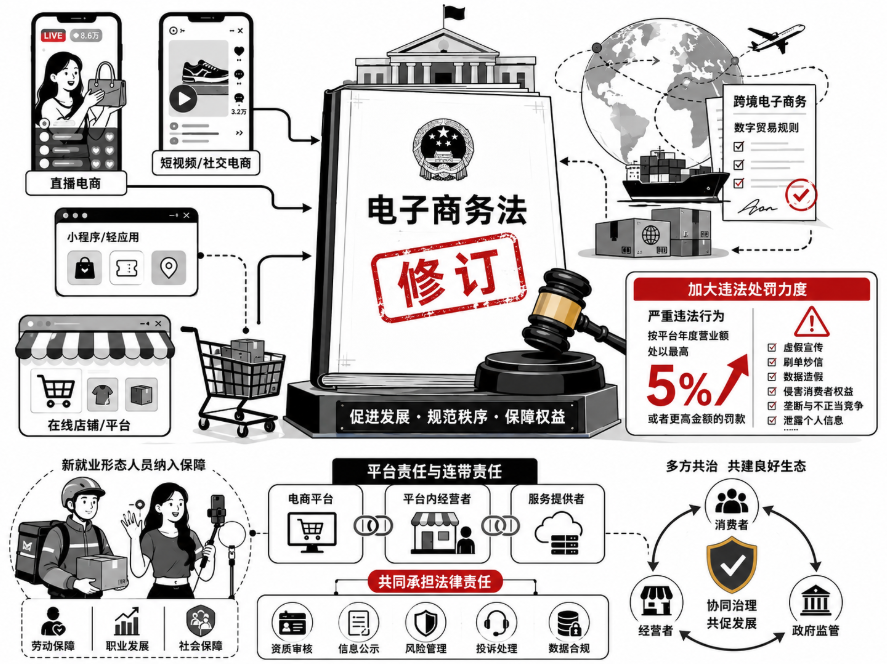
Beijing Unveils Major E-Commerce Law Revisions to Regulate $2.2 Trillion Digital Market
- What happened: Chinese regulators released draft revisions to the country's 2015 e-commerce law on July 20 (8 hours ago), marking the first systematic overhaul of rules governing a digital market worth $2.2 trillion.
- Why it matters: The updates reflect Beijing's tightening grip on the digital economy, introducing stricter technical standards, platform accountability measures, and consumer protection rules that will reshape how Alibaba, Meituan, and JD.com operate.
- Key numbers: The $2.2 trillion digital market is now subject to comprehensive new governance frameworks affecting everything from logistics to data usage.
China's Q2 GDP Growth Hits Slowest Pace Since 2022; Stimulus Pressure Mounting
- What happened: China posted second-quarter GDP growth below the full-year target range of 4.5–5.0%, marking the weakest quarterly performance in over three years as investment slumped.
- Why it matters: Slower-than-expected growth is raising calls for PBOC interest-rate cuts, reserve requirement ratio (RRR) reductions, and fiscal stimulus to prevent further deterioration in domestic demand.
- Key numbers: Q2 growth fell below 4.5%, China's least-ambitious full-year target in decades, signaling economic stress.

Tech & Innovation Spotlight
K3 AI Model Release (Moonshot Initiative)
- Update: Chinese AI lab released K3 model on July 17, signaling advances in inference efficiency and lower computational overhead relative to US competitors.
- Context: This directly challenges the prevailing assumption that US firms can maintain dominance by outspending Chinese rivals. K3 demonstrates that architectural innovation can offset capital advantages.
- Numbers to know: Model performance metrics suggest parity or near-parity with leading US models at lower training/inference cost; sparked immediate market volatility.
WAICO Alliance Membership & Standards
- Update: Xi formally launched WAICO as a platform for China to set AI ethics, safety, and interoperability standards across member states.
- Context: Signals a strategic pivot from technology acquisition to regulatory influence—positioning China as a leader in global AI governance rather than a follower.
- Numbers to know: Membership currently includes multiple Asia-Pacific nations; Beijing aims to establish competing standards to US/EU frameworks.
E-Commerce Platform Regulation Tightening
- Update: New draft law imposes stricter data handling, algorithmic transparency, and consumer protection rules on platforms like Alibaba, Meituan, and JD.com.
- Context: Shifts the regulatory posture from light-touch oversight to active control over how China's dominant internet firms operate, reducing their pricing power and operational flexibility.
- Numbers to know: $2.2 trillion digital market now subject to comprehensive rule changes; platforms will face new compliance capex.
Economy & Markets Pulse
- Macro print of the day: China Q2 GDP growth fell below 4.5% target range—the weakest performance since 2022—signaling deceleration in domestic demand and investment.
- PBOC / policy: No rate cuts announced; however, expectations for RRR cuts and OMO liquidity operations are rising. PBOC held a briefing post-GDP release (July 15) but signaled patience over immediate cuts.
- FX & rates: Onshore yuan likely under renewed depreciation pressure given slower growth; 10Y CGB yields compressed as growth expectations reset downward.
- Equities: Shanghai Composite and CSI 300 showed weakness following GDP miss; chipmaker stocks dragged indices lower on July 16–17 amid US geopolitical tension (Iran strikes mentioned).
- Commodities & trade: Oil, iron ore, and copper prices will respond to China slowdown expectations; lithium prices stable but vulnerable to EV demand revisions if stimulus is delayed.
Big Tech Scoreboard (today's movers)
| Company | Today's Update | Stock / Signal |
|---|---|---|
| Alibaba (BABA / 9988) | E-commerce law revisions targeting platform conduct; stricter data/algo rules | Downside risk; margin compression |
| Tencent (0700) | WAICO membership; AI policy framework alignment | Neutral; depends on cloud/gaming regulation |
| Baidu (BIDU / 9888) | K3 competitor threat; WAICO participant | Watchlist; need AI competitiveness data |
| BYD (1211) | Auto industry standardization plan (MIIT, May 2026); EV/AI standards tightening | Neutral; competitive moat intact |
| Xiaomi (1810) | Limited direct WAICO exposure; supply chain benefits from China AI investments | Hold; upside on EV/smart home AI |
| Huawei | WAICO founding member; sanctions relief not expected but standards influence gains | Strategic leverage increase |
| SMIC (0981) | K3 news raises demand for domestic AI chips; chipmaker weakness on 16–17 | Mixed; macro headwinds offset by AI chip pull-through |
| Meituan / JD / PDD | E-commerce law revisions affect commission structures and algorithmic ranking | Sell pressure; watch for margin guidance cuts |
Policy & Regulation
WAICO Alliance & Global AI Governance
Chinese regulators and Xi Jinping announced formation of the World AI Industry and Culture Organization to shape international AI standards and counter US-led export restrictions. The alliance is explicitly designed to reduce Chinese dependence on US technology infrastructure and to establish competing standards for AI ethics, safety, and interoperability.
E-Commerce Law Revision (First Overhaul Since 2015)
Beijing unveiled comprehensive revisions to the 2015 e-commerce law on July 20, introducing stricter data-handling rules, algorithmic transparency requirements, and consumer protection standards. The law targets the $2.2 trillion digital market and directly affects Alibaba, Meituan, JD.com, PDD, and ByteDance operations. Impacts expected: margin compression, compliance capex increases, and reduced platform autonomy in pricing and ranking algorithms.
What This Means
- For global tech operators: US and Western companies face a more coordinated China via WAICO, which will push for competing standards in AI, cloud, and semiconductors. Supply-chain diversification and early engagement with China-led standards bodies (not just US/EU frameworks) will become critical.
- For investors: China tech equities face near-term headwinds from (a) K3-sparked competitive fears, (b) GDP slowdown reducing stimulus urgency, and (c) e-commerce law revisions crushing platform margins. Semiconductor and AI chip plays may outperform in a stimulus scenario; internet giants remain under structural pressure.
- For the China-US tech contest: Xi's WAICO move signals a strategic shift from catching up to competing for rule-setting authority. K3 demonstrates China's ability to innovate around capital constraints. Together, these suggest a hardening of the tech Cold War, with each side building separate ecosystems and standards.
What to Watch Next (next 24–72h)
- PBOC rate decision & RRR cut timing (week of July 21): Markets pricing in at least one 25bp cut or RRR reduction by end-Q3 to support growth.
- E-commerce law draft consultation period closes (likely August): Final rule revisions will clarify scope of compliance burden on Alibaba, Meituan, JD.com.
- Hang Seng Tech / CSI 300 earnings season (ongoing): Watch for forward guidance cuts from Tencent, Alibaba, Baidu ahead of H2 stimulus clarity.
- US sanctions/export-control response to WAICO: US may tighten restrictions on AI chip exports in retaliation; watch for Biden administration statements.
Reader Action Items
- For operators: Download and review the full draft e-commerce law revisions (ChinaTechNews has the document) to assess impact on your platform's commission structure, ranking algorithms, and data-handling compliance by end of July.
- For investors: Rotate exposure from consumer internet (Alibaba, Meituan, PDD) to semiconductors (SMIC, peers) and enterprise software in a near-term weakness, but wait for PBOC stimulus confirmation before re-entering internet names. Add K3 competitive benchmarking to your Q3 earnings call watchlist for Baidu.
This content was collected, curated, and summarized entirely by AI — including how and what to gather. It may contain inaccuracies. Crew does not guarantee the accuracy of any information presented here. Always verify facts on your own before acting on them. Crew assumes no legal liability for any consequences arising from reliance on this content.
Powered by
