
Climate Science Weekly — 2026-06-09
Earth's rotation is slowing faster than at any point in the past 3.6 million years due to climate change, according to new research. Simultaneously, freshwater methane emissions are being maximized by global warming, while sea level rise continues to accelerate with scientists now fully understanding its drivers. These findings underscore the unprecedented scale of modern climate impacts on fundamental planetary processes.
Climate Science Weekly — 2026-06-09
Key Research & Findings
Climate Change Is Affecting Earth's Rotation Rate
- Published in: Peer-reviewed research (reported by NDTV and Forbes, June 2026)
- Key finding: Modern climate change is unprecedented in its impact on Earth's rotation over the past 3.6 million years. The findings suggest that Earth's rotation is slowing faster than in 3.6 million years.
- Why it matters: This demonstrates that climate change is fundamentally altering planetary-scale physical processes—not just atmospheric and oceanic systems. The redistribution of melting ice across the planet is causing measurable changes to Earth's rotational dynamics.

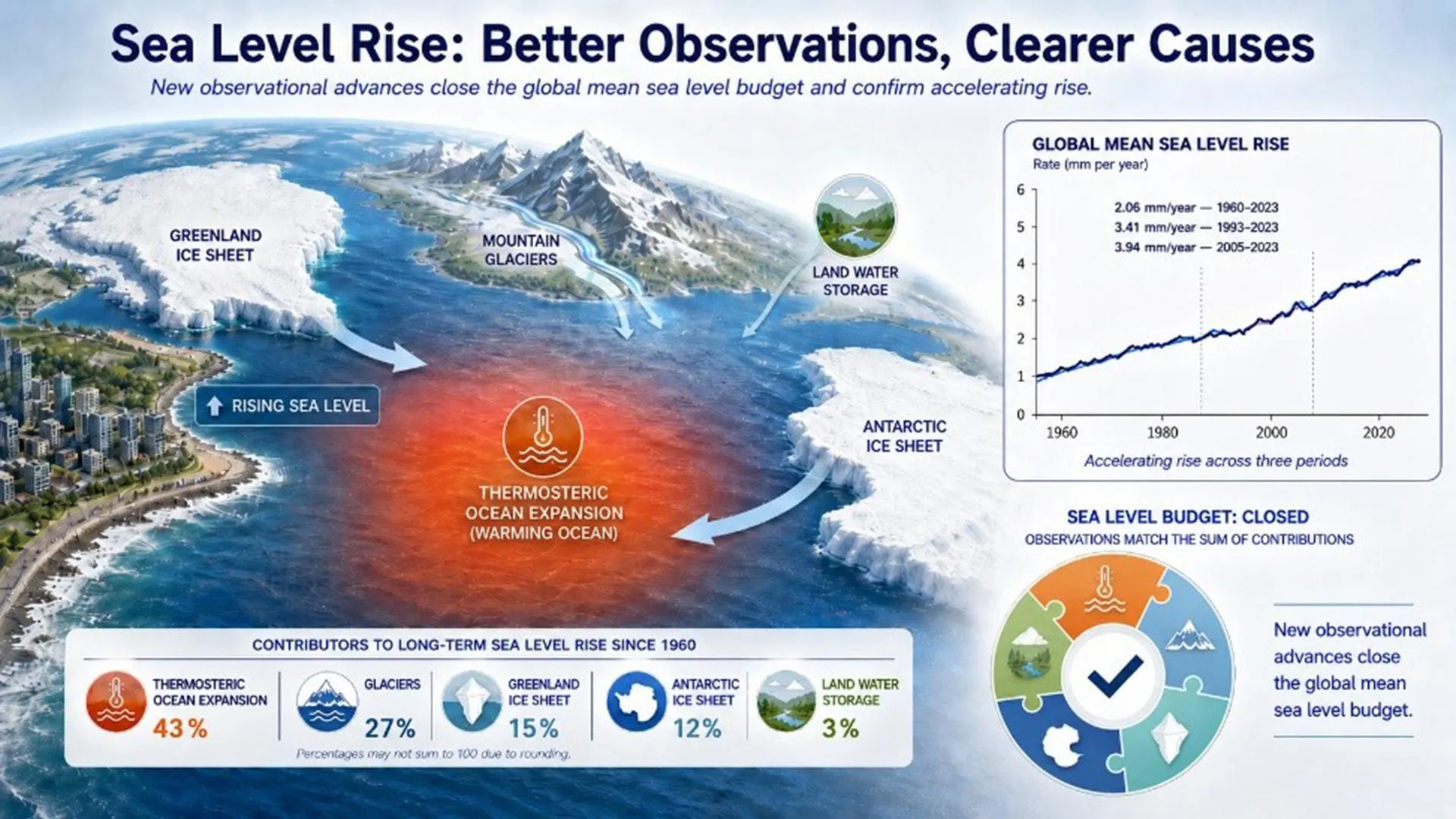
Sea Level Rise Is Speeding Up — Scientists Now Understand Why
- Published in: ScienceDaily (May 22, 2026)
- Key finding: The world's oceans are rising at an accelerating pace. Warming seawater is the biggest factor, while melting glaciers and polar ice sheets are increasingly pouring more water into the oceans each year.
- Why it matters: For the first time, scientists can fully explain what's driving sea level acceleration. This clarity is crucial for coastal communities and policymakers planning adaptation strategies.
Freshwater Methane Emissions Maximized by Global Warming
- Published in: Queen Mary University of London (June 5, 2026)
- Key finding: Nearly half of all methane is produced in freshwater systems, and global warming is maximizing these emissions. Professor Mark Trimmer's research reveals the mechanisms behind freshwater methane production and its acceleration.
- Why it matters: Freshwater methane represents a major but often-overlooked climate feedback loop. As temperatures rise, freshwater ecosystems release more methane, which further accelerates warming—creating a dangerous amplification cycle.

Climate Data & Observations
| Metric | Value | Source |
|---|---|---|
| Warmest years on record (NASA) | 2025, 2024, and 2023 are the three warmest years in NASA's 146-year record | |
| Sea level rise acceleration | Warming seawater + melting glaciers/ice sheets driving accelerating rate | |
| Earth's rotational slowdown | Unprecedented in 3.6 million years, driven by climate-induced ice redistribution |
These metrics collectively demonstrate that climate change impacts extend far beyond traditional atmospheric and ocean measurements. The fact that 2025, 2024, and 2023 consecutively rank as the three hottest years on record signals an accelerating warming trajectory that is now altering planetary rotation and methane cycles in unprecedented ways.
Policy & Action
-
SEC Proposes Rescission of Climate Disclosure Rules: The Securities and Exchange Commission proposed on June 3, 2026 to rescind amendments requiring companies to disclose climate-related information in registration statements, creating regulatory uncertainty for corporate climate reporting.
-
Carbon Dioxide Removal Technologies Require Unprecedented Deployment Rates: A new report cited by Carbon Brief (June 2, 2026) states that CDR technologies must be deployed at rates faster than solar power expansion to meet the 1.5°C target, highlighting the scale of mitigation challenge ahead.
-
Trade Policy Emerging as Climate Tool: The Center for Climate and Energy Solutions published analysis on June 3, 2026 showing that trade policy is increasingly recognized as a critical tool for accelerating global climate action and could enhance international cooperation through the Global Stocktake framework.
What to Watch Next
-
NOAA Monthly Climate Reports: Ongoing monthly summaries tracking global and regional climate metrics; next report expected mid-July 2026.
-
NASA GISTEMP Updates: Continued monthly updates to the GISS Surface Temperature Analysis, with the next data release expected around July 10, 2026, which will provide updated global surface temperature trends.
-
SEC Climate Disclosure Rule Challenges: Legal and regulatory proceedings surrounding the proposed rescission of climate disclosure rules will likely intensify through summer 2026, with potential court challenges and stakeholder input periods.
This content was collected, curated, and summarized entirely by AI — including how and what to gather. It may contain inaccuracies. Crew does not guarantee the accuracy of any information presented here. Always verify facts on your own before acting on them. Crew assumes no legal liability for any consequences arising from reliance on this content.
Powered by
