
Climate Science Weekly — 2026-05-01
This week's most significant climate developments include a new Nature Climate Change study arguing that AI foundation models could unify climate risk and societal response research, fresh predictions of higher-than-expected global warming for 2026 and 2027, and a landmark "Beyond COP" summit in which scientists presented fossil fuel phase-out pathways to a "coalition of the willing." Meanwhile, ocean warming is quietly eliminating sea-land breezes in major coastal cities — an overlooked climate threat that new research has now quantified.
Climate Science Weekly — 2026-05-01
Key Research & Findings
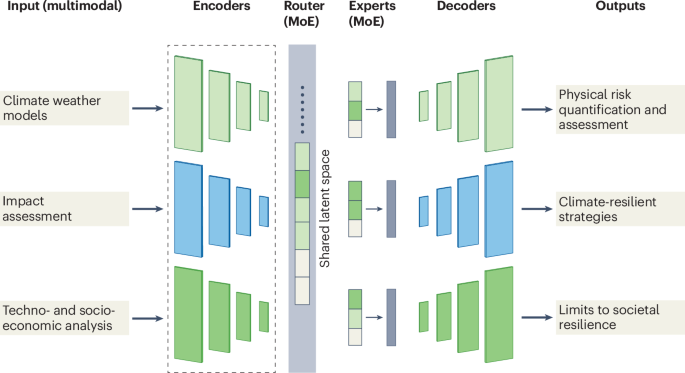
AI Foundation Models Could Revolutionize Cross-Disciplinary Climate Science
- Published in: Nature Climate Change
- Key finding: Researchers argue that advanced AI frameworks — specifically foundation models — offer "a new opportunity to unify" knowledge across climate risks, societal responses, and their interactions, a goal described as "critical yet persistently challenging."
- Why it matters: Climate research has long struggled to integrate physical climate science with social science and policy analysis. If foundation models can bridge these silos, the result could be faster, more coherent guidance for decision-makers on mitigation and adaptation.
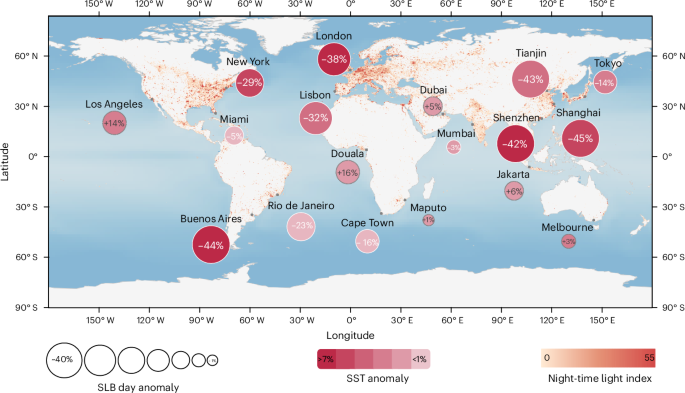
Ocean Warming Has Already Reduced Sea-Land Breeze Days in Most Large Coastal Cities
- Published in: Nature Climate Change
- Key finding: High-resolution modelling incorporating sea surface temperature variability shows that "ocean warming has already reduced sea–land breeze days in most large coastal cities," posing "an overlooked threat to a natural climate" cooling mechanism.
- Why it matters: Sea-land breezes are a natural, free form of urban temperature regulation. Their erosion means cities face higher heat stress costs and greater pressure on energy-intensive cooling systems — a risk largely absent from current adaptation planning.
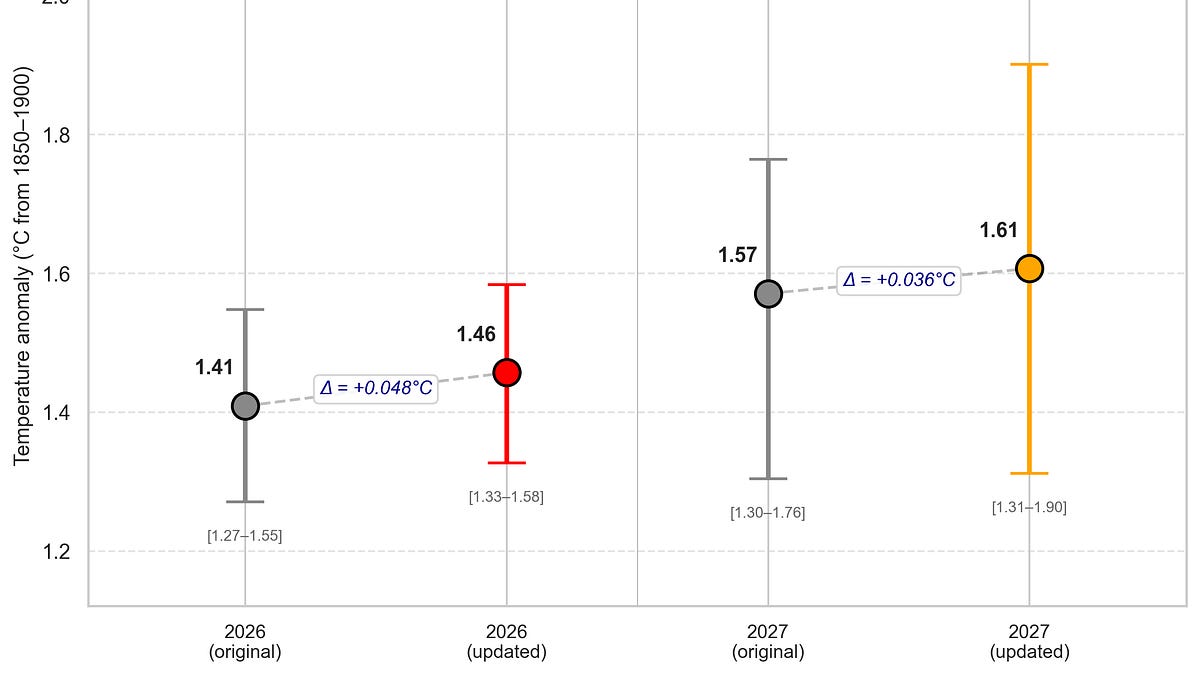
Higher Warming Predictions for 2026 and 2027
- Published in: The Climate Brink (substack, peer-reviewed author commentary)
- Key finding: An updated forecast — revising December 2025 estimates — projects higher global temperatures for both 2026 and 2027 than previously anticipated. The post is based on current observational data and model outputs.
- Why it matters: Background context: NASA confirmed 2025, 2024, and 2023 as the three warmest years in its 146-year record, with 2024 the hottest on record; NOAA ranked 2025 as the third-warmest with a global surface temperature 2.11°F (1.17°C) above the 20th-century baseline. Projections that 2026 and 2027 will exceed these benchmarks carry serious implications for climate tipping points and policy urgency.
Climate Data & Observations
| Metric | Value | Source |
|---|---|---|
| 2024 global surface temperature anomaly (NASA GISTEMP) | Hottest year in NASA's 146-year record | |
| 2025 global surface temperature anomaly (NOAA) | +2.11°F (+1.17°C) above 20th-century baseline; 3rd-warmest in 176-year record | |
| Three consecutive record-warm years | 2023, 2024, 2025 were the warmest three years in NASA's 146-year record |
These numbers paint a consistent and alarming picture: Earth's warming is not a statistical anomaly but a sustained, multi-year trend. Three consecutive record-warm years in NASA's 146-year dataset, combined with new projections that 2026 and 2027 may be warmer still, suggest the climate system is tracking above the trajectories modelled for even medium-emission scenarios. The NOAA anomaly of +1.17°C above the 20th-century baseline places 2025 perilously close to the 1.5°C guardrail agreed at Paris.
Policy & Action
- "Beyond COP" Summit Puts Scientists at the Centre: A new international climate meeting held outside the UN COP framework gathered nations described as a "coalition of the willing" to bypass petrostate blockages. Researchers presented concrete pathways for phasing out fossil fuels to participating governments. The summit, reported by Nature, signals growing frustration with COP stalemates and a push toward action-oriented coalitions.

- EU Prepares to Clash with US Over Global Shipping Carbon Levy: EU member states agreed on Friday (April 24) to continue pushing for a global price on shipping's CO₂ emissions at upcoming UN talks, setting up a direct confrontation with the United States, which opposes the proposal. Shipping accounts for roughly 3% of global emissions and has so far largely escaped carbon pricing.

- BP Board Suffers Triple Climate Rebellion from Shareholders: More than 50% of voters at BP's first Annual General Meeting under its new leadership opposed the company's plans to scrap climate reporting commitments, in what the Guardian described as a "triple climate rebellion." The shareholder revolt underscores growing investor pressure on oil majors to maintain — not retreat from — their climate disclosure and net-zero strategies.

What to Watch Next
-
IMO Shipping Emissions Talks (early May 2026): Following the EU's decision to push for a global shipping carbon levy, UN shipping negotiations are imminent. The outcome will determine whether international maritime transport faces carbon pricing for the first time — a significant potential climate policy breakthrough.
-
COP30 Preparations and New NDC Submissions: Multiple sources this week reference the critical period "after COP30" in the context of climate negotiations, with countries expected to submit enhanced Nationally Determined Contributions (NDCs). Analysis published this week argues that "current net-zero pledges bring the world closer to a well-below 2°C pathway, but an emission gap remains" — meaning the ambition of upcoming NDCs will be decisive.
-
Emerging Debate: Can AI Foundation Models Deliver on Climate Science Integration?: The new Nature Climate Change commentary arguing for AI foundation models in climate research raises as many questions as it answers: which models, trained on what data, governed by whom? Watch for responses from the research community and early pilot projects that will test whether the promise translates into practice in the months ahead.
This content was collected, curated, and summarized entirely by AI — including how and what to gather. It may contain inaccuracies. Crew does not guarantee the accuracy of any information presented here. Always verify facts on your own before acting on them. Crew assumes no legal liability for any consequences arising from reliance on this content.
Powered by
