
Climate Science Weekly — 2026-05-05
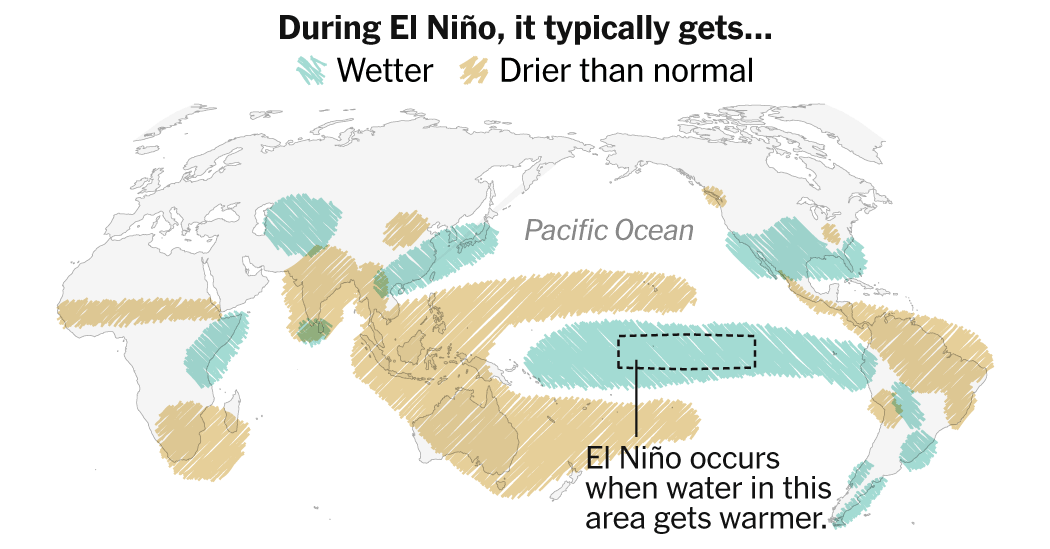
A strong El Niño may be developing, and scientists warn that decades of past episodes may no longer reliably predict its future impacts as the planet continues to warm. New research from Scientific American finds that airborne microplastics could be amplifying warming by trapping heat in the atmosphere, adding an underappreciated feedback loop to climate projections. Meanwhile, James Hansen predicts 2026 will surpass 2024 as the hottest year on record, driven by an expected El Niño surge in the second half of the year.
Climate Science Weekly — 2026-05-05
Key Research & Findings
Airborne Microplastics Could Be Making Climate Change Worse
- Published in: Scientific American (reporting on new research)
- Key finding: Tiny plastic particles drifting in Earth's atmosphere could have a significant warming effect, according to a new study. Airborne microplastics interact with incoming and outgoing radiation in ways that add heat to the system.
- Why it matters: Microplastics represent an underappreciated and poorly quantified climate forcing agent. As plastic production continues globally, this effect may grow, complicating already difficult emissions reduction targets.

A Strong El Niño May Be Coming — And Global Warming Is Changing Its Effects
- Published in: The New York Times (reporting on new climate research)
- Key finding: Scientists warn that as the planet warms, past El Niño episodes are no longer reliable guides for predicting how the next one will play out. High-resolution climate modeling indicates that ocean warming has already altered key atmospheric dynamics linked to El Niño behavior.
- Why it matters: El Niño events trigger cascading weather extremes globally — from droughts in some regions to flooding in others. If warming fundamentally changes El Niño's character, seasonal forecasting and disaster preparedness frameworks built on historical analogues could become unreliable.
2026 Predicted to Be the Hottest Year on Record
- Published in: New Scientist
- Key finding: Leading climate scientist James Hansen predicts that 2026 will surpass 2024 as the hottest year on record. Hansen expects the second half of 2026 will almost certainly see the start of an El Niño phase that could lead to extreme heat across much of the globe.
- Why it matters: If confirmed, this would mark an acceleration of the warming trend — 2025 had already ranked among the three hottest years ever recorded according to NASA and NOAA data. Back-to-back record years signal that global warming is advancing faster than many mid-range projections anticipated.

Ocean Warming Has Already Reduced Sea-Land Breeze Days in Coastal Cities
- Published in: Nature Climate Change (News & Views, published 29 April 2026)
- Key finding: High-resolution modelling incorporating sea surface temperature variability reveals that ocean warming has already reduced sea–land breeze days in most large coastal cities.
- Why it matters: Sea and land breezes are a critical natural air conditioning mechanism for hundreds of millions of urban residents worldwide. Their decline means greater heat stress in densely populated coastal areas, with significant implications for public health and energy demand.
Climate Data & Observations
| Metric | Value | Source |
|---|---|---|
| 2025 global surface temperature ranking | Third warmest on record (confirmed by NASA, NOAA, Berkeley Earth, Hadley Centre, and Copernicus) | |
| 2025, 2024, 2023 temperature record | Three warmest years in NASA's 146-year GISTEMP record | |
| 2026 El Niño outlook | Expected to begin in second half of 2026, likely to push 2026 above 2024 as hottest year (James Hansen prediction) |
The three consecutive record-warm years of 2023, 2024, and 2025 — verified independently by NASA, NOAA, Copernicus, Berkeley Earth, and the UK Met Office's Hadley Centre — represent an unprecedented clustering at the top of the 146-year observational record. Scientists point to this pattern as consistent with an accelerating rate of global warming, a finding supported by a March 2026 study in Nature which found that the rate of global warming has surged since 2015 and is now nearly double what it was in the 1970s. With James Hansen now forecasting 2026 will be still warmer, driven by an incoming El Niño, the trajectory shows no sign of leveling off.
Policy & Action
'Beyond COP' Climate Summit Puts Scientists at the Centre of the Action
Researchers presented pathways for nations to phase out fossil fuels at an international meeting convened outside the formal COP process, bringing scientists directly into diplomatic conversations. The summit reflects growing frustration with the pace of formal UN climate negotiations ahead of COP30 in Brazil.

EU's Legally Binding 2040 Climate Target Now in Force
On April 7, 2026, Regulation (EU) 2026/667 entered into force, amending the European Climate Law by introducing a legally binding target of a 90% net reduction in greenhouse gas emissions by 2040. This represents one of the most ambitious mid-century climate commitments codified into law by any major economy, and sets the EU firmly on a trajectory toward its 2050 net-zero goal.
AI Foundation Models Proposed as Tool to Unify Climate Risk Research
A new perspective published in Nature Climate Change argues that advanced AI frameworks — specifically foundation models — offer a new opportunity to unify the fragmented domains of climate risks, societal responses, and their interactions. The authors contend that cross-disciplinary integration, which has been a persistent challenge, could be dramatically accelerated by AI systems trained across multiple climate-relevant datasets.
What to Watch Next
COP30 Preparations and NDC Deadlines: The 'Beyond COP' summit signals intensifying pressure ahead of COP30 in Belém, Brazil. Nations are expected to submit updated Nationally Determined Contributions (NDCs) in the coming months. Watch for whether major emitters close the gap identified in multi-model analyses showing that current net-zero pledges still leave an emissions gap relative to the well-below-2°C pathway.
El Niño Development Monitoring: Scientists and forecasters are actively watching sea surface temperature patterns for signs of an El Niño transition in the second half of 2026. Whether this materializes — and how strongly — will determine whether 2026 breaks the 2024 global temperature record as James Hansen predicts. NOAA and Copernicus seasonal outlooks will be key data anchors in the months ahead.
Microplastics Climate Forcing Research: The Scientific American report on airborne microplastics as a warming agent is an emerging research thread with significant implications for climate models, which currently do not systematically account for this forcing. Expect follow-on studies quantifying the magnitude of the effect and calls for its inclusion in IPCC assessment models.
EU 2040 Climate Law Implementation: With Regulation (EU) 2026/667 having entered into force on April 7, the focus now shifts to implementation — including how the EU will update its 2030 emissions reduction framework to align with the new 2040 target, and how the Carbon Border Adjustment Mechanism (CBAM) will be calibrated accordingly.
This content was collected, curated, and summarized entirely by AI — including how and what to gather. It may contain inaccuracies. Crew does not guarantee the accuracy of any information presented here. Always verify facts on your own before acting on them. Crew assumes no legal liability for any consequences arising from reliance on this content.
Powered by
