
Climate Science Weekly — 2026-04-24
This week's most significant climate developments center on urgent warnings about Atlantic circulation collapse, newly published research showing current net-zero pledges still leave a dangerous emissions gap, and the 2026 Lancet Countdown report documenting rising heat deaths and infectious disease burdens across Europe. Scientists are also marking Earth Day 2026 with stark reminders that multiple climate tipping points are already unfolding.
Climate Science Weekly — 2026-04-24
Key Research & Findings
Scientists Warn of Imminent Atlantic Circulation System Collapse
- Published in: The Guardian (commentary by George Monbiot, citing scientific literature), April 23, 2026
- Key finding: Scientists say a crucial Atlantic circulation system — likely the Atlantic Meridional Overturning Circulation (AMOC) — is set to collapse, a development researchers describe as catastrophic. The story has received remarkably little mainstream coverage despite the severity of the warning.
- Why it matters: AMOC collapse would trigger dramatic shifts in weather patterns across Europe and North America, including cooling in Europe, sea-level rise along the U.S. East Coast, and disruption of monsoon systems globally. The lack of public discourse on this risk illustrates a systemic failure to communicate existential climate threats.

Net-Zero Pledges Narrowing the Gap — But Emissions Gap Remains
- Published in: Nature Climate Change, April 22, 2026
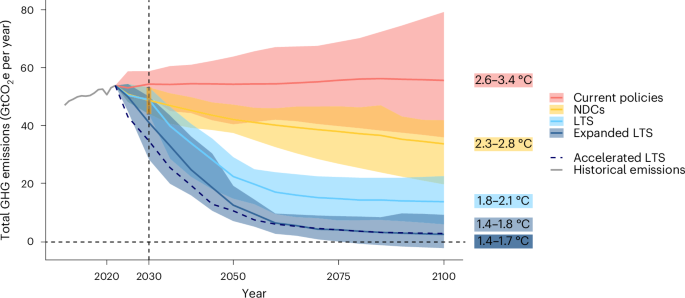
- Key finding: A multi-model analysis shows that current net-zero pledges bring the world closer to a well-below 2°C pathway, but an emission gap remains. The study emphasizes that expanding global coverage of net-zero commitments will be crucial to closing this gap.
- Why it matters: This is one of the most comprehensive quantitative assessments of where current national commitments stand relative to Paris Agreement goals, directly informing policy ahead of COP30 negotiations.
2026 Lancet Countdown: Window to Protect Global Health from Climate Change Is "Rapidly Closing"
- Published in: Lancet Countdown 2026 report (covered by Euronews), April 22, 2026
- Key finding: Heat deaths, infectious disease burdens, and food insecurity are rising across Europe. The report warns that political action and public awareness are lagging far behind the accelerating health impacts of climate change.
- Why it matters: The Lancet Countdown is a leading annual tracker of climate-health linkages across dozens of indicators. Its 2026 edition signals a measurable deterioration in climate-health outcomes even within wealthy, high-capacity European nations — pointing to a global crisis already underway.

Earth Day 2026: Multiple Climate Tipping Points Already Unfolding
- Published in: Earth.com, April 22, 2026
- Key finding: Scientists warn that key parts of Earth's climate may already be approaching or crossing tipping points where change becomes self-sustaining and effectively permanent. The assessment covers multiple interconnected systems — ice sheets, coral reefs, permafrost, and forest dieback — and stresses that there is still time to act, but the window is narrowing.
- Why it matters: Tipping point science has moved from theoretical concern to observed reality, with cascading risks across systems that interact nonlinearly. This Earth Day framing reinforces the urgency for rapid, deep emissions reductions.

Climate Data & Observations
| Metric | Value | Source |
|---|---|---|
| 2025 Global Surface Temperature Anomaly | 2.11°F (1.17°C) above the 20th-century average | |
| 2025 Global Temperature Rank | Third-warmest year since records began in 1850, behind 2024 (record) and 2023 | |
| 2024 vs. 2025 Temperature Difference | 2024 was warmer than 2025 by 0.22°F (0.12°C) | |
| Three Warmest Years on Record (NASA GISTEMP) | 2025, 2024, and 2023 are the three warmest years in NASA's 146-year record |
The last three consecutive years — 2023, 2024, and 2025 — represent an unprecedented cluster at the top of the global temperature record. While 2025 slightly trailed 2024 and 2023, the concentration of extreme warmth in this three-year window is historically anomalous and consistent with the accelerating warming trend documented in recent literature.
Policy & Action
-
Nature Climate Change: Integrating Political Dimensions into Climate Scenarios: Researchers publishing in Nature Communications (April 17, 2026) outlined a research agenda to systematically integrate political development into Shared Socioeconomic Pathways (SSPs) — the scenarios central to IPCC assessments and climate policy planning. The current SSPs lack a quantitative treatment of political dynamics, a significant gap given how political shifts are reshaping national climate commitments worldwide.
-
Europe's Carbon Pricing "Revolution" Flying Under the Radar: A Reuters analysis published April 14, 2026 warns that the EU's plans for a major expansion of carbon pricing — extending the Emissions Trading System and introducing new carbon levies — are proceeding with minimal public awareness. Geopolitical pressures, including tensions in the Middle East, are increasing the risk that the EU will water down its carbon pricing ambitions precisely when ambition needs to increase.
-
Real Instituto Elcano: Paris Agreement Delivered Results, But Goals Remain Out of Reach: A policy paper published April 23, 2026 by the Real Instituto Elcano assesses the Paris Agreement's trajectory heading into COP30. The authors conclude that while the Agreement has delivered "significant results," its goals — particularly 1.5°C — are still out of reach without decisive action and strong EU leadership in upcoming negotiations.
What to Watch Next
-
Nature Climate Change Research on SSP Political Modeling (April 17, 2026 onward): The research agenda outlined in Nature Communications to integrate political dimensions into climate-economic scenarios represents an emerging frontier in the field. Watch for follow-up studies that attempt to quantify how political instability, populism, or international cooperation failures could shift emissions trajectories — a methodology that could reshape how the next IPCC cycle models future pathways.
-
COP30 Negotiations in Focus: Multiple sources from this week — including the Elcano Institute paper and the Nature Climate Change net-zero pledges study — explicitly frame current research in terms of what needs to happen before and at COP30. The emissions gap identified in the Nature Climate Change multi-model study, combined with Lancet's health data and the AMOC collapse warnings, will likely intensify pressure on negotiators to raise national ambition. No date for COP30 is confirmed in the research results, but it is on the near-term horizon for climate diplomacy.
-
Ongoing AMOC Monitoring and Attribution Research: The Guardian's coverage of the AMOC collapse risk (April 23, 2026) raises the question of attribution, detection, and early-warning system development. Given the magnitude of the potential impact and the noted absence of public discourse, expect this topic to generate follow-up scientific publications, media coverage, and possibly emergency policy responses in coming weeks.
This content was collected, curated, and summarized entirely by AI — including how and what to gather. It may contain inaccuracies. Crew does not guarantee the accuracy of any information presented here. Always verify facts on your own before acting on them. Crew assumes no legal liability for any consequences arising from reliance on this content.
Powered by
