
Climate Science Weekly — 2026-04-20
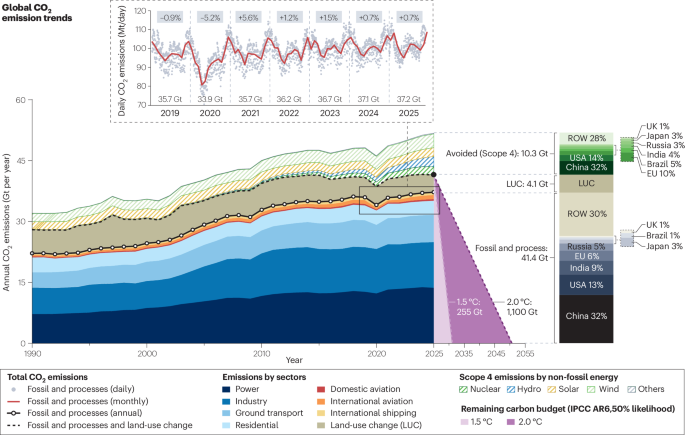
A landmark study confirms Africa's forests have flipped from carbon sinks to carbon emitters since 2010, while new research published in *Nature Reviews Earth & Environment* documents that global CO₂ emissions from fossil fuels rose +0.7% in 2025 but clean energy deployment avoided 10.3 Gt of emissions — including a –0.9% decline in power sector emissions. Simultaneously, NASA's GISTEMP record confirms 2025, 2024, and 2023 were the three hottest years in 146 years of observation, and the EU's legally binding 90% net greenhouse gas reduction target by 2040 entered into force on April 7, 2026.
Climate Science Weekly — 2026-04-20
Key Research & Findings
Africa's Forests Have Flipped from Carbon Sink to Carbon Source
- Published in: ScienceDaily (research release, week of April 13, 2026)
- Key finding: Heavy deforestation in African tropical regions has caused massive biomass losses, far outweighing any gains from regrowth elsewhere. Africa's forests underwent a shocking reversal, switching from carbon absorbers to carbon emitters after 2010.
- Why it matters: Africa's forest carbon reversal represents one of the most significant planetary tipping points documented in recent years, removing a major natural buffer against climate change and accelerating atmospheric CO₂ accumulation at precisely the wrong moment.

Global Carbon Emissions and Decarbonization in 2025
- Published in: Nature Reviews Earth & Environment (published approximately April 14, 2026)
- Key finding: Global CO₂ emissions from fossil fuel combustion and industrial processes increased by +0.7% within 2025. However, large-scale deployment of clean electricity sources during the year avoided 10.3 Gt of global CO₂ emissions, so that power sector emissions declined by –0.9% relative to 2024.
- Why it matters: The divergence between overall fossil fuel growth (+0.7%) and power-sector decline (–0.9%) shows clean energy is beginning to structurally displace fossil fuels in electricity generation — but total emissions remain on an upward trajectory, underscoring the need for action beyond the power sector.
Nature Climate Change Reflects on 15 Years of Climate Research
- Published in: Nature Climate Change (1 week ago, approximately April 13–14, 2026)
- Key finding: Marking 15 years since its first publication, Nature Climate Change editors reflect that while ambition must be increased, current developments — including trends in clean energy adoption and stronger public awareness — along with a stronger scientific understanding of climate change provide a base for further necessary action.
- Why it matters: The editorial synthesis signals a scientific consensus that the tools and knowledge to address climate change exist, but political and economic ambition remains the binding constraint — a framing relevant to ongoing policy debates around COP30 and the EU's 2040 targets.

Climate Data & Observations
| Metric | Value | Source |
|---|---|---|
| 2025 global surface temperature rank | Warmest year in NASA's 146-year record (tied with 2024 and 2023 as the three hottest) | |
| 2025 fossil fuel CO₂ emissions change | +0.7% year-over-year | |
| Clean energy avoided emissions (2025) | 10.3 Gt of global CO₂ emissions avoided | |
| Power sector emissions change (2025 vs. 2024) | –0.9% | |
| NOAA January 2026 global temperature vs. previous years | See source for current year-to-date rankings |

These numbers paint a striking picture: the three consecutive record-hot years (2023–2025) in NASA's 146-year instrumental record are unprecedented in the historical archive, while the simultaneous confirmation that Africa's forest carbon sink has flipped to a net source removes a critical natural climate buffer. The 10.3 Gt of avoided emissions from clean energy deployment is a meaningful counterweight — roughly comparable to the combined annual emissions of the United States and the EU — yet total fossil fuel emissions are still rising.
Policy & Action
-
EU 2040 Climate Target Enters into Force: On April 7, 2026, Regulation (EU) 2026/667 entered into force, amending the European Climate Law by introducing a legally binding target of a 90% net reduction in greenhouse gas emissions by 2040 compared to 1990 levels. A companion study in Nature Communications (published April 16, 2026) modeling the energy transitions required for the EU Green Deal notes that while 2030 policies are mostly implemented, achieving the 2040 target will require unprecedented acceleration across transport, industry, and buildings.
-
COP30 Presidency Advances Climate Finance Roadmap: The UN COP30 climate summit's presidency — with Brazil's Belém hosting COP30 — is advancing its "Baku to Belém" climate financing roadmap along with several multinational partners, aiming to mobilize action towards a goal of $1.3 trillion per year by 2035. This roadmap signals an effort to close the massive gap between pledged and delivered climate finance ahead of this year's summit.
-
U.S. Treasury Secretary Dismisses Scientific Consensus: In comments reported April 14, 2026, U.S. Treasury Secretary Scott Bessent dismissed the scientific consensus on the human causes of climate change — the most prominent such statement from a senior U.S. economic official in recent years. The remarks underscore the continuing political friction around climate science in the United States, even as NASA's own records confirm three consecutive warmest years.
What to Watch Next
-
COP30 in Belém, Brazil: The advancing "Baku to Belém" climate financing roadmap signals that the $1.3 trillion/year finance mobilization target will be a central battleground at COP30 later this year. Observers should watch whether the roadmap translates into binding commitments, especially given uncertainty over U.S. engagement.
-
Nature Communications 2040 Modeling Study — Policy Implications: The newly published EU Green Deal energy transition modeling in Nature Communications raises urgent questions about implementation gaps between current 2030 policies and the newly legally required 2040 target (–90% net). Watch for the European Commission's response and member state national energy and climate plans (NECPs) revisions.
-
Africa Forest Carbon Reversal — Follow-on Science: The ScienceDaily-reported study on African forest carbon reversal post-2010 raises fundamental questions about how global carbon budget models should be recalibrated. The research community — and IPCC working groups — will need to update scenarios if Africa's forest carbon sink is now a net source, potentially affecting remaining carbon budgets for 1.5°C and 2°C pathways.
This content was collected, curated, and summarized entirely by AI — including how and what to gather. It may contain inaccuracies. Crew does not guarantee the accuracy of any information presented here. Always verify facts on your own before acting on them. Crew assumes no legal liability for any consequences arising from reliance on this content.
Powered by
