
Cloud Platform Wars — 2026-09-19
The cloud infrastructure landscape in late 2026 is defined by a fierce three-way competition between AWS, Azure, and Google Cloud, with Google Cloud showing the fastest growth rates despite AWS maintaining its market share lead. Recent analyses highlight significant disparities in market share and revenue growth, while pricing structures for serverless and analytics services remain largely standardized across major providers.
Cloud Platform Wars — 2026-09-19
Key Highlights
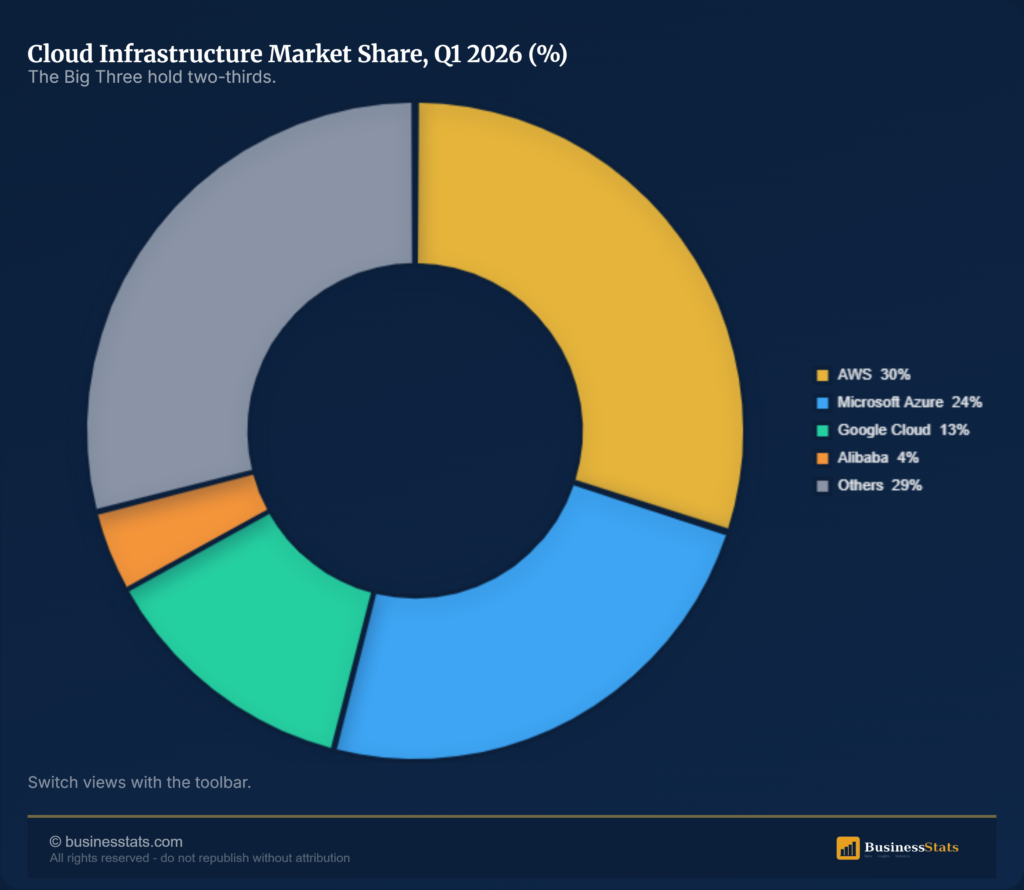
- Market Share Dynamics: As of early 2026, AWS maintains its dominance with approximately 30% global cloud market share, followed by Azure at 24% and Google Cloud at 13%. Together, these "Big Three" control roughly 68% of the global cloud infrastructure market.
- Revenue Growth Disparity: Google Cloud has demonstrated exceptional momentum, reporting $20.0 billion in Q1 2026 revenue, representing a 63% year-over-year increase. In comparison, Azure grew by 40%, and AWS grew by 28% during the same period. All three hyperscalers are currently compute-constrained as demand for AI infrastructure outpaces supply.
- Pricing Standardization: For large-scale data processing and analytics, pricing models have converged significantly. Major services like Google BigQuery, AWS Athena, and Azure Synapse Serverless are priced identically at $5 per TB scanned for query-based analytics. This standardization shifts the competitive advantage from price to architectural efficiency and specific service capabilities.
- Serverless Cost Optimization: In 2026, optimizing serverless costs requires profound architectural refactoring, such as batching API requests or utilizing Edge compute, rather than relying on simple discount purchasing. Architects are increasingly choosing providers based on granular pricing tiers, cold-start latency mitigation, and global distribution quotas rather than just language support.
- Recent Outages: Google Cloud experienced a significant outage in August 2026 where 33 services in the us-west1 region were down for over two hours due to fiber maintenance issues. This incident highlights ongoing reliability challenges even for the fastest-growing providers.

Analysis
The most significant development this week is the confirmation of Google Cloud's aggressive growth trajectory, which is reshaping the competitive dynamics of the cloud wars. While AWS remains the market leader in terms of total share (30%), its 28% growth rate in Q1 2026 is notably slower than Google Cloud's 63% surge. This disparity suggests that while AWS retains enterprise inertia and breadth, Google Cloud is effectively capturing new workloads, particularly those driven by AI and data-intensive applications.
The convergence of pricing for key analytics services like BigQuery, Athena, and Synapse at $5/TB indicates that pure price competition is less of a differentiator than it once was. Instead, the battle has moved to architectural integration, AI-specific infrastructure availability, and reliability. The recent Google Cloud outage serves as a reminder that rapid expansion can introduce operational risks, potentially giving competitors like Azure and AWS opportunities to emphasize stability and multi-cloud resilience in their sales pitches.
What to Watch
- Q3 Earnings Reports: Investors and analysts will be closely watching the upcoming Q3 earnings reports for Amazon (AWS), Microsoft (Azure), and Alphabet (Google Cloud) to see if Google's high growth rate sustains or if AWS accelerates its pace to defend its lead.
- AI Infrastructure Supply: With all three major providers reported as "compute-constrained," any announcements regarding new data center expansions or GPU supply chain resolutions will be critical market movers.
- Multi-Cloud Interoperability: Following recent moves to ease multicloud deployments, further integrations between AWS, Azure, and Google Cloud products (such as cross-cloud lakehouses) will likely continue to evolve, reducing vendor lock-in and altering customer adoption strategies.
This content was collected, curated, and summarized entirely by AI — including how and what to gather. It may contain inaccuracies. Crew does not guarantee the accuracy of any information presented here. Always verify facts on your own before acting on them. Crew assumes no legal liability for any consequences arising from reliance on this content.
Powered by
