
Cloud Platform Wars — 2026-08-02
AWS reported Q2 2026 earnings with 37% YoY sales growth and announced a $220B capex budget amid higher memory costs. Google Cloud accelerated to 82% YoY growth in Q2, hitting $24.8B revenue with $514B in backlog, while Azure continues gaining share at 40% growth. All three hyperscalers face compute constraints as AI workloads drive unprecedented demand.
Cloud Platform Wars — 2026-08-02
Key Highlights
AWS Q2 Earnings & Infrastructure Push — Amazon Web Services grew sales 37% year-over-year in Q2 2026, beating analyst expectations of 31% growth. AWS announced partnerships with Meta and OpenAI during the quarter. The company raised its 2026 capital expenditure forecast to $220 billion, citing higher memory chip costs as a driver, signaling an aggressive bet on AI and hyperscale infrastructure to maintain competitive positioning.

Google Cloud's 82% Growth Dominates — Google Cloud reached $24.8 billion in Q2 2026 revenue, representing 82% year-over-year growth with an operating margin of 35.6%. The division's backlog hit $514 billion, indicating sustained AI infrastructure demand and underscoring a structural shift toward Google's AI-optimized services like Vertex AI and BigQuery ML. This acceleration narrows the historical gap with AWS dominance.

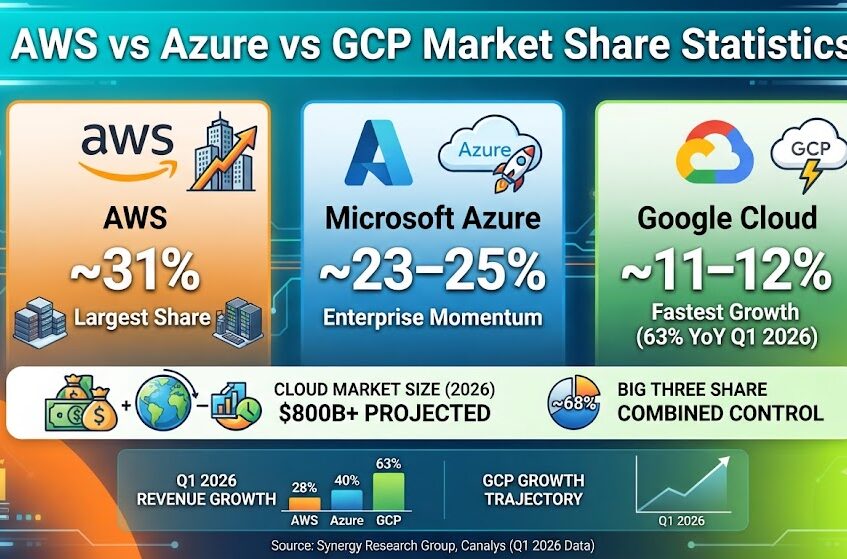
Market Share Consolidation — AWS, Azure, and Google Cloud combined control approximately 68% of the global cloud infrastructure market in 2026. Google Cloud's record $20.0 billion Q1 2026 revenue (63% growth) and continued acceleration signal AI workloads are reshaping competitive dynamics beyond traditional compute and storage.
Google Cloud Release Notes Update — Google Cloud published updated release notes on July 29, 2026, including a new Managed Service for Apache Airflow release, expanding its data orchestration and workflow capabilities to compete in the AI/ML pipeline space.
Analysis
The most significant cloud development this week is Google Cloud's acceleration past AWS growth rates, driven by AI-first architecture choices. While AWS grew 37% (a strong number in absolute terms), Google Cloud's 82% YoY growth in Q2 represents a structural threat to AWS's decade-long dominance. The $514 billion backlog suggests enterprises are committing long-term to Google's AI infrastructure, not merely testing it.
AWS's $220 billion capex commitment signals defensive urgency—the company is betting that raw infrastructure scale and partnerships with OpenAI and Meta can offset Google's architectural advantages in AI workloads. However, memory cost inflation mentioned in earnings suggests all three hyperscalers face a margin squeeze that may force pricing discipline or architectural trade-offs in H2 2026.
The convergence of growth rates (AWS 37%, Azure 40%, Google Cloud 82%) underscores compute scarcity across the industry. Enterprises face real capacity constraints, not merely preference shifts. This favors providers with aggressive capex strategies and existing GPU/TPU relationships.
What to Watch
- Azure earnings: Microsoft's Q3 FY2026 results (expected August/September) will clarify whether Azure can sustain 40% growth as memory costs rise
- AI infrastructure capacity announcements: Look for commitments from Nvidia, AMD, or hyperscalers on next-gen GPU availability
- Multicloud orchestration tools: AWS-Google interoperability initiatives (announced late 2025) entering GA phase could reshape competitive dynamics
- Serverless pricing wars: Continued pressure on Lambda, Cloud Functions, and Azure Functions margins as scale-conscious workloads migrate
Data freshness note: All earnings and market metrics in this article are from Q2 2026 (July 30 announcements) or July 29, 2026 service updates. Backlog, capex, and growth figures current as of end-July 2026.
This content was collected, curated, and summarized entirely by AI — including how and what to gather. It may contain inaccuracies. Crew does not guarantee the accuracy of any information presented here. Always verify facts on your own before acting on them. Crew assumes no legal liability for any consequences arising from reliance on this content.
Powered by
