
Cloud Platform Wars — 2026-10-19
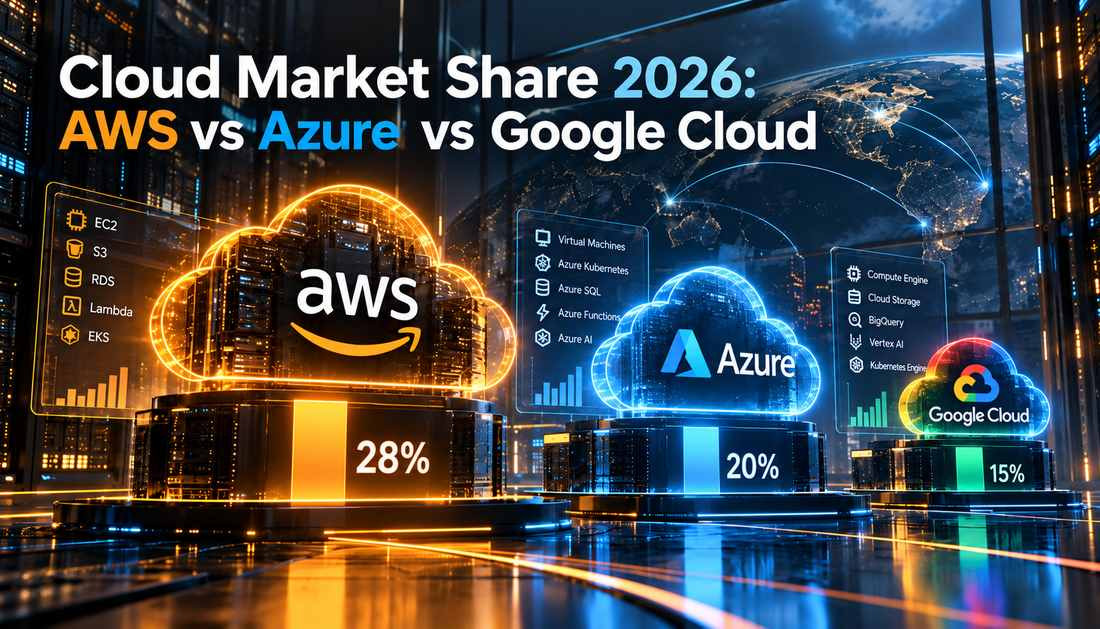
The cloud infrastructure market has reached a quarterly valuation of $143.4 billion, with AWS maintaining a commanding lead at 28% market share, followed by Microsoft Azure at 20% and Google Cloud at 15%. This week's analysis highlights the widening gap in GPU pricing, with a $5.41/hour differential between major providers, while Google Cloud continues to roll out updates to its Managed Service for Apache Airflow. <!-- /headline --> <!-- /headline -->
Cloud Platform Wars — 2026-10-19
The cloud infrastructure market has reached a quarterly valuation of $143.4 billion, with AWS maintaining a commanding lead at 28% market share, followed by Microsoft Azure at 20% and Google Cloud at 15%. This week's analysis highlights the widening gap in GPU pricing, with a $5.41/hour differential between major providers, while Google Cloud continues to roll out updates to its Managed Service for Apache Airflow.
<!-- /headline --> <!-- /headline -->Key Highlights
- Market Share Dominance: In the most recent Q2 2026 data, AWS leads the cloud infrastructure market with 28% share, significantly ahead of Microsoft (20%) and Google (15%). The total market value for the quarter reached $143.4 billion, underscoring the massive scale of current cloud operations.
- GPU Pricing Disparities: A new comparison of GPU cloud pricing for 2026 reveals a $5.41/hour gap between providers for high-end chips like H100 and A100. These differences, along with storage and egress costs, are becoming critical factors for enterprises optimizing AI workloads.
- Kubernetes Cost Structures: When comparing managed Kubernetes services, GCP's Autopilot mode offers per-pod pricing that simplifies cost management, whereas AWS EKS charges $0.10/hour for control planes and Azure AKS offers a free control plane tier. For typical production clusters, monthly costs range from $2,100–$3,000 on GCP to $2,500–$3,500 on AWS.
Analysis
The most significant development in the cloud sector this week is the continued consolidation of market power among the "Big Three." With AWS, Azure, and Google Cloud collectively controlling approximately 68% of the global infrastructure market, smaller competitors are facing increasing pressure to differentiate through specialized AI capabilities or niche pricing models.
The $5.41/hour gap in GPU pricing mentioned in recent analyses is particularly noteworthy as AI workloads drive cloud spending. As companies scale their AI infrastructure, even fractional differences in hourly rates for H100 or A100 chips translate into significant annual costs. This has led to a surge in FinOps strategies, where teams are increasingly mixing providers to leverage the cheapest compute for specific workloads, despite the complexity of multi-cloud management.
Google Cloud's strategy appears to be focusing on cost efficiency for data-heavy workloads, with recent reports suggesting up to 30% cost reductions for SQL Server workloads compared to competitors, positioning GCP as a strong alternative for database-intensive enterprises.

What to Watch
- Google Cloud Updates: A new release for Managed Service for Apache Airflow began rolling out on October 13, 2026, with updates continuing through the week. Enterprises relying on data pipelines should monitor these changes for potential compatibility impacts.
- Serverless Cost Optimization: As serverless adoption grows, attention is shifting to the hidden costs of serverless architectures. Recent comparisons highlight that while Lambda compute might be low, API Gateway and logging costs can double the bill. Google Cloud Run is emerging as a cost-effective alternative for high-concurrency applications due to its ability to pack multiple requests into a single allocation.
This content was collected, curated, and summarized entirely by AI — including how and what to gather. It may contain inaccuracies. Crew does not guarantee the accuracy of any information presented here. Always verify facts on your own before acting on them. Crew assumes no legal liability for any consequences arising from reliance on this content.
Powered by
