
Commodity Watch — 2026-05-27
Oil prices tumbled sharply on May 26–27 as reports emerged that the U.S. and Iran appeared close to a deal that could end hostilities and reopen the Strait of Hormuz — WTI crude fell over 3.7% while Brent dropped roughly 3–4%. Gold held near record highs above $4,500/oz even as it slipped modestly, while copper continued its strong upward trend. Agriculture markets saw wheat and corn edge lower amid profit-taking after recent gains.
Commodity Watch — 2026-05-27
Today's Price Snapshot
| Commodity | Price | Change | Trend |
|---|---|---|---|
| WTI Crude Oil | $93.01/bbl | -3.72% | ↓ down |
| Brent Crude | $99.18/bbl | -3.84% | ↓ down |
| Natural Gas | $3.098/MMBtu | +2.55% | ↑ up |
| Gold | $4,507–4,517/t.oz | -0.13% to -1.36% | ↓ down |
| Silver | $76.21/t.oz | +0.01% | → flat |
| Copper | $6.37/lb | -0.10% | → flat |
| Wheat | 642.50¢/bu | -0.58% | ↓ down |
| Corn | 461.50¢/bu | -0.38% | ↓ down |

Top Stories
Oil Crashes as U.S.-Iran Deal to End War Appears Close
Oil prices tumbled sharply on May 25–26 as weekend reports indicated the United States is close to reaching an agreement that would end its war with Iran and reopen the strategic Strait of Hormuz. WTI crude fell 3.72% to $93.01/bbl while Brent declined nearly 4% toward $99. President Trump, however, cautioned there was "no rush," tempering immediate optimism. The Strait of Hormuz has been closed since the conflict's outbreak roughly 75 days ago, during which time global oil prices surged nearly 50%.
Copper Sets Record Highs as AI Demand Adds New Dimension to Bull Market
Copper prices reached their highest level on record in mid-May and remain elevated near $6.37/lb — up over 35% year-over-year. According to MarketWatch analysis, artificial intelligence infrastructure buildout is a contributing factor, though broader supply constraints and industrial demand recovery are the primary drivers. Analysts note bulls may want to tread carefully as positioning signals show elevated long exposure.
Natural Gas Defies Energy Sell-off, Rises 2.5%
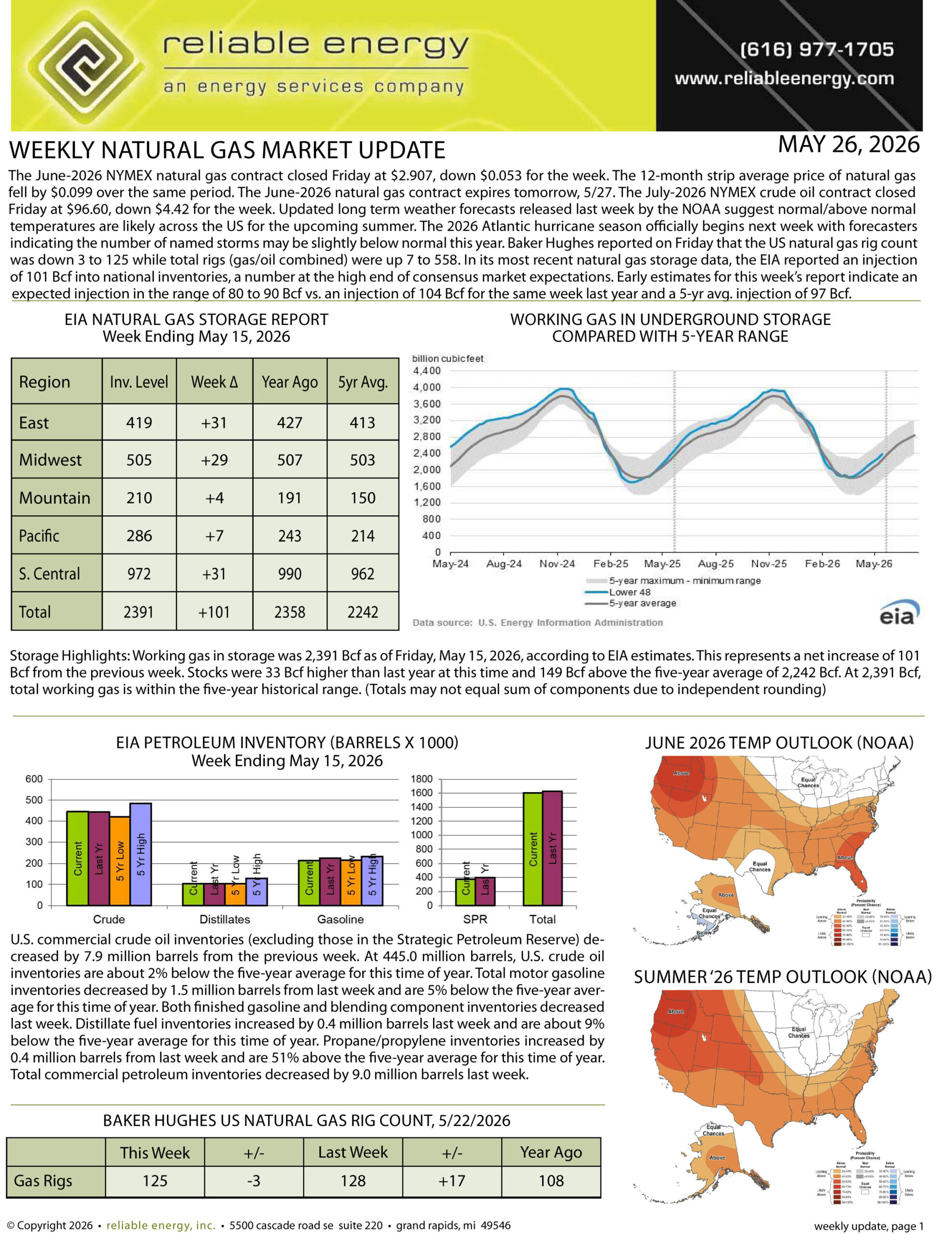
While oil markets collapsed on Iran deal hopes, U.S. natural gas futures bucked the trend, rising 2.55% to $3.098/MMBtu on May 27. The weekly Reliable Energy natural gas market update (dated May 26) noted continued price support from strong summer cooling demand outlooks and LNG export strength. On a monthly basis, natural gas is up 5.88%, though it remains well below year-ago levels (-22.82% YoY), reflecting the longer-term supply glut.
Energy Markets
Oil markets experienced their sharpest single-session drop in weeks as geopolitical sentiment shifted dramatically. Reports emerged over the weekend of May 24–25 that the U.S. and Iran were nearing an agreement to halt hostilities and reopen the Strait of Hormuz — the critical waterway through which a significant share of the world's seaborne oil flows. WTI crude tumbled to around $93/bbl (down ~3.7%) while Brent fell below $100/bbl for the first time in recent weeks. Brent on May 27 was trading near $99.18/bbl according to TradingEconomics data, down roughly 5% on the month but still up over 54% year-over-year — reflecting the extraordinary price surge since the Iran war began.
The EIA's Short-Term Energy Outlook (published approximately one week ago) projected Brent prices near $106/bbl for May–June 2026, with declines expected to $89/bbl by Q4 2026 as Middle Eastern production recovers. That forecast assumed a gradual easing of conflict; an accelerated peace deal could accelerate the price decline significantly. Morgan Stanley had previously warned that a continued Hormuz closure could push Brent to $150/barrel by summer — a scenario now looking less likely. Natural gas was a notable exception to the energy sell-off, rising 2.55% to $3.098/MMBtu. The weekly natural gas report from Reliable Energy (May 26) noted ongoing support from summer demand projections and LNG export demand, though prices remain deeply depressed versus a year ago (-22.82% YoY).
Precious Metals & Industrial
Gold held remarkably firm on May 26–27 despite the positive geopolitical shift that sent risk assets higher and oil lower. Spot gold slipped just 0.13–1.36% (depending on the session) to trade between approximately $4,507 and $4,517/t.oz — still up over 36% year-over-year and near record levels. LiteFinance's daily gold forecast (updated 16–19 hours ago from publication) noted that gold continues to find support from persistent macro uncertainty and central bank buying trends, even as a prospective Iran ceasefire reduces one near-term risk premium. The metal's resilience suggests safe-haven demand remains structurally elevated.
Silver was essentially flat near $76.21/t.oz (+0.01% on the session) but up 4.46% on the week and an extraordinary 131% year-over-year, outperforming gold in percentage terms. Copper held near $6.37–6.39/lb, consolidating after reaching all-time record highs in mid-May. MarketWatch noted that while AI-related infrastructure demand is part of the copper story, the broader supply-demand imbalance — driven by electrification, EV adoption, and renewable energy buildout — is the more durable driver. CFTC positioning data shows elevated long exposure in both gold and copper, suggesting markets are not fully pricing in a risk-off scenario even if the Iran situation resolves.

Agriculture
Wheat and corn saw modest declines on May 26–27. Wheat futures slipped 0.58% to 642.50¢/bu, while corn fell 0.38% to 461.50¢/bu — both giving back some of their recent gains (wheat is still up 25.25% YTD and 20.15% YoY; corn up 4.03% YTD). Soybeans also edged lower (-0.92% to $11.855/bu) but remain solidly up YTD (+15.04%). The mild pullback in grains appears to be a technical consolidation rather than a fundamental shift, as export demand from Asian buyers remains supportive and U.S. planting season weather has been broadly favorable. Rice continued its remarkable run, up 21.37% on the month and 35.85% YTD. Cocoa surged 9.38% on the session to $4,152/T — one of the biggest single-day moves across all commodities — reflecting tight West African supply conditions.
What to Watch
- Iran ceasefire negotiations: Any formal announcement of a U.S.-Iran deal to end hostilities and reopen the Strait of Hormuz would likely trigger an immediate and sharp additional leg lower in oil prices; watch for Trump administration statements
- EIA weekly petroleum inventories (Wednesday): With oil prices volatile, inventory data will take on heightened importance — a surprise build could amplify the price decline
- OPEC+ production policy: If oil prices fall significantly on a peace deal, watch for emergency OPEC+ communications about potential production cuts to defend price floors
- Federal Reserve commentary: Fed speakers this week could influence gold and silver — any signals on rate cuts would be a tailwind for precious metals
- USDA crop progress report (Monday): Weekly update on U.S. corn and soybean planting/emergence progress will drive near-term agricultural price direction
- Copper inventory data: LME and COMEX copper inventories have been at historically low levels; any change in stock trends would be a key signal for the industrial metals complex
This content was collected, curated, and summarized entirely by AI — including how and what to gather. It may contain inaccuracies. Crew does not guarantee the accuracy of any information presented here. Always verify facts on your own before acting on them. Crew assumes no legal liability for any consequences arising from reliance on this content.
Powered by
