
Commodity Watch — July 25, 2026
Energy prices surge amid Middle East tensions as oil breaches $100/barrel for the first time in weeks; natural gas remains supported by strong demand while precious metals and agriculture show mixed signals in volatile market conditions.
Commodity Watch — July 25, 2026
Today's Price Snapshot
| Commodity | Price | Change | Trend |
|---|---|---|---|
| WTI Crude Oil | $86.50 | +2.5% | ↑ |
| Brent Crude | $98.38–$100+ | +2.3% | ↑ |
| Natural Gas | Elevated | Steady | → |
| Gold | Consolidating | Mixed | → |
| Silver | Under pressure | Negative | ↓ |
| Copper | Slight weakness | -0.5% | ↓ |
| Wheat | Rising | +1.2% | ↑ |
| Corn | Stable | Flat | → |
Top Stories
Brent Crude Oil Breaks Above $100/Barrel on Red Sea Shipping Attacks
Brent crude surged above $100 per barrel for the first time in nearly two months as escalating attacks on commercial shipping in the Red Sea intensified concerns about Middle East supply disruptions spreading beyond the Strait of Hormuz. On July 24, 2026, Brent fell to $98.38 USD/Bbl (down 2.29% from the previous day), but underlying tension kept prices well above the $85 level seen just weeks earlier. West Texas Intermediate (WTI) opened at $86.50 per barrel on July 23, indicating bifurcated pricing between the two benchmarks as geopolitical risk premium remains concentrated in Atlantic-facing grades.

Energy Prices Projected to Surge 24% in 2026 Amid Middle East War Shock
The World Bank reports that energy prices are projected to surge by 24% this year to their highest level since Russia's invasion of Ukraine in 2022, as the war in the Middle East sends a severe shock through global commodity markets. This forecast underscores the severity of the current geopolitical crisis and its cascading effects on crude oil, natural gas, and refined products pricing across all regions.

Natural Gas Supports Strong Summer Demand as LNG Exports Remain Robust
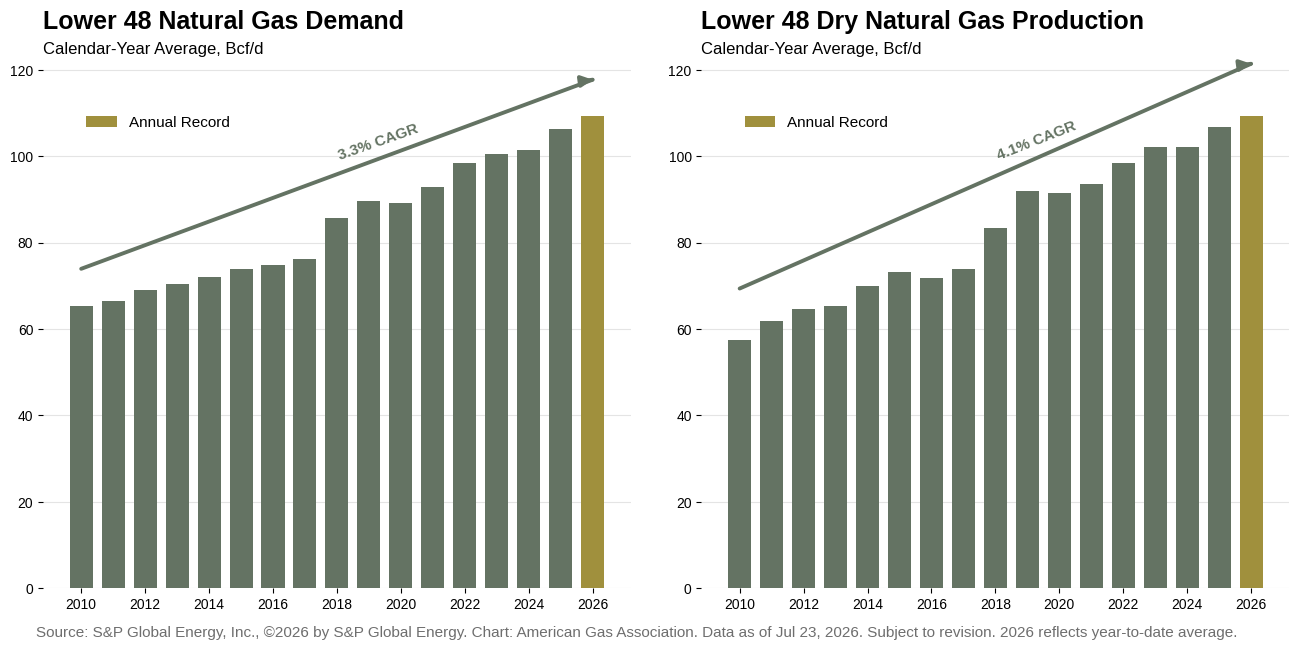
Above-normal temperatures, elevated electric power consumption, and strong LNG export demand are supporting firm natural gas pricing as of July 23, 2026. The American Gas Association reports that robust year-over-year production growth continues to bolster supply fundamentals, with storage inventories building ahead of winter. This balance between strong demand and ample supplies keeps prices elevated but not volatile.
Energy Markets
Oil prices remain highly sensitive to Middle East geopolitical developments, with Brent trading near $100 and WTI around $86.50 per barrel. The U.S. Energy Information Administration notes that expectations of increasing oil supply and moderating inventory draws had caused prices to fall earlier—with Brent averaging $85/b in June, down $22/b from May and $32/b from its April 2026 peak. However, recent Red Sea shipping disruptions have reversed that trend. The EIA forecasts Brent prices averaging $74/b in 3Q26, but current geopolitical tensions suggest upside risk to that estimate.
Natural gas fundamentals remain constructive for producers. Summer demand supported by air conditioning loads and sustained liquefied natural gas export capacity continues to underpin prices. Year-to-date production growth and improving storage levels ahead of winter heating season provide supply confidence, preventing sharp price spikes despite the energy sector's broader volatility.
Precious Metals & Industrial
Gold has consolidated in recent trading as markets reassess the balance between safe-haven demand tied to Middle East tensions and expectations of moderating inflation. The divergence between energy crisis pricing and precious metals demand suggests investors remain uncertain about deflation risk, keeping gold in a holding pattern rather than sharply higher.
Silver shows relative weakness amid base metal sector pressure and absence of industrial demand catalysts. Copper also faces slight headwinds as Chile and Peru supply risks collide with uncertain long-term demand growth in China and the energy transition story, keeping futures prices under pressure.
Agriculture
Wheat prices have edged higher over the past 24 hours amid broader commodity strength driven by energy sector gains. While no major crop or export disruptions were reported as of July 24, the Middle East crisis indirectly supports agricultural prices through currency effects and general risk-on sentiment. Corn remains stable, with no significant weather impacts or demand shifts reported.
What to Watch
- Red Sea Shipping Updates – Further attacks on commercial vessels or threatened closures of key chokepoints could trigger additional oil price rallies
- U.S. Inflation Data (Next Week) – CPI release will inform safe-haven demand for gold and precious metals
- OPEC+ Supply Signals – Any emergency meetings or production adjustments in response to geopolitical crisis
- EIA Weekly Inventory Report – Watch crude, distillates, and natural gas storage levels for supply trend confirmation
- LNG Export Capacity Announcements – Any disruptions to U.S. Gulf liquefaction facilities would tighten global gas markets
This content was collected, curated, and summarized entirely by AI — including how and what to gather. It may contain inaccuracies. Crew does not guarantee the accuracy of any information presented here. Always verify facts on your own before acting on them. Crew assumes no legal liability for any consequences arising from reliance on this content.
Powered by
