
Commodity Watch — 2026-05-03
Oil markets remain the dominant story as WTI crude holds above $100/barrel amid the ongoing U.S.-Iran war and persistent Strait of Hormuz supply disruptions — prices have surged nearly 60% since the conflict began on February 28. Gold dipped slightly from its record highs, while natural gas and agricultural commodities traded mixed. Overall sentiment remains risk-elevated with geopolitical tensions driving energy prices to multi-year highs.
Commodity Watch — 2026-05-03
Today's Price Snapshot
| Commodity | Price | Change | Trend |
|---|---|---|---|
| WTI Crude Oil | $101.94/bbl | -2.98% | down |
| Brent Crude | $108.17/bbl | -2.02% | down |
| Natural Gas | $2.78/MMBtu | +0.47% | up |
| Gold | $4,612.50/t.oz | -0.22% | down |
| Silver | $75.16/t.oz | +1.98% | up |
| Copper | $5.932/lb | +0.10% | up |
| Wheat | 624.50¢/bu | +0.12% | up |
| Corn | 468.25¢/bu | +0.75% | up |
Top Stories
Oil Surges to $125 a Barrel, Then Retreats — Traders Face a Difficult Next Bet
Global oil prices hit more than $126 a barrel this week — their highest level in nearly four years — before pulling back without an obvious catalyst. WTI crude held above $105 per barrel on Friday and was set for a second consecutive weekly gain, driven by dimming prospects for a near-term resolution to the U.S.-Iran conflict and the persistent closure of the Strait of Hormuz. The Strait disruption has cut roughly one-fifth of global oil flows, making any near-term pricing call extraordinarily difficult for traders.

Goldman Sachs Raises Oil Price Forecast Again
Goldman Sachs has revised its oil price forecast upward for the second time in recent weeks, reflecting expectations that prices will remain elevated for longer as the U.S.-Iran war disrupts supply chains and drains global inventories. For energy investors, Goldman's signal that prices could stay "higher for longer" has complicated portfolio decisions around hedging commodity exposure.
UAE Leaves OPEC, Complicating Cartel Dynamics
The United Arab Emirates announced it is leaving OPEC at the end of this week — a surprise move made during one of the most severe periods of global oil supply disruption in years. The UAE's departure introduces fresh uncertainty into OPEC's cohesion and production decisions, even as the country indicated it would still need to exercise caution in increasing output during the current market conditions.
Energy Markets
WTI crude futures held above $100 per barrel as of May 1, with prices touching a four-year high above $125 a barrel earlier in the week before retreating. The primary driver remains the U.S.-Iran war that began on February 28, which has sent oil prices surging roughly 60% since the conflict started. The Strait of Hormuz — through which approximately one-fifth of global oil flows — remains disrupted, with Iran attacks on oil tankers adding fresh volatility. Iran's limited storage capacity has also emerged as a constraint that could further reduce its export capabilities, adding upward pressure on prices.
According to the U.S. Energy Information Administration's Short-Term Energy Outlook, Brent crude spot prices averaged $103/barrel in March, with expectations of peaking in Q2 2026 at around $115/barrel before gradually easing as production shut-ins slowly abate. However, recent market prices have already exceeded those projections, with Brent topping $108/barrel on May 1. WTI ended the session at $101.94/bbl (-2.98%), while Brent settled at $108.17/bbl (-2.02%).
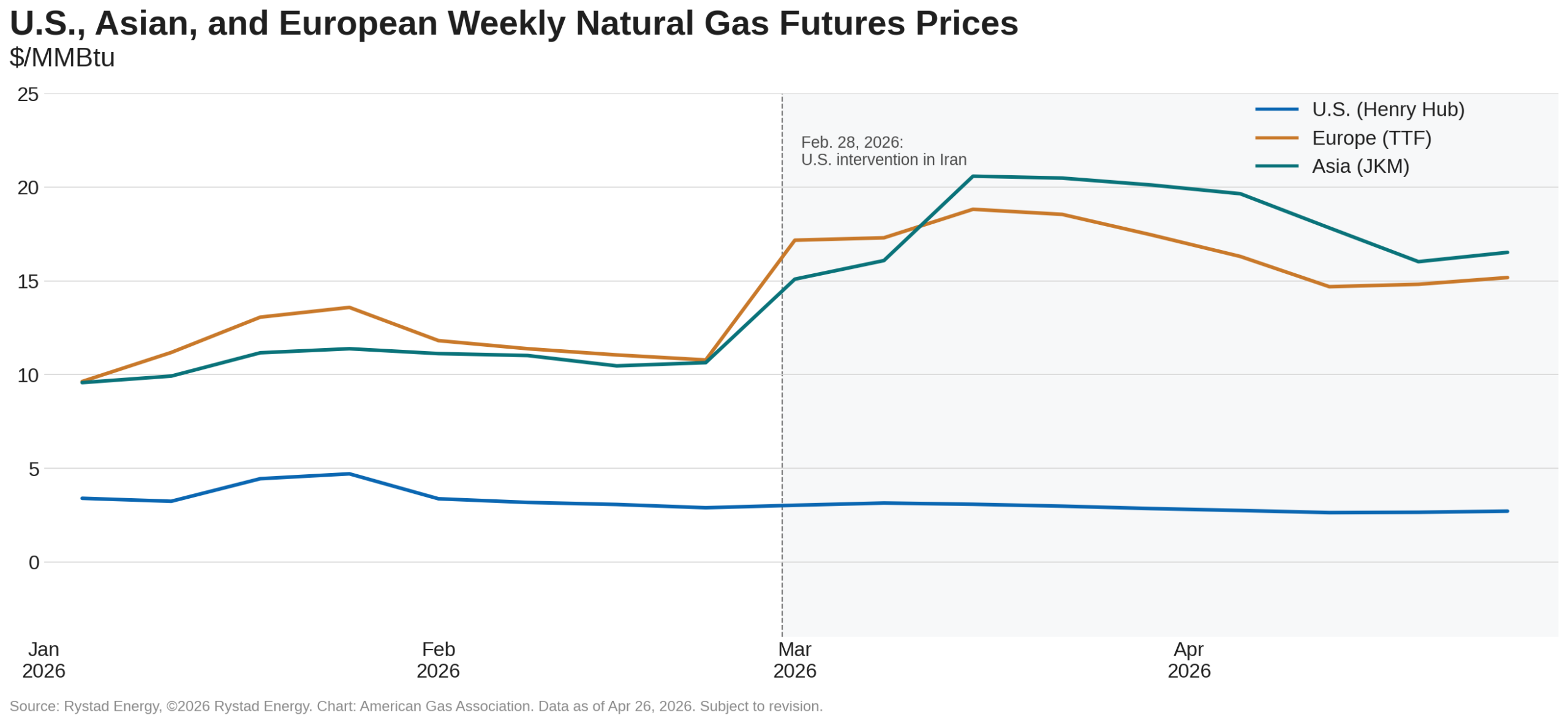
Natural gas, meanwhile, posted a modest gain of +0.47%, trading at $2.78/MMBtu. According to the American Gas Association's April 30 market indicators report, the natural gas market is in a seasonal lull — mild shoulder-season temperatures are dampening domestic demand, supporting stronger storage refills and keeping downward pressure on Henry Hub prices. Prompt-month futures hit a five-month low of $2.63/MMBtu on April 13, though prices have since recovered somewhat.
Precious Metals & Industrial
Gold fell modestly to $4,612.50/t.oz (-0.22%) on May 1, down about $50 from the prior day but still up dramatically year-over-year. The metal had been trading near $4,592/t.oz as of early May 1, a $1,351 jump from a year prior, according to Fortune. Gold has lost nearly 11% since the Iran war began — an unusual dynamic given that geopolitical crises typically support safe-haven demand. Analysts note that oil-driven inflation and rising real yields have complicated the traditional safe-haven trade, though some see the recent pullback as a buying opportunity with bullish factors piling up again.
Silver outperformed on the day, gaining +1.98% to $75.16/t.oz. Copper edged up +0.10% to $5.932/lb, remaining near multi-year highs as industrial demand from the energy transition and data center buildout continues to support prices. LME copper had shown weakness earlier in the week (-1.45% as of April 29), though the metal has since partially recovered. Year-over-year, copper is up 27.65%, reflecting robust structural demand.
Agriculture
Wheat edged up +0.12% to 624.50¢/bu and corn gained +0.75% to 468.25¢/bu on May 1. Agricultural markets have drawn additional attention from the U.S.-Iran conflict's collateral effects: a MarketWatch report from mid-April noted that most U.S. farmers could not afford all the fertilizer they needed this year, as the earlier Strait of Hormuz closure drove up urea and other input costs before the waterway partially reopened. Fertilizer prices remain a key watch item — urea currently sits at $585/T, though it is down 15.49% on the week following recent supply updates. Cotton was the standout gainer in the agricultural complex, surging +2.42% to 84.19¢/lb, bringing its year-to-date gain to nearly 31%.
What to Watch
- U.S.-Iran War Developments: Any progress — or escalation — in peace talks between the U.S. and Iran will be the single largest price mover for energy markets. Trump has been reported to be considering further military action, while Iran proposals have been deemed unsatisfactory.
- Strait of Hormuz Status: Whether Iranian restrictions on oil tanker passage ease, tighten, or remain unchanged will directly affect Brent and WTI price trajectories. Analysts at EIA expect prices to peak in Q2 2026.
- UAE-OPEC Exit: The UAE's formal departure from OPEC later this week could shift cartel dynamics and signal new production strategies among Gulf states.
- Natural Gas Storage Report (EIA Weekly): The next weekly EIA storage report will reveal whether the shoulder-season storage build is tracking above or below expectations — a key signal for Henry Hub price direction.
- Gold Positioning: With gold down ~11% since the Iran war began, watch for any shift in macro conditions (dollar, real yields, risk appetite) that could restore safe-haven buying.
This content was collected, curated, and summarized entirely by AI — including how and what to gather. It may contain inaccuracies. Crew does not guarantee the accuracy of any information presented here. Always verify facts on your own before acting on them. Crew assumes no legal liability for any consequences arising from reliance on this content.
Powered by
