
Commodity Watch — 2026-05-19
Energy markets dominated trading on May 19, with WTI crude oil and Brent both slipping modestly on the day but remaining dramatically elevated year-over-year amid the ongoing U.S.-Iran war and Strait of Hormuz disruption. Gold pulled back from recent highs while copper held near record levels, and agricultural commodities saw wheat and corn post gains. Overall market sentiment remains cautious-bullish on energy, with geopolitical risk continuing to be the dominant driver across all commodity classes.
Commodity Watch — 2026-05-19
Today's Price Snapshot
| Commodity | Price | Change | Trend |
|---|---|---|---|
| WTI Crude Oil | $102.83/bbl | -1.49% | ↓ down |
| Brent Crude | $109.95/bbl | -1.92% | ↓ down |
| Natural Gas | $3.024/MMBtu | +0.01% | → flat |
| Gold | $4,544.50/t.oz | -0.49% | ↓ down |
| Silver | $76.13/t.oz | -1.97% | ↓ down |
| Copper | $6.20/lb | -1.08% | ↓ down |
| Wheat | 671¢/bu | +0.99% | ↑ up |
| Corn | 478¢/bu | +0.32% | ↑ up |
Top Stories
Iran War Stalemate Keeps Oil Prices Near Multi-Year Highs
U.S. stock futures slipped and crude prices rose Sunday after markets digested an impasse in the U.S.-Iran war. WTI is now up roughly 79% year-to-date and 66% year-over-year, while Brent has surged over 68% in the same period. Trump has called Iran's latest peace offer "totally unacceptable," keeping the geopolitical risk premium baked into oil prices. Analysts at Morgan Stanley have warned that a full Strait of Hormuz closure could push Brent toward $150/barrel by summer.
World Lost Nearly 1 Billion Barrels of Oil Supply in 75 Days
Global oil prices have climbed nearly 50% since late February, but analysts warn that the scale of supply destruction — an estimated 1 billion barrels lost since the start of the Iran war — is not yet fully priced in by markets. The EIA's May Short-Term Energy Outlook estimates global oil inventories will fall by an average of 8.5 million b/d in Q2 2026, supporting Brent around $106/b for May and June before an anticipated production rebound.
Copper Hits Record Highs; AI Demand Meets Hormuz Bottleneck
Copper prices have reached an all-time high, driven not only by artificial intelligence infrastructure demand but also by a newly emerging "Strait of Hormuz problem" for copper refining. With the conflict disrupting shipping lanes critical to global trade, copper supply chains are under additional stress. Copper stands at $6.20/lb on May 19, up 33.5% year-over-year.
Energy Markets

WTI crude pulled back 1.49% on May 19 to $102.83/barrel, while Brent fell 1.92% to $109.95/barrel, as markets weighed stalled diplomatic progress between the U.S. and Iran. Despite today's pullback, both benchmarks remain near their highest levels in years. WTI is up 79% year-to-date and Brent is up more than 80%. The EIA's May Short-Term Energy Outlook, published last week, projected Brent averaging around $106/b in May and June before easing to $89/b in Q4 2026 as Middle East production gradually returns.
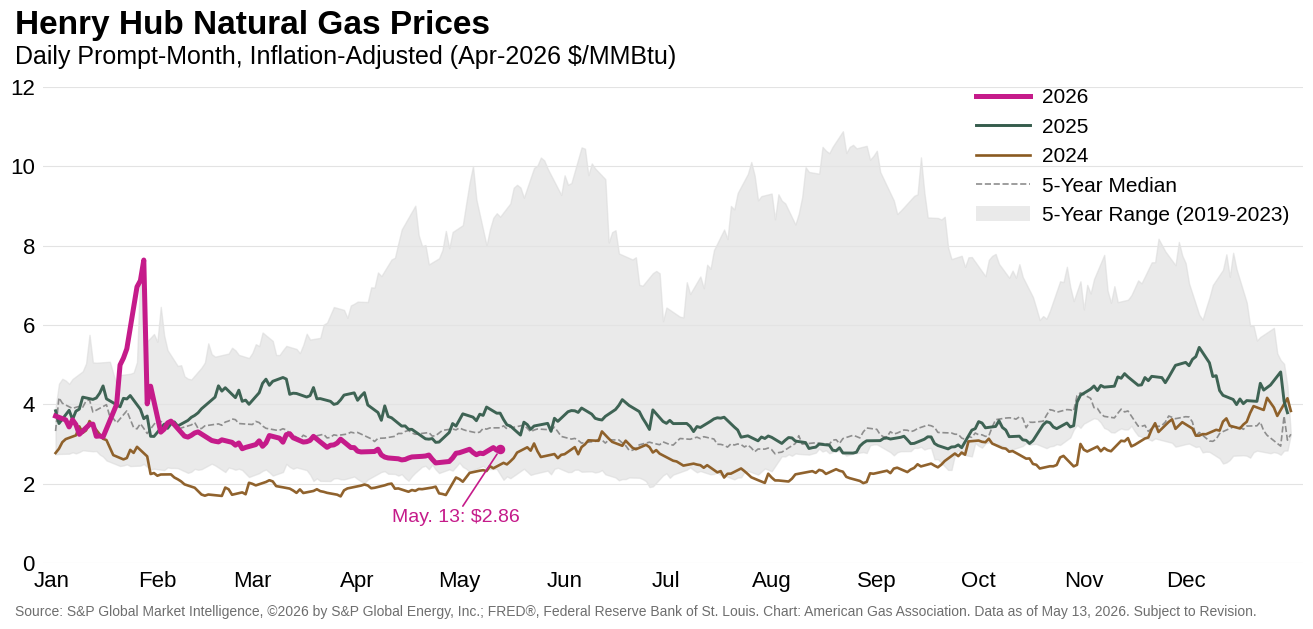
Natural gas prices were roughly flat on the day at $3.024/MMBtu (+0.01%), though they remain down nearly 18% year-to-date — a reflection of mild shoulder-season demand and healthy storage injections as the U.S. heads into summer. The American Gas Association's May 15 report highlighted that dry natural gas production has remained resilient year-over-year even as lower prices have contributed to softer drilling activity. European gas benchmarks told a different story: TTF Gas fell 1.77% to €49.36/MWh but is still up 75% year-to-date, while LNG JKM surged 10.84% on the session.
Precious Metals & Industrial

Gold retreated 0.49% on May 19 to $4,544.50/troy oz, a continuation of the modest pullback seen over the past month. Despite the daily and monthly declines (down 5.77% over 30 days), gold remains up a remarkable 38% year-over-year, reflecting the sustained safe-haven demand driven by the Middle East conflict and broader macro uncertainty. Analysts note that gold climbed back above a key trend line in early May, with some expecting further consolidation before the next directional move.
Silver dropped 1.97% on the session to $76.13/troy oz, though it is up nearly 130% year-over-year — an extraordinary gain that reflects both safe-haven and industrial demand dynamics. Copper slipped 1.08% to $6.20/lb on the day, but the longer-term story is the record-high copper prices driven by AI infrastructure build-out and the emerging supply chain stress from the Strait of Hormuz disruption. Copper is up 33.5% year-over-year. The dollar's trajectory and Federal Reserve rate outlook continue to act as a counterweight to precious metals upside, as higher oil-driven inflation complicates the Fed's path.
Agriculture
Wheat futures gained 0.99% to 671¢/bushel on May 19, while corn ticked up 0.32% to 478¢/bushel. Both crops are up meaningfully year-to-date (wheat +32%, corn +9%), supported by the broader inflationary backdrop from elevated energy costs and persistent supply-chain uncertainty. Soybeans edged up 0.16% to 1,215¢/bushel and are 17.9% higher year-to-date. Palm oil surged 2.31% in the session. Agricultural commodities broadly continue to absorb the secondary effects of elevated diesel and transportation costs stemming from the energy crisis.
What to Watch
- U.S.-Iran war developments: Any diplomatic breakthrough or escalation in the Strait of Hormuz standoff will be the single biggest mover across energy, metals, and agriculture markets. Trump's "totally unacceptable" response to Iran's latest offer suggests no near-term resolution.
- EIA Weekly Petroleum Status Report: Inventory data will test whether the 8.5 million b/d Q2 draw forecast is materializing, with any surprise builds potentially pressuring crude prices.
- Fed communications and inflation data: Oil-driven CPI pressure is complicating the Federal Reserve's rate path. Any Fed statements this week on the inflation outlook could move gold and silver.
- Copper supply chain updates: Watch for any new data on copper refining disruptions tied to the Strait of Hormuz shipping bottleneck, which has added a new dimension to already-elevated prices.
- Morgan Stanley's $150 Brent scenario: Market participants are closely watching Hormuz shipping data; any further deterioration in tanker traffic could catalyze the price spike scenario flagged by the bank.
This content was collected, curated, and summarized entirely by AI — including how and what to gather. It may contain inaccuracies. Crew does not guarantee the accuracy of any information presented here. Always verify facts on your own before acting on them. Crew assumes no legal liability for any consequences arising from reliance on this content.
Powered by
