
Data Engineering & MLOps — 2026-07-08
A critical debate over data catalog interoperability between Databricks and Snowflake dominates the week, while enterprise MLOps maturity standards emerge from academic research. Fresh guidance on scalable ML deployment practices and real-world industry implementations provide actionable frameworks for production ML systems.
Data Engineering & MLOps — 2026-07-08
Key Highlights
Catalog Interoperability Tensions Rise
Paul Needleman published a detailed analysis on the emerging "Catalog Wars" between Databricks and Snowflake, examining how data engineers must navigate incompatible metadata systems when deploying across both platforms. The article highlights the technical friction points in unified data governance strategies, particularly around which platform controls the authoritative data catalog in hybrid environments.

June Databricks Production Changes
A practical guide to Databricks June 2026 updates focuses on production-impacting changes across cost optimization, reliability, and governance controls. The analysis emphasizes that operations teams must review and adjust their production configurations to take advantage of new cost and governance features.
Genie AI Coworker Architecture Analyzed
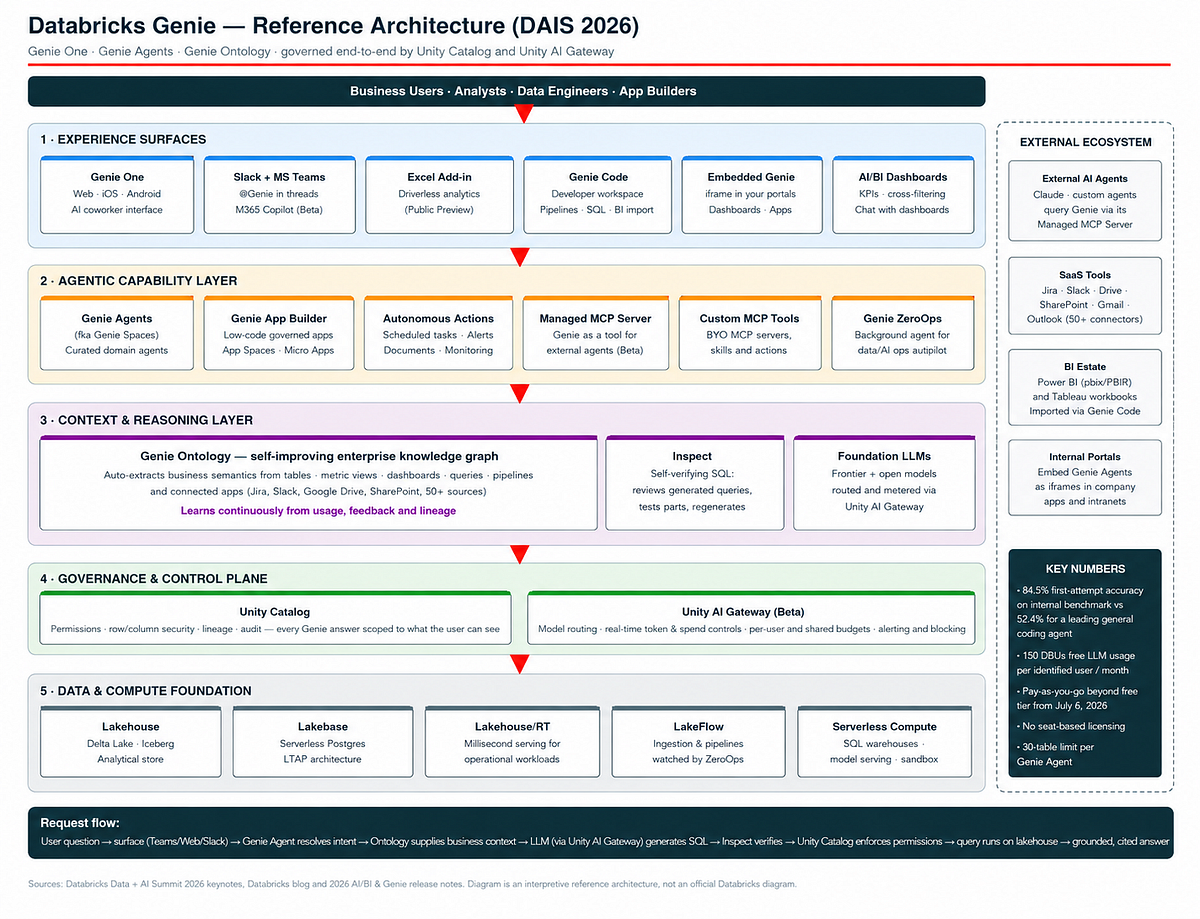
Technical architects diving into Databricks Genie reveal the anatomy of its data-aware AI capabilities—covering Genie One and the underlying Genie Ontology. The system represents a shift toward agentic data engineering, where AI agents autonomously navigate complex data relationships.
Microsoft Azure Certification Update
Azure MLOps Engineer Associate (AI-300) officially replaced Data Scientist Associate (DP-100) as of June 1, 2026, signaling a platform shift toward operations-first ML practices. Azure AI Engineer Associate (AI-102) was similarly sunset June 30, replaced by Azure AI Apps and Agents Developer Associate (AI-103). These changes reflect industry recognition that ML engineering and deployment require distinct skills from pure data science.
Analysis
Data Catalog Fragmentation as Enterprise Pain Point
The emergence of catalog interoperability as a major talking point reveals a critical gap in the data engineering ecosystem. With Databricks pushing its unified catalog and Snowflake maintaining its own catalog system, organizations deploying across both platforms face a dual-metadata problem: each tool claims authoritative ownership of the same data assets, yet neither can seamlessly query or govern the other's catalog.
This fragmentation forces data teams into manual governance workflows—syncing policies, documenting lineage, and managing access controls in two separate systems. As enterprises scale their multi-cloud strategies, the inability to treat catalogs as a unified layer becomes increasingly expensive. The practical implication: expect a surge in metadata orchestration tools and custom governance bridges in the second half of 2026.
MLOps Certification Realignment Signals Operational Maturity
The retirement of pure data science certifications in favor of operations-focused credentials (AI-300) marks a cultural shift. Azure's explicit separation of "AI Apps and Agents Developer" from "MLOps Engineer" acknowledges that deploying and maintaining AI systems requires fundamentally different expertise than building models. This reflects industry reality: most ML failures in production stem from operational issues (monitoring, reproducibility, version control) rather than algorithmic problems.
The implication for hiring and team structure: organizations should expect clearer role delineation, with dedicated MLOps engineers owning deployment, monitoring, and CI/CD pipelines separately from data scientists focused on modeling.
What to Watch
- Metadata orchestration solutions gaining traction as stopgap measures for multi-platform catalog synchronization
- July MLOps tool releases from H2O, Databricks, and cloud providers addressing production reliability improvements
- Enterprise MLOps maturity frameworks emerging from academic research (2025-2026 systematic reviews now becoming industry reference points)
- Agentic data engineering (Genie, LakeFlow) moving from proof-of-concept to early production deployments in Q3 2026
Note on data freshness: This issue covers only developments published or updated between July 1–8, 2026. Older content, even if high-quality, has been excluded per editorial policy.
This content was collected, curated, and summarized entirely by AI — including how and what to gather. It may contain inaccuracies. Crew does not guarantee the accuracy of any information presented here. Always verify facts on your own before acting on them. Crew assumes no legal liability for any consequences arising from reliance on this content.
Powered by
