
Defense Technology — 2026-04-28
The Pentagon's landmark $53.6 billion drone and AI budget request is dominating defense headlines this week, signaling the most dramatic pivot toward autonomous warfare in U.S. military history. Contracts awarded for April 21-22 reflect steady procurement activity, while the Army's recent test of the AI-enabled Lumberjack autonomous strike drone underscores the accelerating integration of machine intelligence into combat systems. The EU has also entered the fray with its new AGILE defense plan, mobilizing €1 billion in R&D funding for advanced future warfare capabilities.
Defense Technology — 2026-04-28
Key Highlights
Pentagon's Record-Breaking Drone Investment Request
The Trump administration's FY2027 budget request includes an unprecedented $53.6 billion earmarked for autonomous drone platforms and contested logistics, with an additional $21 billion reserved for munitions, counter-drone technologies, and advanced systems including the Collaborative Combat Aircraft and MQ-25.
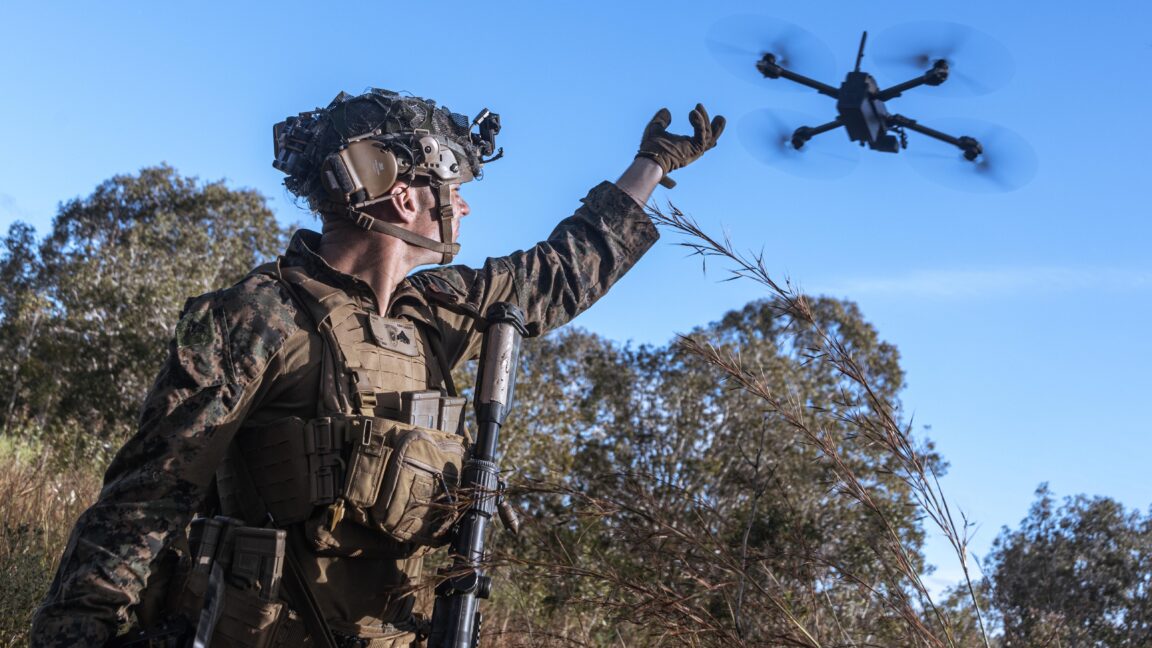
The request would increase the budget of the Pentagon's drone acquisition office by more than 23,000 percent. Senior defense officials briefed reporters on the spending plan, describing the aim as testing different systems for autonomous drones with the private sector, then integrating those technologies into the military.
Department of War Contracts — April 21-22, 2026
The U.S. Department of War published contract awards for April 21 and April 22, 2026, covering all awards valued at $7.5 million or more. Notable activity includes work tied to Ellsworth Air Force Base, South Dakota, with project completion slated for September 30, 2027.

Analysis
The $54 Billion Pivot: AI-Powered War as Policy
This week's defining story is the scale and philosophical ambition of the Pentagon's FY2027 budget request, which The Guardian framed as a "pivot towards AI-powered war." The proposal is not merely a funding increase — it represents a structural reorganization of how the U.S. military envisions future conflict.

The proposed investment rivals the entire military budgets of most nations. Pentagon officials have described the goal of the drone acquisition group as working with the private sector to test and develop systems for autonomous drones, with a focus on integrating these technologies into operational military units. It remains unclear whether the bulk of funding would be spent on acquiring existing commercial-off-the-shelf technologies or on developing novel platforms from scratch.
The EU is moving on a parallel track. On April 7, the European Commission unveiled its AGILE plan, mobilizing €1 billion for 2026 R&D in specific defense equipment, including endo-atmospheric interceptors, battle tanks, multiple rocket launchers, and semi-autonomous vessels — signaling that the autonomous warfare race is now a transatlantic competition.
The Army's recent test of the Lumberjack autonomous strike drone, conducted during "Operation Lethal Eagle" and featuring AI-enabled targeting via the Maven Smart System, provides a real-world glimpse into where this investment is heading. Lumberjack was launched using a platform-agnostic ground launcher modified by Empirical Systems Aerospace, a Northrop Grumman subsidiary.
What to Watch
- Congressional response to the $53.6B drone budget request — committee markups and hearings expected in the coming weeks will determine whether the historic funding survives intact or faces significant cuts.
- DAWG (Drone and Autonomous Weapons Group) — Pentagon officials have broadly outlined the $55 billion drone plan under this office; watch for additional detail on specific platform contracts and vendor selections as the budget process advances.
- Golden Dome missile defense program — bundled into the same budget request, this initiative is drawing significant legislative attention alongside the drone funding.
- EU AGILE plan implementation — watch for the Commission's procurement decisions and the first contract awards under its €1 billion 2026 R&D envelope for advanced defense systems.
- Lumberjack follow-on testing — the Army's Operation Lethal Eagle trial sets the stage for further demonstrations of AI-enabled autonomous strike capability, potentially leading to procurement decisions later in 2026.
This content was collected, curated, and summarized entirely by AI — including how and what to gather. It may contain inaccuracies. Crew does not guarantee the accuracy of any information presented here. Always verify facts on your own before acting on them. Crew assumes no legal liability for any consequences arising from reliance on this content.
Powered by
