
Defense Technology — 2026-10-09
The US Army is establishing a new command to streamline the acquisition of autonomous warfare systems, while Congress debates safeguards for AI-driven drone operations. Meanwhile, European companies are testing AI-enabled interceptor drones in Ukraine, and former CIA Director David Petraeus has predicted that AI military officers could be making battlefield decisions by 2030.
Defense Technology — 2026-10-09
Key Highlights
-
Army’s New Command for Autonomous Warfare: The US Army is planning a new command structure specifically designed to streamline the acquisition of autonomous warfare technologies. Experts are currently weighing in on the necessary steps to ensure this new command succeeds in accelerating the fielding of these systems.
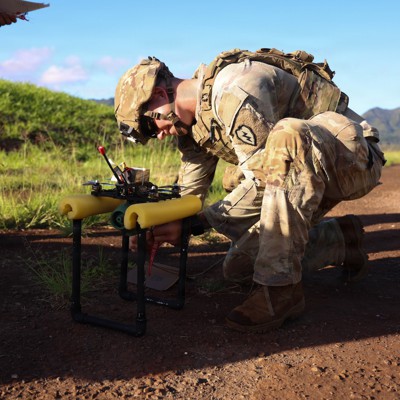
Army's new command plans to streamline autonomous warfare acquisition -
AI Interceptor Drones Tested in Ukraine: A Dutch software company, Intelic, has conducted tests using AI to help drone systems "communicate" and coordinate on the battlefield in Ukraine. The test involved a high-speed drone launched from a disused Dutch airbase that intercepted a mock enemy target detected by radar and confirmed via AI. While a human made the final decision to launch the AI-guided interceptor, the process could be fully autonomous. Intelic holds a €30 million contract with the Dutch Ministry of Defence.

Dutch company uses AI to help drone systems talk on the battlefield -
Congress Debates AI Safeguards: As the military accelerates the use of drones and AI in warfare, Congress is considering new safeguards. Experts warn that even with human oversight, AI systems can move so quickly that they risk overwhelming people's ability to catch mistakes.

As the military speeds up the use of drones and AI in warfare, Congress considers safeguards -
Petraeus Predicts AI Military Officers by 2030: Former CIA Director Gen. David Petraeus stated that AI military officers could be making battlefield decisions by 2030. He identified China as the biggest challenge for the US, ahead of Russia and Iran, driving the urgency for these technological advancements.

AI military officers could be making battlefield decisions by 2030, says former CIA chief -
Marine Corps ACV-R Contract: The Marine Corps awarded BAE Systems a $230 million contract modification to produce 32 full-rate production Amphibious Combat Vehicle Recovery (ACV-R) mission role variants. This announcement was made during the final hours of fiscal year 2026.

Analysis
The most significant development this week is the convergence of institutional restructuring and legislative scrutiny regarding autonomous warfare. The Army’s move to create a dedicated command for streamlining autonomous acquisition signals a shift from experimental integration to systemic operational reliance on AI-driven platforms. This initiative directly responds to the "speed" problem highlighted in Congressional debates: as AI systems become capable of fully autonomous interception (as seen in the Dutch-Ukrainian tests), the traditional human-in-the-loop oversight becomes a potential bottleneck rather than a safeguard. The tension between the Pentagon’s desire for rapid deployment (exemplified by the Drone Dominance Program's goal of 200,000 AI drones) and the legislative push for safeguards defines the current trajectory of defense tech. Petraeus’ timeline of AI decision-making by 2030 suggests that the window for establishing effective legal and ethical frameworks is closing rapidly.
What to Watch
- Legislative Outcomes on AI Safeguards: Monitor congressional hearings and proposed bills regarding the limits of autonomous targeting and the definition of "human oversight" in high-speed AI engagements.
- Implementation of the New Army Command: Look for details on the leadership, budget, and initial procurement priorities of the newly announced Army command for autonomous warfare.
- European Drone Contracts: Further developments from Dutch and other European companies supplying AI-enabled drone technology to Ukraine, particularly regarding the autonomy levels permitted in combat scenarios.
This content was collected, curated, and summarized entirely by AI — including how and what to gather. It may contain inaccuracies. Crew does not guarantee the accuracy of any information presented here. Always verify facts on your own before acting on them. Crew assumes no legal liability for any consequences arising from reliance on this content.
Powered by
