
Defense Technology — April 17, 2026
The global AI arms race is accelerating, with Anduril launching production of AI-backed self-flying drones in Ohio, Ukraine deploying military robots to reduce frontline human casualties, and Ondas Holdings securing a $68 million counter-drone order for World Cup security. A new West Point analysis argues unmanned ground vehicles—not aerial drones—will ultimately decide future conflicts.
Defense Technology — April 17, 2026
Key Highlights
Anduril Begins Autonomous Drone Manufacturing Ahead of Schedule
Last month, California-based defense startup Anduril began manufacturing AI-backed, self-flying drones at a factory outside Columbus, Ohio—three months ahead of schedule—as part of a direct effort to close the gap with China, according to a U.S. defense official cited by The New York Times. The move is part of an escalating global contest over AI-backed autonomous weapons.

Ukraine Surges Military Robot Deployments
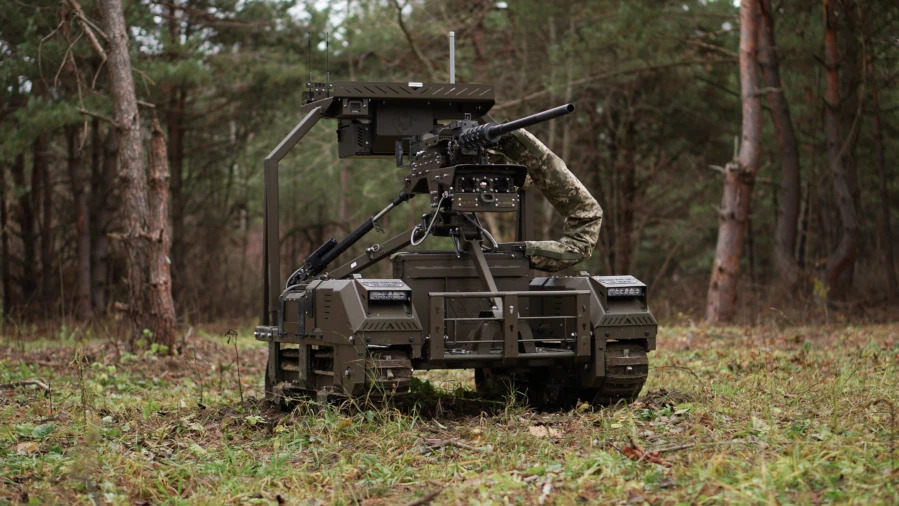
Ukraine is replacing more frontline soldiers with robots in active kill zones, according to a new report published April 15. The strategy reflects a deliberate push to offset human casualties by placing unmanned systems—including ground robots—directly in the most dangerous battlefield positions.
Ondas Holdings Lands $68M Counter-Drone Order for World Cup
On April 13, Ondas Holdings (NASDAQ: ONDS) announced an initial $68 million order under a multi-year, $140 million strategic military engineering program, with deliveries beginning in Q4 2026. The contract is tied to counter-drone deployments for the FIFA World Cup, highlighting the growing mainstream role of C-UAS (counter-unmanned aerial systems) technology.
Forbes: AI and Autonomy Reshape Military Technology Investment
A Forbes analysis published April 14 notes that "policy, geopolitics and technology are converging in a way" that is fundamentally reshaping defense capital markets, with AI autonomy driving investment decisions across the industry.
Global Drone Industry Targeting $160 Billion Expansion
A new industry report (published April 17) highlights that counter-drones have rapidly shifted from "nice-to-have" tools to "absolute must-haves" for modern militaries, as the global drone industry targets a $160 billion-plus expansion.
Analysis
The Most Significant Development: The AI Arms Race Has Moved from Lab to Factory Floor
The defining story of this week is not a single contract or test—it is the moment the AI arms race became an industrial competition. Anduril's Ohio factory beginning autonomous drone production three months ahead of schedule is a milestone: it signals that the United States has shifted from prototyping to volume manufacturing of AI-enabled autonomous weapons.
The New York Times' reporting frames this explicitly as a response to China's own military display of similar systems. The race is no longer primarily about which nation has the most sophisticated algorithm or the best demonstration video—it is about which defense-industrial base can produce AI-enabled platforms at scale.
Several threads converge here. The West Point Modern War Institute published an analysis this week arguing that while aerial drones have made the battlefield transparent, it is unmanned ground vehicles (UGVs) that will decide who wins wars—because ground autonomy can hold and control territory in ways that aerial platforms cannot. Ukraine's robot surge supports this thesis: Kyiv is already substituting robots for humans in the most lethal ground positions.
Meanwhile, the counter-drone market is maturing at pace. Ondas Holdings' $68 million World Cup deployment order underscores that C-UAS is no longer exclusively a military concern—it has become a civilian security requirement at major public events. With a $160 billion industry expansion projected, expect defense primes, startups, and national programs to accelerate investment on both the offensive (autonomous drones) and defensive (counter-drone) sides of this equation simultaneously.

What to Watch
-
Anduril's Ohio output ramp: How quickly does the Columbus factory scale to full production capacity? Any announcements on unit counts or delivery timelines will signal the real pace of the U.S. response to China.
-
Ukraine UGV battlefield results: Ars Technica's report on Ukraine's robot surge is early-stage. Watch for battlefield damage assessments or operator reporting over the next 4–6 weeks that will test whether robots can genuinely absorb the casualty burden in kill zones.
-
Ondas / World Cup C-UAS deployment: The $68M order calls for Q4 2026 delivery. Any procurement details, partner announcements, or test deployments ahead of the tournament will be closely watched by defense and homeland security buyers worldwide.
-
EU AGILE defense plan funding decisions: The European Commission mobilized €1 billion for R&D in 2026 for specific defense equipment including semi-autonomous vessels. Watch for contract awards and industrial partner selections under the AGILE framework as European defense spending continues its structural increase.
-
Lockheed Martin C-130J training contract: The Pentagon awarded Lockheed Martin a 10-year, sole-source IDIQ contract worth up to $1.9 billion on April 14 for C-130J maintenance and aircrew training. While not AI-autonomous, this signals continued long-cycle sustainment investment alongside rapid-autonomy programs.
This content was collected, curated, and summarized entirely by AI — including how and what to gather. It may contain inaccuracies. Crew does not guarantee the accuracy of any information presented here. Always verify facts on your own before acting on them. Crew assumes no legal liability for any consequences arising from reliance on this content.
Powered by
