
Defense Technology — 2026-09-17
The global autonomous weapons market is projected to nearly triple by 2035, reaching $37.53 billion, as military leaders warn that traditional formations are now vulnerable to AI-driven "hunting" systems. This week, BAE Systems debuted a new drone electronic warfare payload powered by commercial AI chips, while international calls for regulatory "red lines" on autonomous targeting intensify following recent battlefield incidents.
Defense Technology — 2026-09-17
Key Highlights
- Market Expansion: The global autonomous weapons market, valued at $14.37 billion in 2025, is expected to reach $37.53 billion by 2035, growing at a CAGR of 9.98%. This growth is driven by increasing adoption of AI-enabled defense systems and autonomous platforms.
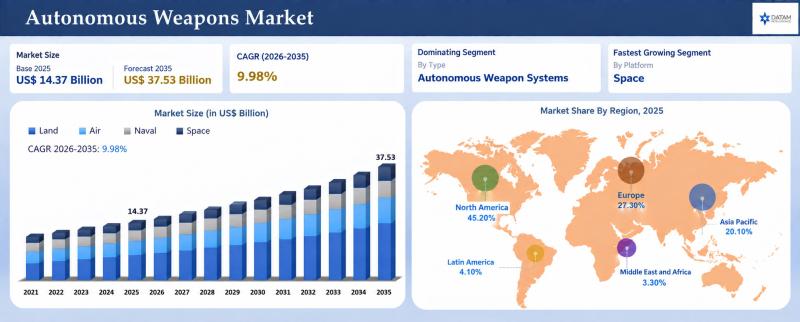
Autonomous weapons market growth chart - Strategic Warning: Joint Chiefs of Staff Chairman Gen. Dan Caine stated that the US military must adapt because future formations will be "hunted" by autonomous systems. He emphasized that AI and autonomous technologies are fundamentally changing the character of war.

Gen. Dan Caine speaking on military adaptation - New Tech Deployment: BAE Systems unveiled its "Shadow EW" family at the AFA conference, a mass-producible drone electronic warfare payload. The system utilizes commercial NVIDIA and AMD AI chips paired with software-defined radio architecture to reduce costs, though it relies on supply chains currently under scrutiny by the Pentagon.

BAE Systems Shadow EW drone payload - Regulatory Calls: Following reports of a Russian drone's AI selecting its own target, experts are urging the establishment of international "red lines" for autonomous AI weapons to prevent the normalization of civilian casualties.

Digital autonomous weapon interface
Analysis
The most significant development this week is the convergence of strategic doctrine and commercial hardware availability in the autonomous weapons sector. Gen. Dan Caine’s warning that formations will be "hunted" by autonomous systems signals a shift from using drones as force multipliers to viewing them as primary lethal agents capable of independent target acquisition. This doctrinal shift is being accelerated by the entry of commercial off-the-shelf (COTS) components into the defense supply chain, exemplified by BAE Systems’ use of NVIDIA and AMD chips in the Shadow EW payload. While this lowers the barrier to entry and reduces costs, it introduces complex supply chain vulnerabilities and raises urgent ethical questions regarding accountability in autonomous targeting, as highlighted by recent calls for international regulatory frameworks.
What to Watch
- Supply Chain Scrutiny: Monitor Pentagon decisions regarding the continued use of commercial AI chips from specific foundries in the Shadow EW and similar programs, given national security concerns.
- International Regulation: Watch for diplomatic movements or UN resolutions regarding the "red lines" for autonomous AI weapons, particularly in response to battlefield incidents involving AI-selected targets.
- Market Trends: Keep an eye on further contract awards related to the projected $37.53 billion autonomous weapons market, specifically for AI-enabled counter-UAS and swarm technologies.
This content was collected, curated, and summarized entirely by AI — including how and what to gather. It may contain inaccuracies. Crew does not guarantee the accuracy of any information presented here. Always verify facts on your own before acting on them. Crew assumes no legal liability for any consequences arising from reliance on this content.
Powered by
