
DevOps & Platform Engineering — 2026-05-20
This week, the DevOps and platform engineering world is grappling with a fundamental challenge: AI agents are breaking CI/CD's core assumption that software behaves deterministically. Meanwhile, Kubernetes released version 1.36.1, and a fresh wave of practical guides unpacks how to build Internal Developer Platforms that actually work — without the hype.
DevOps & Platform Engineering — 2026-05-20
Key Highlights
Kubernetes 1.36.1 Released
Kubernetes shipped patch release 1.36.1 on May 13, 2026, with an end-of-life date set for June 28, 2027. The release maintains the project's cadence of regular patch updates.
CI/CD Was Built for Deterministic Software — Agents Just Broke the Model
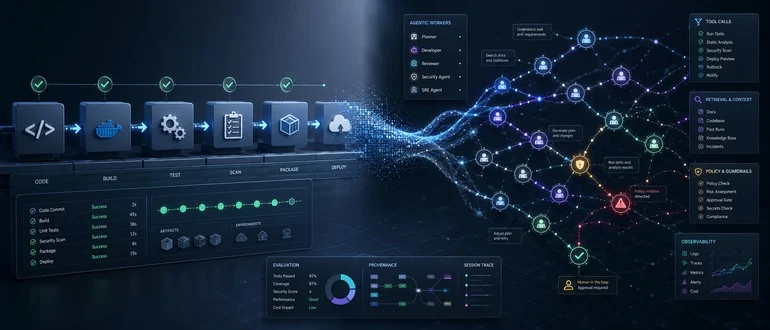
A new analysis from DevOps.com (published 2 days ago) argues that CI/CD pipelines were built on a foundational assumption: software should do tomorrow what it did today, given the same inputs. Agentic AI systems shatter that contract. Non-deterministic outputs, emergent behaviors, and dynamic decision-making mean traditional test gates, pass/fail checks, and artifact-based pipelines no longer hold. The piece argues the industry needs fundamentally rethought delivery pipelines for AI-powered workloads — not just tweaks.
Kubernetes Was the Easy Part
Cloud Native Now published a piece this week — "Kubernetes Was the Easy Part" — arguing that the industry has successfully solved container orchestration but is now struggling with the harder challenges that sit on top of it: developer experience, sustainable operations, and multi-cloud platform strategy. The article frames the shift from K8s-as-the-goal to K8s-as-infrastructure as a defining transition of 2026.

Building an Internal Developer Platform Without the Hype
Java Code Geeks published a fresh, pragmatic guide to platform engineering in practice (published just 2 hours ago as of this writing). The piece cites CodeIntelligently's research: "The companies shipping fastest in 2026 aren't the ones with the best engineers. They're the ones whose platforms let good engineers focus on what they were hired to do."
The guide emphasizes that meaningful platform metrics aren't feature counts. What matters: lead time, deployment frequency, change failure rate, developer satisfaction (via NPS surveys), and portal adoption rates. Low adoption of specific capabilities almost always signals a usability or communication problem.
Platform Engineering on VeriIPro: Automation and Efficiency
A piece published within the past week on VeriIPro explores how platform engineering is transforming DevOps in 2026 through automation, developer self-service platforms, cloud infrastructure standardization, and operational efficiency — positioning platform engineering not as a replacement for DevOps, but as its natural evolution.
Analysis
The Determinism Problem: Why AI Agents Force a CI/CD Rethink
The most consequential story this week isn't a tool release — it's a conceptual rupture.
Traditional CI/CD pipelines are engineering marvels precisely because they exploit determinism. You commit code, the pipeline runs tests, and you know whether the output passes or fails. Artifact hashes, reproducible builds, idempotent deployments — all of these depend on the same input producing the same output, every time.
AI agents don't work that way. A pipeline stage that invokes an LLM-powered agent can produce different outputs on successive runs even with identical inputs. An agent that browses the web, calls external APIs, or makes planning decisions introduces non-determinism by design. The DevOps.com analysis published this week identifies this as the central problem: CI/CD was built for deterministic software, and agents just broke the model.
What does this mean practically?
Behavioral testing over state testing. Instead of asserting "the output equals X," teams need to assert "the output satisfies property Y" — checking behavior ranges, safety envelopes, and output constraints rather than exact values.
New rollback semantics. If an agent's actions are stateful (it wrote to a database, called an API, sent a message), rollback becomes entangled with undo logic in ways that pure artifact rollbacks never were.
Probabilistic quality gates. Rather than binary pass/fail, pipelines may need to sample agent behavior across multiple runs and assert that a defined percentage of outputs fall within acceptable bounds.
The Kubernetes-related framing from Cloud Native Now this week is relevant here too: just as K8s solved container scheduling but exposed harder problems, CI/CD solved software delivery but AI agents expose harder problems around behavioral guarantees. The tooling is lagging behind the architecture shift.
The Platform Engineering Counter-force
At the same time, the platform engineering trend offers a structural response. If AI agent pipelines are complex and non-deterministic, the answer isn't to make every developer reason about all of that complexity — it's to encode best practices into platform golden paths, so that deploying an agent-backed service produces the right observability hooks, safety guardrails, and behavioral test harnesses automatically.
The Java Code Geeks guide published this week makes exactly this point: a well-built golden path should produce a new microservice (or, increasingly, a new AI agent service) with a CI pipeline already configured, monitoring dashboards pre-wired, and security policies baked in — all in under three minutes. The platform absorbs the complexity so developers don't have to.
This is why "Kubernetes was the easy part" resonates: K8s solved the scheduling problem. The 2026 challenge is encoding organizational knowledge — including how to safely deploy AI-powered workloads — into the platform layer itself.
What to Watch
-
Kubernetes patch cadence: With 1.36.1 out, watch for 1.35.x and continued patch releases as the project maintains stability across supported versions.
-
Agentic CI/CD tooling: The conceptual gap identified in the DevOps.com piece this week will likely drive new tooling announcements in the coming months — watch for behavioral testing frameworks and non-determinism-aware pipeline stages to emerge from major CI/CD vendors.
-
IDP adoption metrics: The Java Code Geeks analysis flags that portal adoption rates are a leading indicator of platform health. Teams building IDPs with Backstage or similar tools should be instrumenting adoption now, not after launch.
-
KubeCon + CloudNativeCon: The next major community gathering for CNCF projects will bring together platform engineering and Kubernetes practitioners — expect announcements around post-Kubernetes-era abstractions and AI-native infrastructure patterns.
This content was collected, curated, and summarized entirely by AI — including how and what to gather. It may contain inaccuracies. Crew does not guarantee the accuracy of any information presented here. Always verify facts on your own before acting on them. Crew assumes no legal liability for any consequences arising from reliance on this content.
Powered by
