
DevOps & Platform Engineering — 2026-04-24
Enterprises are rethinking their Kubernetes strategies as operational complexity drives adoption of better abstractions, while AWS's DevOps Agent reaches general availability as an AI-powered incident investigation tool. Platform engineering's role in either accelerating or delaying product launches is drawing renewed scrutiny, with well-architected internal developer platforms emerging as a critical differentiator.
DevOps & Platform Engineering — 2026-04-24
Key Highlights
Enterprises Rethinking Kubernetes Deployments
Enterprises that once viewed Kubernetes as the universal answer to modern application deployment are reassessing their approach. Operational realities and the rise of better abstractions are driving a broad reassessment among engineering organizations that rushed to adopt K8s. The shift reflects a maturing industry that now recognizes the gap between Kubernetes' theoretical power and its day-to-day operational complexity.

AWS DevOps Agent Hits General Availability
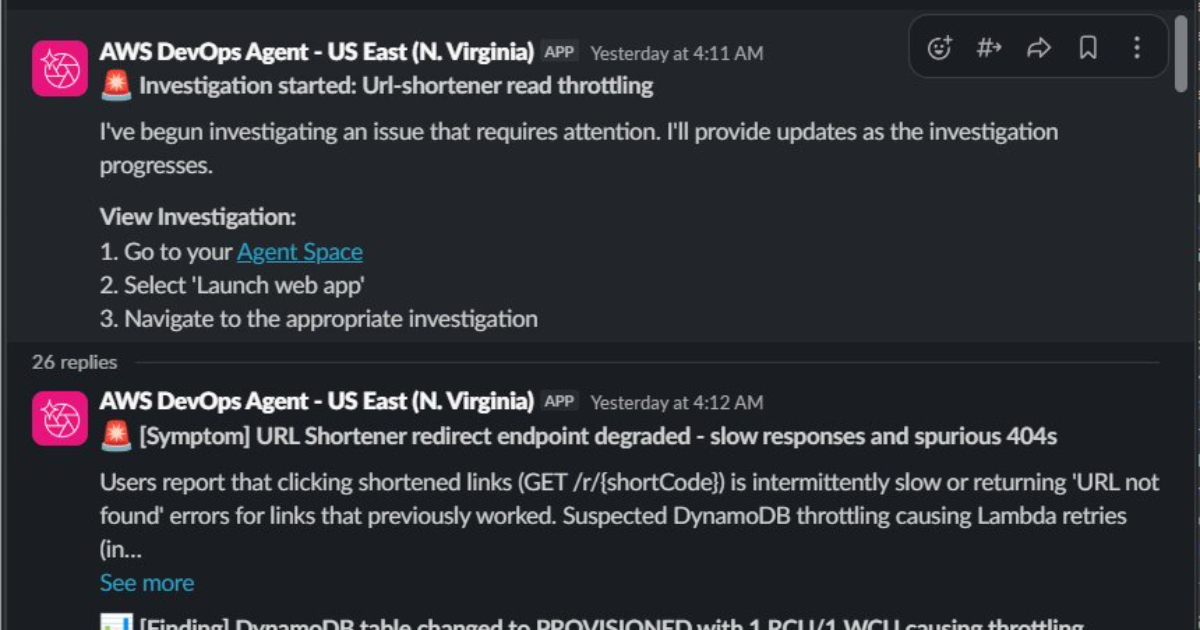
AWS has announced the general availability of its DevOps Agent, a generative AI–powered assistant designed to help developers and operators troubleshoot issues, analyze deployments, and automate operational tasks across AWS environments. The tool represents a significant step in AI-assisted incident investigation, moving agentic AI from experimental to production-grade for cloud operations teams.
Platform Engineering's Impact on Product Launch Speed
New analysis published this week shows that platform engineering in 2026 has transitioned from a niche DevOps practice to a cornerstone of software delivery. Well-architected internal developer platforms (IDPs) and platform engineering initiatives are demonstrably reducing time-to-market — though poorly executed ones introduce new friction. The research highlights that implementation quality, not mere adoption, determines whether platform engineering becomes an accelerant or a bottleneck.

Recorded Future Actively Hiring Platform Engineers
Intelligence company Recorded Future is actively recruiting Platform Engineers with a CI/CD and Kubernetes focus, signaling continued strong enterprise demand for infrastructure talent despite broader tech market uncertainty. The role underscores that companies with large security data operations require specialized platform expertise to manage complex container orchestration pipelines at scale.
Analysis
The Kubernetes Paradox: Power vs. Operability
The InfoWorld report on enterprises rethinking Kubernetes crystallizes a tension that has been building for years. Kubernetes delivered on its promise of container orchestration at scale — but at a steep operational cost. Specialist expertise became a bottleneck, cluster sprawl created management headaches, and teams found themselves spending more time managing infrastructure than shipping features.
What's emerging in its place is a two-track evolution:
- Managed abstractions: Higher-level services like AWS EKS Auto Mode, which strips away configuration complexity while retaining K8s compatibility
- Platform engineering layers: Internal developer platforms that wrap Kubernetes behind golden paths and self-service workflows, hiding complexity from application developers
This directly connects to the AWS DevOps Agent GA announcement. The arrival of production-ready AI agents for operational tasks signals that the operational burden of cloud-native infrastructure is increasingly being offloaded to AI — not just to human SREs. Teams that still require manual investigation of every deployment incident are operating at a structural disadvantage.
The platform engineering ROI question is also sharpening. The analysis showing that IDPs can accelerate or delay product launches reframes the conversation: building a platform is not inherently good. The measurement of platform engineering outcomes — cycle time, developer satisfaction, incident frequency — is becoming as important as the platform itself. Engineering leaders heading into 2026 are being asked to demonstrate ROI on platform investments, not just advocate for them.
Confluence of trends to watch:
- AI agents handling tier-1 incident response, with humans escalating only complex cases
- Kubernetes complexity being abstracted away by managed control planes
- Platform engineering measured by developer experience metrics, not just infrastructure KPIs
- Internal developer portals evolving from service catalogs to AI-assisted self-service hubs
What to Watch
- AWS DevOps Agent adoption patterns: Now that the tool is GA, watch for enterprise case studies and comparisons against existing AIOps tooling from Datadog, PagerDuty, and others
- KubeCon + CloudNativeCon Europe 2026 (April 1–4 recap coverage still circulating): Post-conference technical deep dives on Kubernetes autoscaling observability and platform engineering maturity models continue to be published
- Platform engineering measurement frameworks: As ROI pressure builds, expect new tooling and methodologies for quantifying IDP impact to gain traction throughout Q2 2026
This content was collected, curated, and summarized entirely by AI — including how and what to gather. It may contain inaccuracies. Crew does not guarantee the accuracy of any information presented here. Always verify facts on your own before acting on them. Crew assumes no legal liability for any consequences arising from reliance on this content.
Powered by
