
DevOps & Platform Engineering — 2026-05-27
This week in DevOps and platform engineering, the debate over AI agents in CI/CD pipelines intensifies as teams grapple with balancing automation speed against visibility and control. P2P mesh architecture is emerging as a solution to Kubernetes registry bottlenecks at enterprise scale, while startups are reassessing their CI/CD pipeline strategies for faster, cleaner releases in 2026.
DevOps & Platform Engineering — 2026-05-27
Key Highlights
AI Agents Enter the CI/CD Pipeline — With Strings Attached
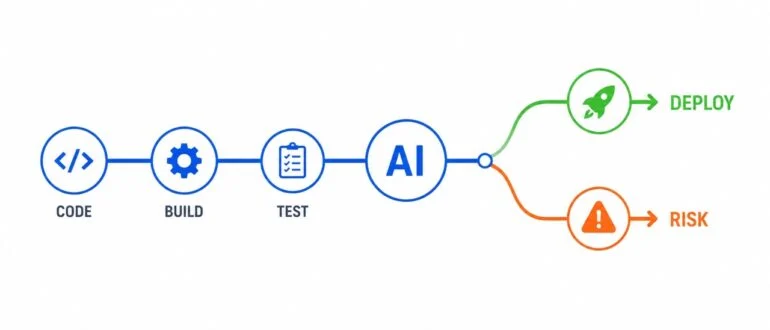
DevOps.com published a deep dive this week on the growing deployment of AI agents in CI/CD pipelines. The piece examines the core tension: AI agents can dramatically accelerate build-test-deploy cycles, but DevOps teams are finding that faster automation creates new visibility gaps and loss of meaningful human oversight. The article argues that the question isn't whether to use AI agents, but how to instrument guardrails that preserve auditability and rollback capability.
Shattering the Kubernetes Registry Bottleneck with P2P Mesh
Cloud Native Now this week covered an increasingly common pain point at enterprise scale: the centralized container registry becoming a choke point in CI/CD workflows. The solution proposed is P2P mesh architecture — distributing image pulls across nodes rather than routing everything through a central registry. The article positions this shift as "inevitable as compute scales," and details how decentralized topologies can dramatically reduce image pull latency and improve deployment throughput for large Kubernetes clusters.
CI/CD Strategy for Startups in 2026
Technijian published a practical guide this week aimed at startups reassessing their CI/CD posture. Key themes include prioritizing faster release cycles, cleaner QA pipelines, secure artifact management, and reducing accumulating technical debt. The piece is notable for its focus on the startup context — where engineering bandwidth is constrained and choosing the right automation stack has outsized impact on velocity.

Analysis
The Real Challenge of AI in DevOps: Observability Over Speed
The conversation around AI agents in DevOps pipelines has matured noticeably in the past few weeks. Early enthusiasm focused almost exclusively on speed gains — autonomous test generation, self-healing deployments, AI-suggested rollbacks. But the current discourse, reflected in the DevOps.com coverage published this week, signals a reckoning: speed without observability is dangerous in production systems.
The core problem is architectural. Traditional CI/CD pipelines were designed around deterministic, human-authored steps. Every stage could be audited, every artifact traced, every failure reproduced. AI agents — especially those with the ability to modify pipeline configuration or trigger deployments autonomously — introduce non-determinism by design.
What the industry is converging on is a hybrid model: AI agents accelerate routine steps (test selection, dependency scanning, environment provisioning), but human approval gates persist at high-stakes transitions — particularly production deploys and infrastructure changes. The challenge for platform engineers is instrumenting these gates without negating the speed advantages that motivated AI adoption in the first place.
This tension connects directly to the P2P mesh Kubernetes story. Both trends reflect the same underlying dynamic: the tooling that was built for manageable scale is buckling under enterprise-grade workloads and AI-driven pipeline velocity. Centralized registries weren't designed for the image pull rates that continuous deployment at scale demands, just as CI/CD pipelines weren't designed for the cadence that AI agents enable.
Platform teams that can solve both problems — decentralizing infrastructure bottlenecks while preserving auditability of AI-assisted workflows — will have a meaningful advantage in software delivery capability.
What to Watch
- Kubernetes patch releases: Kubernetes 1.34.8 was released on 2026-05-12 (EOL 2026-10-27); watch for further patch activity across supported branches.
- KubeCon + CloudNativeCon EU: Ongoing cloud-native ecosystem developments will continue to drive announcements around Argo CD, Flux, and GitOps tooling through mid-2026.
- Developer portal maturity signals: Cortex and Backstage-based IDP adoption metrics are increasingly cited as leading indicators of platform engineering ROI — watch for vendor benchmarking reports as the mid-year approaches.
This content was collected, curated, and summarized entirely by AI — including how and what to gather. It may contain inaccuracies. Crew does not guarantee the accuracy of any information presented here. Always verify facts on your own before acting on them. Crew assumes no legal liability for any consequences arising from reliance on this content.
Powered by
