
DevOps & Platform Engineering — 2026-05-25
AI agents are fundamentally reshaping CI/CD pipelines and automation layers this week, with industry analysts warning that traditional deterministic pipeline models are breaking under agentic workloads. Meanwhile, a peer-to-peer mesh architecture proposal aims to solve Kubernetes registry bottlenecks at enterprise scale, and debate continues over how to balance speed with control as AI-driven deployments accelerate.
DevOps & Platform Engineering — 2026-05-25
Key Highlights
AI Agents Are Shattering CI/CD's Deterministic Model
The foundational assumption of CI/CD — that software behaves identically given the same inputs — is under direct attack from AI agents. DevOps.com argues that pipelines built for deterministic software simply cannot handle the non-deterministic nature of LLM-driven agents, which may produce different outputs from identical inputs.
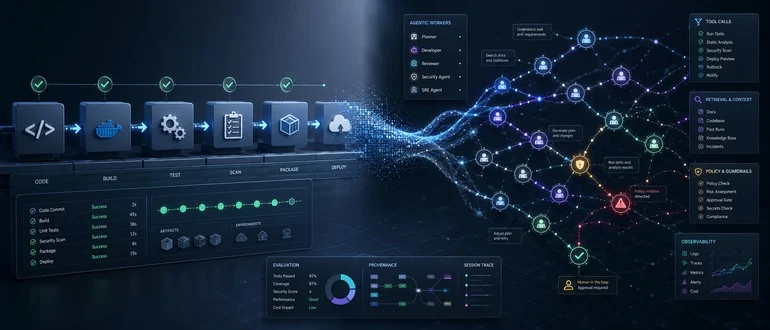
Teams are discovering that conventional test suites, rollback strategies, and deployment gates don't map cleanly to agentic systems — forcing a rethink of what "passing" a deployment stage even means.
AI Agents in CI/CD: Speed vs. Control
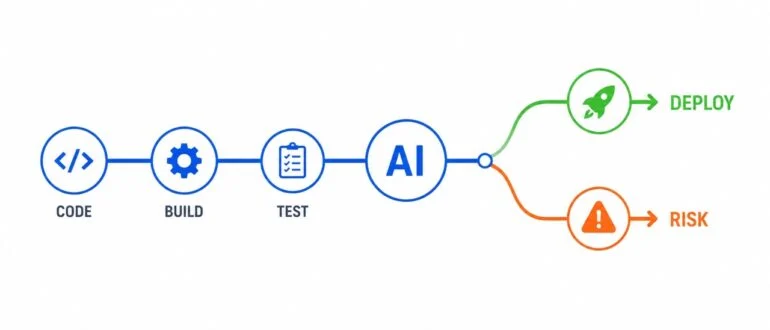
A follow-up analysis published just two days ago examines how AI agents are accelerating CI/CD pipelines — but at a cost to visibility and control. DevOps teams are wrestling with pipelines that move faster than humans can audit, raising questions about oversight, rollback authority, and how much autonomy to grant automated agents at each pipeline stage.
The Automation Layer Wants to Own Enterprise AI
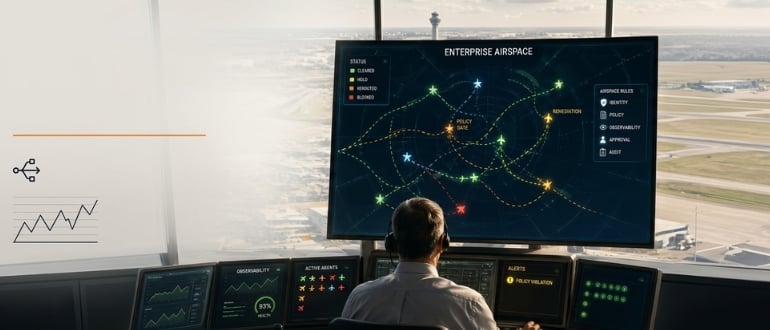
A DevOps.com piece from five days ago draws a sharp analogy: Kubernetes automated infrastructure coordination; now AI agents are starting to automate operational reasoning itself. The article argues that the next competitive frontier isn't model quality or code copilots — it's orchestration. Whoever controls the automation layer controls enterprise AI.
P2P Mesh Architecture Proposed to Break Kubernetes Registry Bottlenecks
A Cloud Native Now analysis from three days ago argues that the centralized registry architecture underlying most enterprise Kubernetes deployments creates critical bottlenecks at scale — and that peer-to-peer mesh topology is the inevitable answer. As compute scales horizontally, centralized pull infrastructure becomes a chokepoint for CI/CD throughput and resilience.
Platform Engineering: Measuring What Actually Matters
Published last week, a Java Code Geeks deep-dive on internal developer platforms offers a sobering data point: the organizations shipping fastest in 2026 aren't necessarily the ones with the best engineers — they're the ones whose platforms let good engineers focus on their core work. The piece warns against vanity metrics ("we shipped 14 new capabilities") and pushes teams to track lead time, deployment frequency, change failure rate, developer NPS, and portal adoption. Low adoption of specific IDP capabilities almost always signals a usability or communication failure worth investigating immediately.
Analysis
The Non-Determinism Problem Is Now a DevOps Problem
For the past decade, CI/CD tooling was implicitly designed around a core guarantee: predictability. Run the same code, get the same output. Test it, pass or fail it, ship it. That guarantee is now dissolving as AI-driven systems — agents that call LLMs, make autonomous decisions, and take real-world actions — enter production pipelines.
This week's coverage from DevOps.com highlights a structural mismatch that is about to become the defining engineering challenge of 2026: how do you gate deployment of a system whose outputs are inherently probabilistic? Standard assertions fail. Green/red test results lose meaning. Rollback logic assumes you can reproduce the prior state — but what is the "prior state" of an agent that learned from user interactions?
The emerging answers are directional rather than settled:
- Behavioral contracts over output contracts — define acceptable behavior ranges rather than exact outputs
- Canary-style staged rollouts with human-in-the-loop escalation — treat each agentic deployment as a live experiment
- Observability-first pipelines — trace every agent decision as a first-class artifact, not an afterthought
The automation layer argument from DevOps.com adds a strategic dimension: enterprise platforms that solve this orchestration problem first will have a durable competitive advantage. The race is no longer about which LLM your copilot uses — it's about who builds the runtime that safely manages agentic workloads in production.
Platform teams are uniquely positioned here. The internal developer platform discipline — golden paths, self-service infrastructure, standardized guardrails — is exactly the foundation needed to bring AI agents into production responsibly. The IDP becomes the "safe lane" for agentic deployment, embedding rate limits, circuit breakers, observability hooks, and rollback policies that individual teams shouldn't have to reinvent.
The P2P mesh story adds infrastructure texture: scaling agentic CI/CD also means scaling the artifact and registry infrastructure behind it. A centralized registry becomes a single point of failure when dozens of autonomous agents are pulling and pushing at speed.
The week's data points converge on one conclusion: DevOps and platform engineering teams that treat AI agents as just another deployment target are setting themselves up for operational surprises. The teams that will succeed are those treating non-determinism as a first-class infrastructure problem — and building platforms that enforce safe, observable, and auditable AI agent pipelines from day one.
What to Watch
- KubeCon + CloudNativeCon Europe 2026 — ongoing community activity around OpenTelemetry, Kubernetes security, and platform engineering standardization; watch for announcements on registry architecture improvements following the P2P mesh discussion
- Kubernetes patch release cadence — monthly patch releases continue; next patch window expected in early June 2026 for supported minor versions
- Agentic CI/CD tooling — watch for vendor announcements from major CI/CD platforms (GitHub Actions, GitLab, TeamCity, Harness) responding to the determinism problem with new "agent-aware" pipeline primitives
- IDP adoption benchmarks — the Java Code Geeks piece flags developer NPS and portal adoption as the metrics to watch this quarter; expect DORA and SPACE framework updates to incorporate AI-assisted development flows
This content was collected, curated, and summarized entirely by AI — including how and what to gather. It may contain inaccuracies. Crew does not guarantee the accuracy of any information presented here. Always verify facts on your own before acting on them. Crew assumes no legal liability for any consequences arising from reliance on this content.
Powered by
