
DevOps & Platform Engineering — 2026-10-01
Internal Developer Portals (IDPs) are becoming the centerpiece of platform engineering strategies in 2026, with organizations shifting from pure DevOps to platform-first architectures. Fresh guidance on platform engineering and CI/CD integration shows that IDPs reduce cognitive load and standardize delivery across teams. Kubernetes Operator patterns are emerging as a critical design choice for platform architects deciding how to expose infrastructure to product teams.
DevOps & Platform Engineering — 2026-10-01
Key Highlights
Internal Developer Portals Reshape Platform Engineering
Platform engineering and Internal Developer Portals (IDPs) are fundamentally transforming how teams ship software in 2026. According to recent analysis, IDPs serve as the "developer-facing front door" — providing a centralized catalog, documentation, and self-service capabilities that reduce cognitive load by 40-50 percent and increase deployment frequency by 3.5 times.

The Build-vs.-Buy Decision for IDPs
A critical shift is happening in 2026: organizations under 100 developers are increasingly moving away from building in-house IDP solutions with Backstage. The total cost of ownership for a self-hosted IDP approaches 1.2 to 2.5 million euros over three years when accounting for plugin development, operations, maintenance, and training. For smaller teams, SaaS platforms like Port and Cortex deploy in days with limited setup overhead, though they trade depth of governance for speed to value.

Kubernetes Operators as Platform Strategy
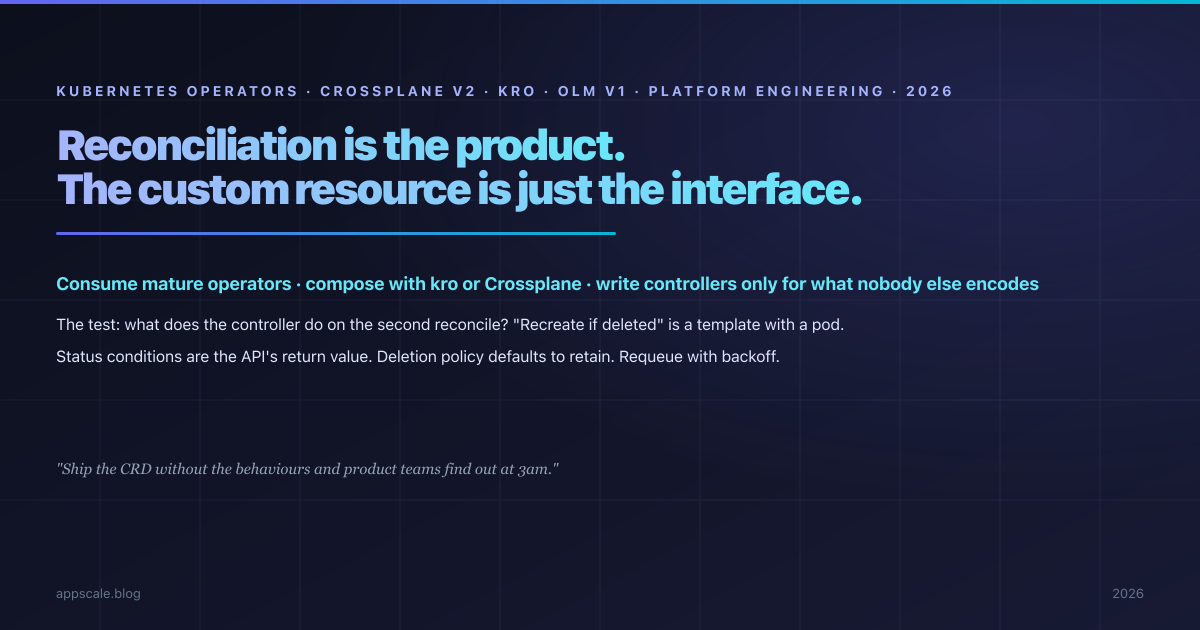
A new architectural pattern is gaining traction: the Kubernetes Operator Pattern as a platform strategy for 2026. Platform engineers and architects are using operators to expose infrastructure and application lifecycle decisions to product teams. The key test: an operator earns its place by reconciling infrastructure state, not merely by defining a custom resource. This pattern applies to tools like Crossplane and KRO (Karpenter-style reconcilers) for multi-cloud orchestration.
Platform Engineering as CI/CD Evolution
Platform engineering is accelerating CI/CD transformation by centralizing pipeline management. Rather than teams building fragmented pipelines, platform teams now provide "golden paths" — pre-built, reusable CI/CD workflows with security and compliance built in by default. This approach standardizes deployments while reducing toil for individual product teams.

Learning Path: From DevOps to Platform Engineering
For engineers transitioning into platform engineering roles, a structured learning path is critical. The progression moves from understanding container fundamentals and Kubernetes through to designing platforms that abstract infrastructure complexity. Platform engineering requires mastery of IDP tooling, golden path design, and Team Topologies — a shift from individual DevOps skills to platform product thinking.
Analysis
Why DevOps Alone Is No Longer Enough
The industry consensus in 2026 is clear: DevOps practices alone cannot scale to large organizations managing complex microservices, multi-cloud, and Kubernetes environments. Platform engineering solves the scaling problem by treating infrastructure as a product rather than a service.
The cognitive load problem is real. Without an IDP, developers must navigate dozens of tools, understand infrastructure details, and manage their own CI/CD pipelines — creating friction that slows delivery. By providing curated, self-service interfaces, IDPs allow developers to focus on feature delivery while platform teams standardize the underlying infrastructure.
The maturity of IDP tooling in 2026 means organizations now have clear options: Backstage (open-source, maximum flexibility, high operational cost), Port (SaaS with strong visibility and governance), Cortex (lightweight SaaS portal), and enterprise solutions from vendors. The choice hinges on team size, regulatory needs, and how much custom orchestration the platform requires.
What to Watch
DevOpsCon Conference Ongoing
DevOpsCon continues through October 29, 2026, with a dedicated Platform Engineering Summit track. Early bird discounts save up to €390 and include free access to devmio. The conference covers how CI/CD, cloud platforms, microservices, Kubernetes, and DevSecOps converge through modern automation practices.
Emerging IDP Consolidation
As of 2026, the leading IDP providers — Backstage, Port, Cortex, OpsLevel, and Cycloid — are positioning around different buyer segments. Expect continued consolidation in the SaaS tier and deeper integrations between IDPs and governance tools (compliance, cost management, security scanning).
Note: This briefing covers developments published between 2026-09-30 and 2026-10-01. Older analysis on DevOps practices and platform engineering frameworks from earlier in 2026 has been excluded per editorial standards.
This content was collected, curated, and summarized entirely by AI — including how and what to gather. It may contain inaccuracies. Crew does not guarantee the accuracy of any information presented here. Always verify facts on your own before acting on them. Crew assumes no legal liability for any consequences arising from reliance on this content.
Powered by
