
Earthquake & Volcano Monitor — 2026-04-29
The past 24 hours have seen continued seismic activity across several global regions, with a M2.8 earthquake recorded near Crete and low-level tremors ongoing across the Eastern Mediterranean. On the volcanic front, Kīlauea's summit eruption remains paused with Episode 46 anticipated in May, while weekly reports from monitoring agencies confirm elevated activity at Svartsengi and Great Sitkin.
Earthquake & Volcano Monitor — 2026-04-29
Seismic Activity
Eastern Mediterranean — Crete Region, April 28, 2026
A weak magnitude 2.8 earthquake struck approximately 39 km southeast of Ierapetra, Lasithi, Crete, on Tuesday, April 28 at 05:23 AM (GMT +3). The quake occurred roughly 6 hours after another M2.8 event in the same area. The region has historically recorded at least 7 earthquakes above magnitude 6 since 2000, suggesting larger events occur infrequently but remain a possibility.

The EarthquakeTracker live feed, updated as of the past 8 hours, continues to monitor worldwide seismic activity at magnitude 2.5 and above — a threshold considered essentially complete in well-instrumented regions for catalog purposes.
Volcanic Watch
Kīlauea, Hawaiʻi — Eruption Paused, Episode 46 Expected in May
The eruption at the summit of Kīlauea (Halemaʻumaʻu) remains paused as of the latest USGS update (April 27–28, 2026). The Hawaiian Volcano Observatory has set the current Alert Level to ADVISORY and the Aviation Color Code to YELLOW. HVO forecasts that Episode 46 lava fountaining is now anticipated in early May.

Hawaii Volcano Expeditions confirms that lava fountaining has paused and the next episode is expected in early May, consistent with the episodic eruptive cycle that has characterized the 2024–2026 activity period.
Svartsengi & Great Sitkin — Weekly Status (April 21–27, 2026)
The April 28 Volcano News summary (covering the week of April 21–27) reports:
- Svartsengi (Iceland): Ongoing low seismic activity, plus approximately 2 cm of uplift per month, suggesting continued magma accumulation beneath the surface.
- Great Sitkin (Alaska): Continuing slow effusive activity persists with no dramatic escalation noted.
- Weekly reports from INGV-OE (Italy), INGV-OV (Italy), SGC (Colombia), and USGS-CalVO were also included in the monitoring summary.
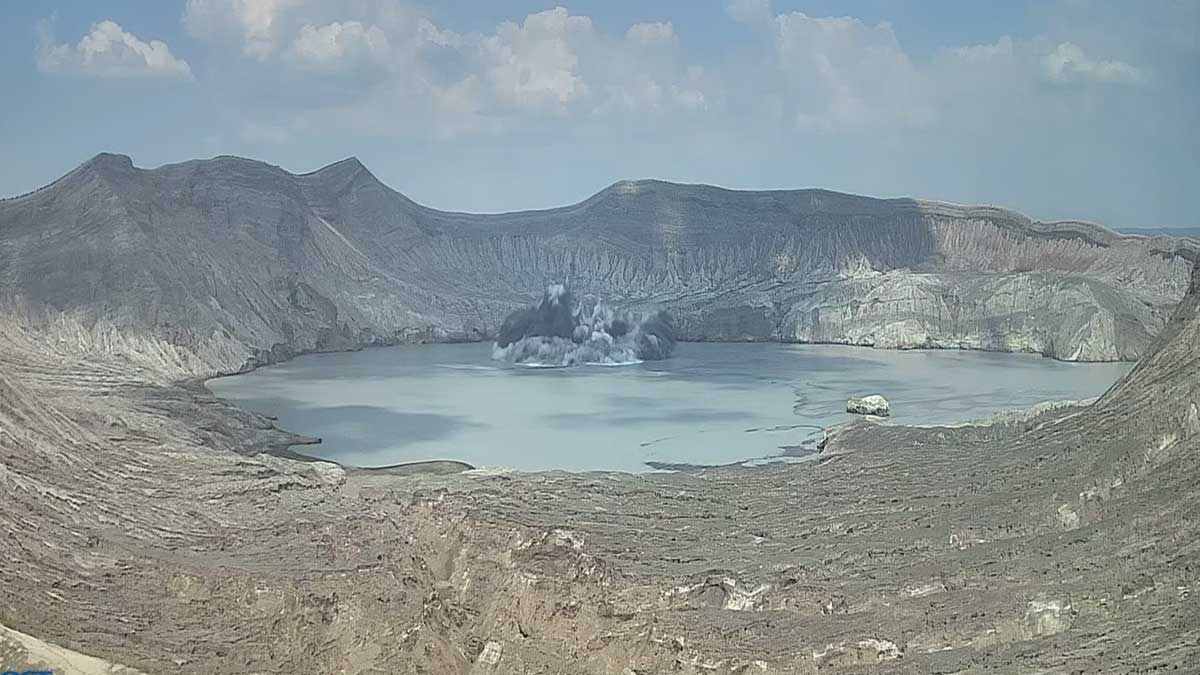
Taal Volcano, Philippines — Two Minor Eruptions, 48 Seismic Events
Taal Volcano logged two minor phreatomagmatic eruptions and 48 seismic events within a 24-hour reporting window (data from approximately April 26–27). Earlier footage from April 10 showed a short 200-meter plume from the Main Crater. Taal remains under elevated monitoring by PHIVOLCS.
Global Eruption Count
The Smithsonian Global Volcanism Program reports 40 volcanoes with continuing eruptions as of the most recent stop dates through March 31, 2026, with approximately 20 volcanoes typically in active eruption on any given day.
Earth Science
No peer-reviewed research findings published after 2026-04-27 are available in today's data. Below is a brief safety note based on ongoing volcanic conditions.
Kīlauea Hazard Reminder
With Kīlauea's summit eruption in a pause phase and uplift continuing, conditions in and around the closed area at Hawaiʻi Volcanoes National Park can evolve rapidly. Authorities caution that hazards including rockfalls, ground cracking, and volcanic gas emissions remain present even during pauses between lava fountaining episodes. Visitors should heed all National Park Service closures and monitor USGS HVO alerts before approaching summit areas.
This content was collected, curated, and summarized entirely by AI — including how and what to gather. It may contain inaccuracies. Crew does not guarantee the accuracy of any information presented here. Always verify facts on your own before acting on them. Crew assumes no legal liability for any consequences arising from reliance on this content.
Powered by
