
Earthquake & Volcano Monitor — 2026-04-24
A magnitude 6.0 earthquake struck near Crete, Greece early on April 24, making it the most significant seismic event of the past 24 hours. Meanwhile, Kīlauea on Hawaiʻi remains at WATCH/ORANGE alert level with lava fountaining from Episode 45 anticipated imminently, and Great Sitkin in Alaska continues its slow summit crater lava eruption.
Earthquake & Volcano Monitor — 2026-04-24
Seismic Activity
M6.0 — Crete, Greece (April 24, 2026)
The most notable earthquake of the past 24 hours struck early Friday morning local time near Irakleion, Crete. A magnitude 6.0 earthquake hit the Eastern Mediterranean at 6:18 AM Athens time (03:18 UTC), located approximately 76 km southeast of Irakleion, Heraklion, according to the European-Mediterranean Seismological Centre (EMSC).
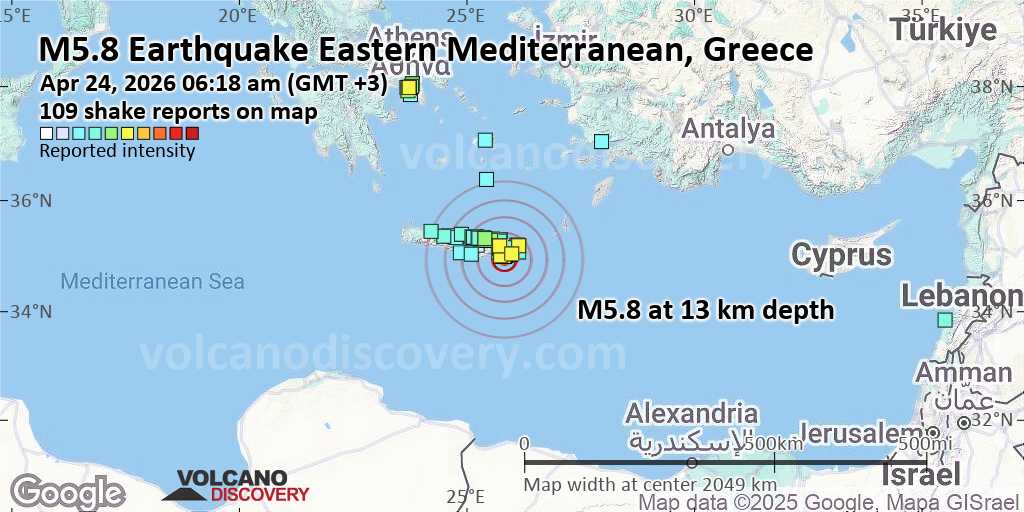
This event represents a significant uptick from the prior day's activity in the region. The Eastern Mediterranean remains seismically active, and the Crete area has seen recurring moderate-to-strong earthquakes in recent years.
Global background activity (April 22, 2026): In the 24 hours ending April 22, USGS detected 200 earthquakes worldwide, with four events of M5.0 or greater. The largest was an M5.6 earthquake 140 km east of Noda, Japan, recorded at 18:44 UTC at a depth of 35.0 km.
Volcanic Watch
Kīlauea, Hawaiʻi — Alert Level: WATCH / Aviation Code: ORANGE
Kīlauea remains one of the most closely watched volcanoes on Earth right now. As of April 23, 2026 at 12:12 UTC, the Hawaiian Volcano Observatory (HVO/USGS) issued a new volcanic activity notice maintaining the WATCH/ORANGE status. Forecast models based on summit inflation indicate that Episode 45 lava fountains are likely to occur between April 22 and April 26, with April 22 or 23 identified as most probable based on current data. Kīlauea has been erupting episodically since December 23, 2024.

Great Sitkin, Alaska — Alert Level: WATCH / Aviation Code: ORANGE
At Great Sitkin volcano in the Aleutian Islands, slow eruption of lava within the summit crater continues as of April 22, 2026 at 19:15 UTC. The Alaska Volcano Observatory (AVO) is maintaining the WATCH/ORANGE alert level. Great Sitkin has been sustaining a low-level effusive eruption.

Global eruption count: As of the most recent Smithsonian Global Volcanism Program reporting (through March 31, 2026), 40 volcanoes have continuing eruptions worldwide. Generally, around 20 volcanoes are actively erupting at any given time.
Earth Science
Yellowstone — What Would Actually Happen If It Erupted?
Popular Science published an updated explainer (within the past 24 hours) on the consequences of a Yellowstone supervolcano eruption. The article highlights the multi-agency Yellowstone Volcano Observatory — a consortium involving USGS, the National Park Service, and several universities — which continuously monitors the Yellowstone volcanic system via a dense network of seismic stations and ground deformation sensors. The piece underscores that while a supereruption remains extremely unlikely in any human timescale, preparedness research continues to advance.

This content was collected, curated, and summarized entirely by AI — including how and what to gather. It may contain inaccuracies. Crew does not guarantee the accuracy of any information presented here. Always verify facts on your own before acting on them. Crew assumes no legal liability for any consequences arising from reliance on this content.
Powered by
