
Earthquake & Volcano Monitor — 2026-05-30
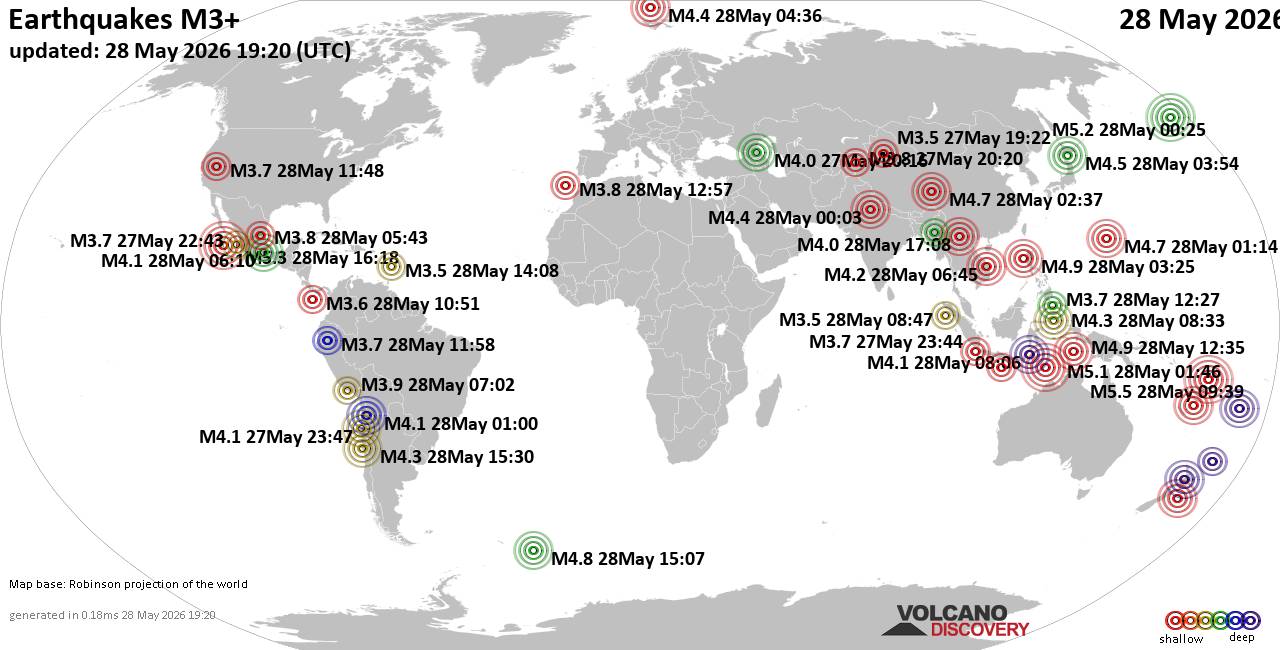
Mayon volcano in the Philippines continued active eruptions on May 29, with ash advisories issued by Tokyo's VAAC. Great Sitkin in Alaska reported ongoing lava extrusion within its summit crater at ORANGE alert level. Mount Merapi in Indonesia produced lava avalanches reaching 1,900 meters, while global seismic activity included a magnitude 5.3 quake near the Revillagigedo Islands on May 28.
Earthquake & Volcano Monitor — 2026-05-30
Seismic Activity
A magnitude 5.3 earthquake struck near the Revillagigedo Islands on May 28, 2026 at 16:18 UTC, originating approximately 10 kilometers below the surface and classified as shallow crustal activity.
Greece recorded a weak magnitude 2.5 earthquake in the Ionian Islands, 32 kilometers south of Preveza on May 29, 2026 at 12:11 am GMT +3.
Volcanic Watch
Mount Mayon (Luzon Island, Philippines) continued eruption activity on May 29, 2026. The Volcanic Ash Advisory Center Tokyo (VAAC) issued an advisory at 04:24 UTC reporting an eruption with ash cloud of unknown altitude.

Great Sitkin Volcano (Alaska) remains at ORANGE alert level and WATCH status as of May 29, 2026. The U.S. Geological Survey Alaska Volcano Observatory reported slow eruption of lava continuing within the summit crater with associated low-level seismicity.
Mount Merapi (Indonesia) produced lava avalanches reaching 1,900 meters elevation as part of ongoing effusive activity documented in May 29 volcano news summaries.
Dukono Volcano (Indonesia, Sulawesi) issued a Volcanic Ash Advisory on May 28 with ash reported to flight level 7,000 feet (2,100 meters).
Kīlauea (Hawaii) remains at ADVISORY alert level with YELLOW aviation color code, with the Halemaʻumaʻu eruption currently paused.
Earth Science
Recent research published May 29, 2026 revealed why large earthquakes don't always trigger volcanic eruptions. Scientists studying two active volcanoes discovered unexpected patterns in volcanic response following seismic events, showing that earthquakes and volcanic activity operate through independent mechanisms that scientists are only beginning to fully understand.
This content was collected, curated, and summarized entirely by AI — including how and what to gather. It may contain inaccuracies. Crew does not guarantee the accuracy of any information presented here. Always verify facts on your own before acting on them. Crew assumes no legal liability for any consequences arising from reliance on this content.
Powered by
