
Earthquake & Volcano Monitor — 2026-06-06
Multiple volcanoes showed heightened activity this week, with Popocatépetl producing 186 exhalations, Suwanosejima sending ash 900 meters high, and Taal experiencing a minor phreatic eruption. Great Sitkin continues a slow lava effusion with low-level seismicity. Meanwhile, a magnitude-6.2 earthquake struck near Valparaíso, Chile on June 1st, and today's global earthquake count reached 210 worldwide with the largest at magnitude 5.2.
Earthquake & Volcano Monitor — 2026-06-06
Seismic Activity
A magnitude 6.2 earthquake struck approximately 22 km southwest of Valparaíso, Chile on June 1, 2026, at 22:12 UTC, marking a significant seismic event in the South Pacific region.
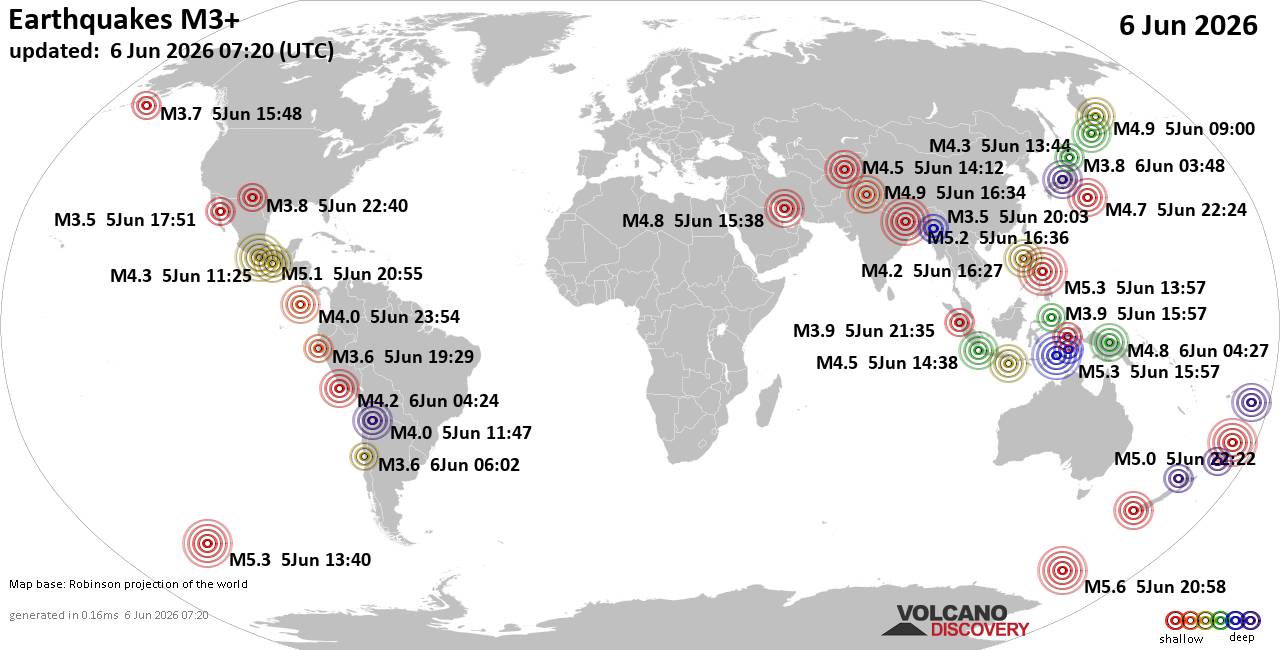
As of June 5-6, 2026, approximately 210 earthquakes were recorded worldwide, with the largest measuring magnitude 5.2.
The USGS continues to monitor seismic activity across multiple regions globally through its Earthquake Hazards Program.
Volcanic Watch
Popocatépetl (Mexico) demonstrated remarkable activity on June 5, 2026, with 186 exhalations recorded during a 24-hour observation period.
Suwanosejima (Japan) produced an ash plume rising 900 meters above the volcano, indicating sustained eruptive output.
Taal Volcano (Philippines) experienced a minor phreatic eruption lasting approximately 4 minutes, classified as low-level unrest (Alert Level 1) as of June 6, 2026. The volcano also recorded 4 volcanic tremors ranging from 2 to 194 minutes in duration during the 24-hour observation window.
Kanlaon Volcano (Philippines) escalated to Alert Level 2 (Increased Unrest) during the same observation period.
Great Sitkin (Alaska) continues a slow eruption of lava within its summit crater with associated low-level seismicity. The volcano remains at WATCH alert level with an ORANGE Aviation Color Code as of June 5, 2026, 19:45 UTC.

Kīlauea (Hawaii) is not currently erupting; the summit eruption in Halemaʻumaʻu remains paused as of June 5, 2026. The volcano maintains a YELLOW Aviation Color Code.

Earth Science
Volcanic gas emissions during active eruptions include water vapor (H₂O), carbon dioxide (CO₂), and sulfur dioxide (SO₂), continuously released from magmatic systems.
The USGS Hawaiian Volcano Observatory continues to provide real-time monitoring and daily updates on volcano activity across the Pacific region and beyond.
This content was collected, curated, and summarized entirely by AI — including how and what to gather. It may contain inaccuracies. Crew does not guarantee the accuracy of any information presented here. Always verify facts on your own before acting on them. Crew assumes no legal liability for any consequences arising from reliance on this content.
Powered by
