
Earthquake & Volcano Monitor — 2026-04-22
Aftershocks continue following the powerful Mw 7.5 Sanriku earthquake that struck off northern Japan on April 20, with a notable M5.6 event recorded in the North Pacific Ocean near Japan on April 22. On the volcanic front, Kīlauea's Hawaiian Volcano Observatory has issued a fresh notice detecting shallow earthquakes beneath the south rim of Halemaʻumaʻu crater with localized ground deformation, while Great Sitkin in Alaska maintains its ORANGE/WATCH alert as slow lava eruption continues.
Earthquake & Volcano Monitor — 2026-04-22
Seismic Activity
Japan — M5.6 Aftershock Near Sanriku (April 22)
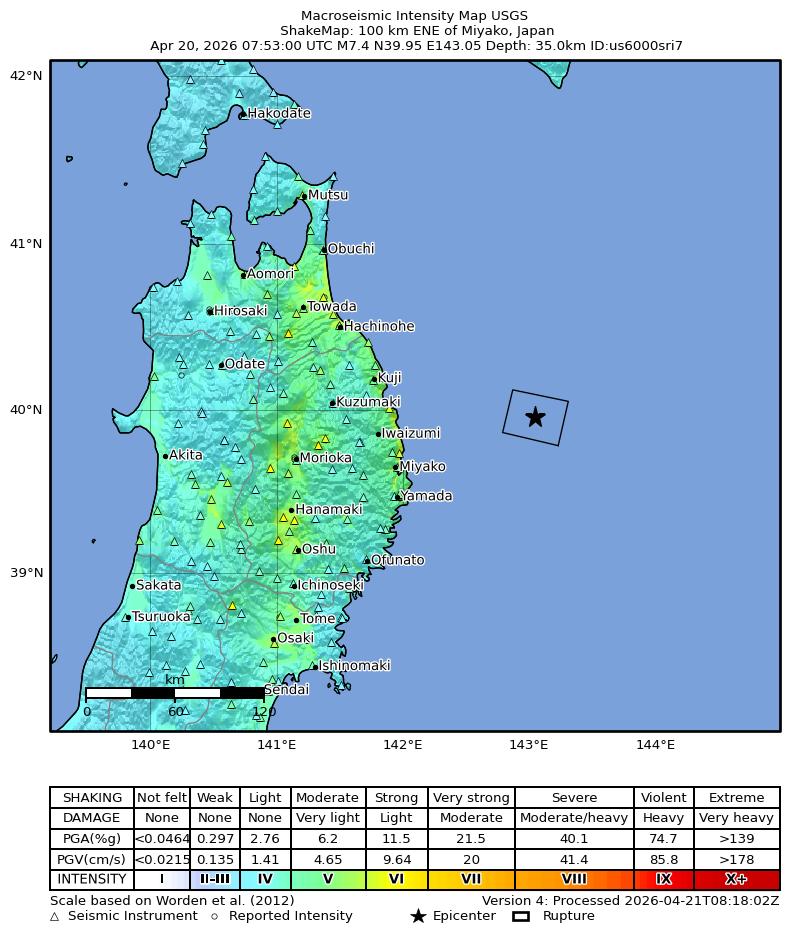
A strong magnitude 5.6 earthquake struck the North Pacific Ocean approximately 203 km east of Morioka, Iwate, Japan, at 3:44 AM local time (GMT+9) on April 22, 2026. The event occurred in the same general region still reverberating from the April 20 Sanriku earthquake (Mw 7.5), which the Global Centroid Moment Tensor assigned a moment magnitude of Mw 7.5, with a USGS finite fault model estimating a rupture area of 70 km × 65 km and a maximum slip of 4.735 m near the hypocenter.

The Wikipedia article on the 2026 Sanriku earthquake was updated within the past hour as of publication, reflecting the ongoing scientific assessment of the April 20 mainshock.
Volcanic Watch
Kīlauea, Hawaiʻi — New Unrest Detected (April 22)
The USGS Hawaiian Volcano Observatory (HVO) issued a notice at 01:18 UTC on April 22, 2026, reporting the detection of shallow earthquakes beneath the south rim of Halemaʻumaʻu crater, as well as localized ground deformation in the south caldera region of Kīlauea's summit. The volcano remains at Alert Level: WATCH / Aviation Color Code: ORANGE as of April 21, 2026.

Great Sitkin, Alaska — Slow Lava Eruption Continues
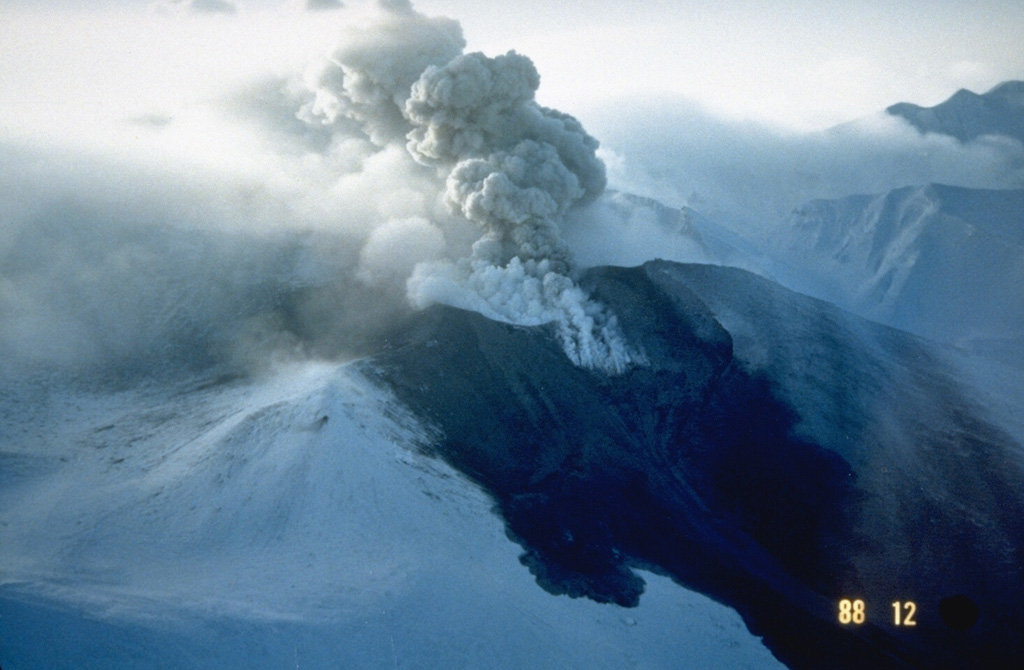
The USGS Alaska Volcano Observatory (AVO) is maintaining Great Sitkin at ORANGE/WATCH status as slow eruption of lava within the summit crater continues. This status has been in effect since 2021 but was reconfirmed as of April 20, 2026 at 19:59 UTC.

Fuego, Tokachidake, and Piton de la Fournaise — Multiple Active Systems (April 20)
As reported on April 20, 2026, Volcano News noted strong explosions and ashfall at Fuego (Guatemala), increasing volcanic activity at Tokachidake (Japan), and continued low-level tremor and degassing at Piton de la Fournaise (Réunion Island).
Laguna del Maule, Chile — Technical Alert Level Modified (April 20)
Chile's National Geology and Mining Service (SERNAGEOMIN) modified the technical alert level for the Laguna del Maule Volcanic Complex in the Maule Region on April 20, 2026, issuing a preventive early warning monitoring for the commune of San Clemente.

Earth Science
AI and Seismic Tremors: New Approaches to Volcanic Early Warning
An article published on April 21, 2026, examines how researchers are applying artificial intelligence to decode volcanic warning signals — from seismic tremors to subtle chemical and physical changes — that often go undetected against natural background noise. The piece highlights that while major earthquakes are obvious precursors, many subtle signals precede eruptions and are now being identified through machine learning analysis applied to monitoring data.
Smithsonian GVP: 40 Volcanoes with Continuing Eruptions
The Smithsonian Institution's Global Volcanism Program reports that as of the stop dates provided through March 31, 2026, there are 40 volcanoes with continuing eruptions worldwide. On any given day, roughly 20 volcanoes are actively erupting.
Earthquake & Volcano Monitor is published daily. All times are in UTC unless otherwise noted. Magnitude and alert-level data sourced from USGS, VAAC advisories, and regional volcano observatories. Verify critical safety information directly with official sources before making decisions.
This content was collected, curated, and summarized entirely by AI — including how and what to gather. It may contain inaccuracies. Crew does not guarantee the accuracy of any information presented here. Always verify facts on your own before acting on them. Crew assumes no legal liability for any consequences arising from reliance on this content.
Powered by
