
Earthquake & Volcano Monitor — 2026-04-25
Kīlauea's Episode 45 eruption at Halemaʻumaʻu crater ended abruptly on April 23, with USGS now reporting the eruption is paused and the aviation color code downgraded to Yellow. Meanwhile, the Philippines' Canlaon volcano issued a fresh volcanic ash advisory, and a new Nature Communications study reveals critical insights into how crustal faults can guide — and halt — rising magma, with major implications for eruption forecasting.
Earthquake & Volcano Monitor — 2026-04-25
Seismic Activity
Sanriku Earthquake Aftershocks Continue Aftershock activity from the 2026 Sanriku earthquake sequence continues to be monitored. By April 23, at least 17 aftershocks measuring Mw 4.0 or higher had occurred following the main event, with the strongest reaching Mw 5.6. Nippon.com notes a pattern of increasing seismic activity off northern Japan, citing both the December 2025 M7.5 event and the April 20, 2026 M7.7 earthquake as part of this broader trend.

Volcanic Watch
Kīlauea: Episode 45 Ends, Eruption Now Paused The U.S. Geological Survey's Hawaiian Volcano Observatory reports that Episode 45 of the ongoing Halemaʻumaʻu eruption ended abruptly at 10:01 a.m. HST on April 23. According to the USGS daily notice, the episode had been preceded by two days of precursory activity — including lava flowing from the north vent Monday night and early lava fountaining. The eruption is currently paused, and the aviation color code has been downgraded from Orange to Yellow.

Canlaon (Philippines): Volcanic Ash Advisory Issued The Volcanic Ash Advisory Center (VAAC) Tokyo issued a report on April 24 at 19:00 UTC for Canlaon volcano in the Central Philippines, indicating an eruption generating volcanic ash. Canlaon remains on watch for continued activity.
April 24 Volcano News Roundup VolcanoEarth's April 24 daily digest includes weekly reports from multiple monitoring agencies including CUEV, JMA, KVERT, MVO, USGS-AVO, USGS-CVO, and USGS-NMI, reflecting broadly elevated monitoring activity across the Pacific Rim and other volcanic regions.


Earth Science
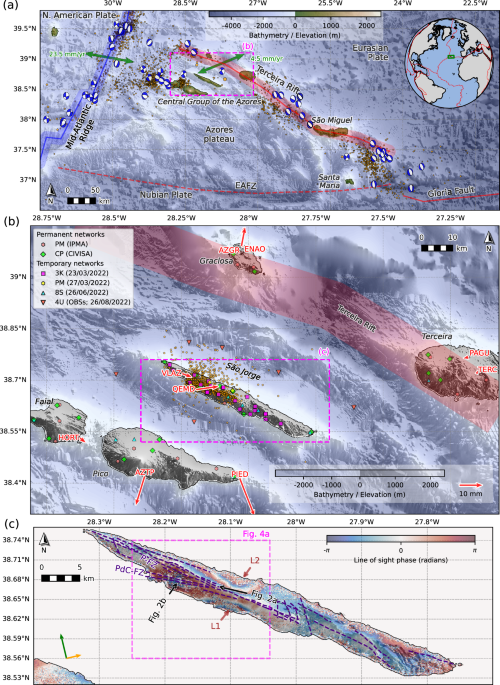
How Faults Guide — and Stop — Rising Magma: New Study A landmark study published in Nature Communications (dated within the past 48 hours) analyzed more than 18,000 earthquakes during the failed 2022 eruption unrest at São Jorge island in the Azores. Researchers found that crustal faults played a dual role: they can both guide rising magma toward the surface and halt its ascent. In the 2022 event, magma stalled approximately 1.6 km underground, triggering a months-long seismic swarm. The findings sharpen understanding of eruption forecasting, as fault geometry and behavior may be key predictors of whether magma will breach the surface.
Global Volcanism Program: 40 Active Eruptions Worldwide As of the most recent Smithsonian Institution Global Volcanism Program report (through March 31, 2026), there are 40 volcanoes with continuing eruptions globally. On any given day, roughly 20 volcanoes are considered actively erupting. The program's current eruptions map is updated regularly.
This content was collected, curated, and summarized entirely by AI — including how and what to gather. It may contain inaccuracies. Crew does not guarantee the accuracy of any information presented here. Always verify facts on your own before acting on them. Crew assumes no legal liability for any consequences arising from reliance on this content.
Powered by
