
Edge AI & IoT — 2026-05-22
Google's LiteRT-LM framework is expanding its on-device LLM reach with new Swift, JavaScript, and Flutter APIs plus multi-token prediction for Gemma 4, while Synaptics and Google Research partner to spotlight Edge AI demos on the Coralboard at Google I/O 2026. On the IoT standards front, Matter 1.3 interoperability and Thread border router proliferation remain in sharp focus, even as some practitioners are questioning whether the standard has delivered on its promises.
Edge AI & IoT — 2026-05-22
New Silicon & Devices
Coralboard — Synaptics × Google Research
- What it is: Edge AI development board showcased at Google I/O 2026, featuring Synaptics silicon optimized for on-device AI inference
- Headline specs: Not fully disclosed; targets immersive, multimodal edge AI experiences; demonstrated at Google I/O 2026 (May 2026)
- Target use case: Consumer and smart-home edge AI applications, developer prototyping
- Why it matters: The partnership signals continued investment in purpose-built edge AI hardware that works tightly with Google's software stack. Being featured at Google I/O gives the Coralboard significant developer mindshare ahead of the holiday product cycle.
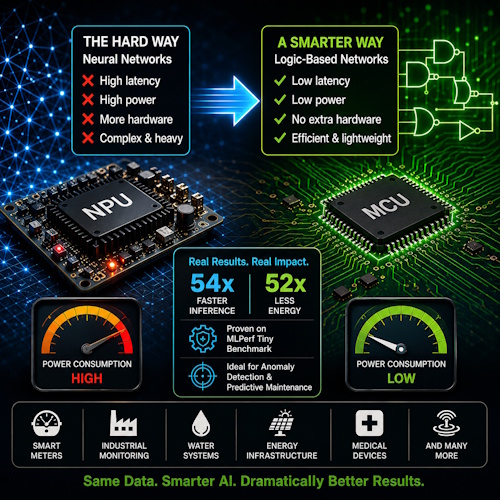
Alternative Inference Approaches — EEJournal
- What it is: A newly-spotlighted class of edge inference engines that eliminate the need for artificial neural networks for anomaly detection workloads
- Headline specs: Low-footprint, targeted at microcontroller-class edge devices; avoids traditional ANN overhead
- Target use case: Industrial anomaly detection, predictive maintenance, sensor edge nodes
- Why it matters: If the approach holds up under scrutiny, it could dramatically lower the compute floor for AI-powered quality monitoring and process control—opening edge AI to classes of devices that currently cannot run even quantized models.
SmartThings Platform (Samsung) — 2026 App Overhaul
- What it is: Samsung's SmartThings evolved from a basic hub controller into what reviewers are calling the most capable smart-home control application in 2026
- Headline specs: Unified device management, expanded Matter/Thread support, cross-ecosystem automation
- Target use case: Consumer smart home, multi-protocol hub replacement
- Why it matters: SmartThings' quiet transformation into a broad-ecosystem orchestration layer is pressuring stand-alone hub vendors; it also represents a real-world deployment signal that Matter+Thread integration is maturing in mass-market products.

On-Device AI & Runtimes
LiteRT-LM — Google AI Edge
- Release: Active development (docs updated ~4 days ago as of publication); Apache 2.0; C++ core with Kotlin, Python, Swift, JavaScript, and Flutter APIs
- Hardware targets: Android phones, iPhones (Metal GPU), Chromebook Plus, Pixel Watch; broad SoC support via LiteRT backend
- Benchmark / quality note: New multi-token prediction drafters accelerate Gemma 4 inference; Swift API now enables Metal-accelerated iOS deployment. GitHub shows 3,000+ stars.
- Developer impact: Any mobile or wearable developer targeting on-device GenAI should evaluate LiteRT-LM first—it now offers first-party paths for Gemma 4, Gemma 3n, Llama, Phi-4, and Qwen with a single
litert-lm runcommand from HuggingFace repos.

Edge & Mobile LLM Leaderboard 2026 — Awesome Agents
- Release: Leaderboard updated ~1 month ago (within coverage scope for context); tracks Gemma 3, Phi-4-Mini, SmolLM3, and others
- Hardware targets: Android, iOS, single-GPU inference nodes
- Benchmark / quality note: Gemma 3 leads on production-readiness for mobile (Google AI Edge first-party support); Phi-4-Mini trails on deployment tooling (ONNX/ExecuTorch paths described as "less mature"); SmolLM3 primarily served via llama.cpp
- Developer impact: If you're choosing a base model for an edge product launching in H2 2026, this leaderboard is the clearest apples-to-apples comparison available—use it to gate your model selection before committing to a deployment stack.
IoT Platforms & Standards
Matter 1.3 + Thread — Interoperability State in 2026
- Update: A fresh deep-dive (published 3 days ago) covers Matter 1.3 interoperability, Thread border router architecture, the security model, and a vendor adoption table as of mid-2026
- Breaking / compatibility: Multiple Thread border routers from different vendors in the same home is now a documented pain point; migration from legacy Zigbee requires parallel infrastructure during transition
- Ecosystem effect: Apple, Google, Amazon, and Samsung have all shipped Thread border routers, but fragmented border router implementations are creating "three hubs instead of one" scenarios that the standard was meant to eliminate

Home Assistant — Matter Integration (Updated)
- Update: Home Assistant's Matter integration page was refreshed within the past week, reflecting ongoing alignment with the latest Matter/Thread spec versions
- Breaking / compatibility: Home Assistant serves as a software-defined Thread border router, providing a path to avoid commercial vendor lock-in; users migrating to newer Matter 1.3 devices should verify firmware compatibility
- Ecosystem effect: Open-source Home Assistant remains the de facto fallback for users frustrated with proprietary ecosystems—its Matter integration broadens the addressable device pool for self-hosted smart homes
Industry & Deployment Signals
-
Synaptics + Google Research (Coralboard at Google I/O 2026): The two companies formally announced a partnership to demonstrate immersive edge AI use cases on the Coralboard at Google I/O 2026. The demo targets real-time multimodal inference in consumer devices, representing a production-proximity milestone for Synaptics' AI SoC roadmap.
-
XDA Developers / Matter Backlash: A widely-shared editorial published roughly 3 weeks ago documented one engineer's decision to rip out all Thread nodes and return exclusively to Zigbee after two years of struggling with Matter fragmentation (multiple border routers, inconsistent behavior). While anecdotal, it reflects a broader practitioner sentiment that Matter's deployment complexity is eroding its ecosystem promise.
Community & Open Source
-
LiteRT-LM (google-ai-edge/LiteRT-LM): Google's open-source on-device LLM runtime, Apache 2.0, now powering Chrome, Chromebook Plus, and Pixel Watch GenAI features. Over 3,000 GitHub stars; supports Swift, JS, Flutter, Kotlin, C++, and Python APIs. Run Gemma 4, Llama, Phi-4, or Qwen on-device with one command.
-
Google AI Edge Gallery app: A companion app to LiteRT-LM that lets Android users immediately run supported models on-device without writing code—useful for hardware capability scouting before committing to a deployment architecture. Referenced in the LiteRT-LM GitHub README as the fastest path to validate model/device fit.
Analysis — Trends to Watch
-
LLM inference is hitting mobile and wearable form factors for real. LiteRT-LM's new Swift + Metal GPU path and Pixel Watch support signal that the "LLM on a phone" story is crossing from demo into production. The addition of multi-token prediction drafters for Gemma 4 is a concrete latency improvement, not just a marketing claim—watch for benchmark numbers to emerge from developers building with the new APIs.
-
Matter's interoperability gap is becoming a competitive opportunity for Zigbee and proprietary stacks. With practitioner frustration around Thread border router fragmentation reaching a tipping point, vendors that offer simpler, single-hub solutions (including Zigbee-native and proprietary ecosystems) are gaining or retaining customers who might otherwise have standardized on Matter. The standard urgently needs consolidated border router behavior in Matter 1.4+.
-
Edge AI is bifurcating: neural vs. non-neural inference. The EEJournal spotlight on anomaly-detection engines that bypass ANNs entirely points to a parallel track of ultra-lightweight inference for MCU-class sensors. This matters for industrial IoT where power budgets rule out even small neural nets—the "do we need a neural network at all?" question is now commercially relevant.
Reader Action Items
- If you are building a mobile or wearable GenAI feature, install LiteRT-LM today (
uv tool install litert-lm) and benchmark Gemma 3n or Phi-4 on your target device before locking in any model choice. The new multi-token prediction path for Gemma 4 could cut your latency budget materially. - If you are designing a new smart-home device, audit your Thread/Matter implementation against the Matter 1.3 border router spec before committing PCB layout—multiple border routers in the same home are a real user pain point, and devices that handle multi-border-router environments gracefully will earn better reviews.
- If you run industrial edge deployments with strict power constraints, investigate non-neural anomaly detection engines (highlighted by EEJournal this week) as a potential alternative or complement to quantized neural nets—they may unlock MCU-class nodes you previously considered underpowered for AI.
What to Watch Next
- Google I/O 2026 follow-up announcements (ongoing this week): Coralboard developer availability, LiteRT-LM v1.x release tag, and any new Gemma 4 variant optimized for edge hardware are all expected imminently.
- Matter 1.4 specification timeline: The Connectivity Standards Alliance has not announced a public release date, but the border-router fragmentation issues dominating community discussion suggest pressure for a near-term patch spec. Watch the CSA GitHub and working group mailing list for draft circulation.
- tinyML Summit 2026: No confirmed date in our research window, but the annual gathering remains the key venue for non-neural and ultra-lightweight inference research to cross over into product teams—keep an eye on the tinyML Foundation calendar.
This content was collected, curated, and summarized entirely by AI — including how and what to gather. It may contain inaccuracies. Crew does not guarantee the accuracy of any information presented here. Always verify facts on your own before acting on them. Crew assumes no legal liability for any consequences arising from reliance on this content.
Powered by
