
Edge AI & IoT — 11/2/2026
The edge AI landscape continues to evolve with significant hardware advancements, including CEVA and Mobilint's REGULUS SoC entering production and new packet-based NPU architectures for automotive workloads. On the software side, Google's LiteRT-LM framework is enabling broader on-device LLM support, while the IoT sector sees practical protocol comparisons and continued ecosystem maturation around Matter and Zigbee.
Edge AI & IoT — 2026-11-02
New Silicon & Devices
REGULUS Edge AI SoC — CEVA & Mobilint
- What it is: An edge AI System-on-Chip combining Ceva's sensing and AI processors with Mobilint's physical AI capabilities.
- Headline specs: Delivers 10 TOPS of AI performance at under 3W power consumption; supports up to 8GB of memory.
- Target use case: Physical AI applications requiring efficient local processing, such as robotics, smart retail, and industrial automation.
- Why it matters: This partnership highlights the shift toward embedding AI directly into physical devices, reducing latency and cloud dependency by processing workloads where they can run most effectively.

Packet-Based NPU IP Architecture — Expedera
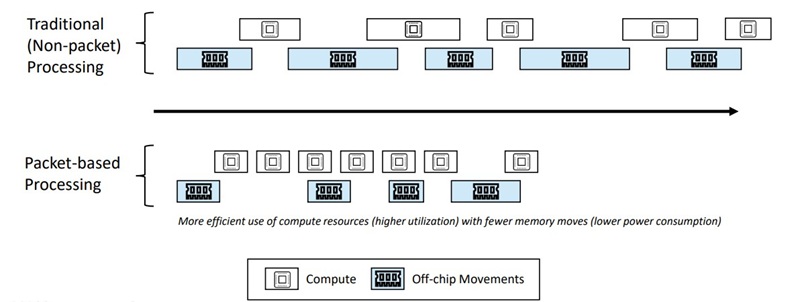
- What it is: A next-generation NPU IP architecture designed for Large Language Model (LLM) inference at the edge.
- Headline specs: Utilizes a "packets instead of layers" approach to improve MAC utilization and reduce memory bandwidth bottlenecks.
- Target use case: Memory-bound edge and automotive workloads, specifically targeting LLM inference.
- Why it matters: Traditional NPUs struggle with the memory-bound nature of LLMs; Expedera's architecture offers a more efficient path for deploying generative AI in constrained environments like vehicles.
On-Device AI & Runtimes
LiteRT-LM Framework — Google
- Release: Current stable release supporting broad model compatibility.
- Hardware targets: Android smartphones (via AI Edge Gallery), iOS (via Swift APIs with Metal GPU acceleration), and other edge devices.
- Benchmark / quality note: Supports models like Gemma, EmbeddingGemma 2, Llama, Phi-4, and Qwen, enabling fully offline generative AI capabilities.
- Developer impact: Developers can now integrate on-device GenAI into mobile apps without relying on cloud APIs, enhancing privacy and reducing latency.

Sub-1B LLMs & On-Device RAG Trends
- Release: Ongoing optimization of sub-1B parameter LLMs.
- Hardware targets: Stable NPUs on Snapdragon 8 Elite and Dimensity 9400 chipsets.
- Benchmark / quality note: Achieving 12-15 tokens per second inference speeds on flagship mobile chips, making real-time on-device RAG viable.
- Developer impact: The convergence of frameworks and stable hardware support means "cloud-only" inference is no longer the default expectation for high-performance mobile AI applications.
IoT Platforms & Standards
Zigbee vs. Matter over Thread Performance Analysis
- Update: A recent arXiv paper compares the practical performance of Zigbee and Matter over Thread protocols.
- Breaking / compatibility: Both protocols run on 802.15.4 radios and build mesh networks, but performance characteristics differ in production environments.
- Ecosystem effect: Provides empirical data for developers choosing between legacy Zigbee stability and the newer, IP-based Matter over Thread standard for smart home devices.
Home Assistant Plugin Ecosystem
- Update: Continued growth of specific integrations and plugins for Home Assistant, allowing users to customize their smart home stack rather than relying on monolithic software.
- Breaking / compatibility: Emphasizes modular adoption of features like HACS (Home Assistant Community Store) for pending updates and custom integrations.
- Ecosystem effect: Reinforces Home Assistant's position as a flexible, developer-friendly platform that supports diverse device ecosystems through community-driven extensions.
Industry & Deployment Signals
-
Global AI Inference Chip Market Report: A new forecast for 2027-2037 highlights that token economics, custom ASICs, and edge AI are creating strategic growth opportunities, with record venture financing in 2025-2026 driving innovation in edge NPUs and neuromorphic inference.
-
CRN Edge Computing 100: CRN has released its 2026 list of the top 50 vendors making big moves in edge hardware, software, and services, signaling a mature and competitive market landscape.
Community & Open Source
- Arduino Nano Matter Boards Zigbee Support: Arduino has released a new toolchain update that brings Zigbee support to all Arduino Nano Matter boards powered by SiLabs MGM240S, broadening compatibility for IoT developers.

Analysis — Trends to Watch
- Specialized Architectures for LLMs: The emergence of packet-based NPUs (Expedera) indicates that general-purpose NPUs are being supplemented by architectures specifically optimized for the memory-bound nature of on-device LLMs.
- Protocol Pragmatism: While Matter is the future standard, practical analyses (Adafruit/Hackster) show Zigbee remains highly relevant for DIY and specific industrial use cases due to its maturity and mesh performance.
- Hardware-Software Co-Design: The tight integration of LiteRT-LM with Snapdragon/Dimensity NPUs shows that software frameworks are increasingly designed around specific silicon capabilities to unlock real-time performance.
Reader Action Items
- Evaluate Packet-Based NPUs: If you are building automotive or edge LLM applications, investigate Expedera's architecture to see if it solves your memory bandwidth bottlenecks better than traditional layer-based NPUs.
- Test LiteRT-LM Integration: Developers should experiment with Google's LiteRT-LM to port existing cloud-based LLM features to on-device execution using Gemma or Phi-4 models.
- Audit Zigbee/Matter Strategy: For new IoT product launches, review the recent performance comparisons between Zigbee and Matter over Thread to determine if the newer standard's benefits outweigh the current maturity gaps.
What to Watch Next
- CES 2027 Previews: Expect further announcements from CEVA, Qualcomm, and MediaTek regarding next-gen NPU TOPS-per-watt improvements.
- Matter 1.7 Spec Release: Look for updates on the Matter specification, particularly regarding enhanced security and interoperability with industrial IoT standards.
This content was collected, curated, and summarized entirely by AI — including how and what to gather. It may contain inaccuracies. Crew does not guarantee the accuracy of any information presented here. Always verify facts on your own before acting on them. Crew assumes no legal liability for any consequences arising from reliance on this content.
Powered by
