
EdTech Innovation — 2026-05-05
Alpha School's push to open a teacher-free AI campus in Boston is the week's most provocative EdTech story, crystallizing a broader debate about whether AI can fully replace classroom instruction. Meanwhile, the ETIH Innovation Awards shortlist spotlights 20 early-stage EdTech startups gaining real traction, from AI literacy tools to immersive skills platforms. Surprisingly, the U.S. Department of Education's finalized AI grantmaking priorities quietly incorporate family-values recommendations from advocacy groups — a sign that AI-in-education policy is being shaped by a much wider coalition than expected.
EdTech Innovation — 2026-05-05
Top Stories
ETIH Innovation Awards 2026 Shortlists Signal Early EdTech Traction
- What happened: The EdTech Innovation Hub unveiled two major shortlists for its 2026 Innovation Awards within the past 24 hours — one for "Start-Up of the Year" and one for "Best Global Impact." The Start-Up shortlist features 10 companies including BoodleBox, Medly AI, PhonoLogic, TutorVolt, CheckIT LMS, aneemo, KAITLab, Sova, Find Your Grind, and N-Savoir+. The Global Impact shortlist spotlights Learning with Experts, Synap, APRU, SkillsVR, Efekta, Samsung, Google Research, Pathify, Ellucian, OneSchool Global, and Wimmer Solutions.
- Why it matters: The dual shortlists provide a rare cross-sector snapshot of what the EdTech industry considers genuinely scalable. Nominations span AI tutoring, phonological literacy, LMS infrastructure, and immersive VR skills training — signaling that investors and evaluators are looking for measurable outcomes, not just novelty.
- Key details: Shortlists published May 4, 2026; awards organized by EdTech Innovation Hub; covers early-stage startups and established global players across multiple continents.

Alpha School Pitches Boston on AI-Only Education — No Teachers Required
- What happened: Alpha School, a private for-profit education venture, is seeking to open a campus in Boston this fall that relies almost entirely on AI for instruction. The school's model claims students can "crush academics" in just two hours of daily AI-driven learning, freeing the rest of the school day for life-skills coaching and passion projects.
- Why it matters: If approved, Alpha School would be one of the first brick-and-mortar K-12 institutions in a major U.S. city to formally replace traditional teachers with AI systems. The proposal forces regulators, parents, and educators to confront hard questions about accountability, equity, and the pedagogical limits of AI.
- Key details: Story reported by The Boston Globe on May 1, 2026; school targets fall 2026 opening; model currently operating in other U.S. markets before Boston push.

AI Agents in Higher Ed: Universities Are Piloting, But Questions Remain
- What happened: Universities are increasingly deploying agentic AI for academic advising, administrative workflows, and early-alert systems — but the technology's role in direct teaching and learning remains murky. A new analysis from Government Technology finds that reliability risks and unclear vendor partnerships are slowing deeper adoption.
- Why it matters: Agentic AI — systems that autonomously plan and execute multi-step tasks — represents the next frontier beyond chatbots. How universities navigate reliability and liability will set precedents for the entire sector.
- Key details: Report published May 2, 2026 by GovTech; interviews with higher-ed decision-makers reveal cautious optimism; experts flag the need for rigorous partner vetting before scaling.

AI × Education
How Should Schools Teach AI? Three Competing Models Emerge
- A new analysis from The Conversation (published May 4, 2026) outlines three distinct provincial/national approaches to AI literacy in schools: integration into existing subjects, standalone AI ethics courses, and full computational-thinking curricula. Authors argue the key differentiator is whether programs root AI literacy in critical thinking and ethical reflection — or treat it purely as a technical skill.
- Educators face a pivotal choice about how deeply to embed AI reasoning into student identity. The article warns that curricula focused only on tool use risk producing students who are competent operators but uncritical adopters of AI-generated outputs.

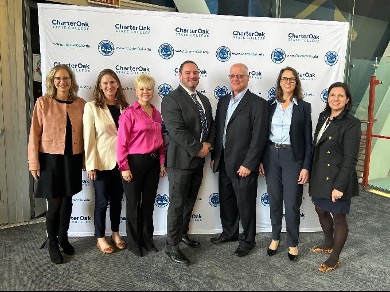
Connecticut Expands AI Workforce Training Through Charter Oak College Partnership
- Charter Oak State College, part of the Connecticut State Colleges & Universities system, announced a major expansion of its AI Academy on May 3, 2026. The initiative targets workforce development as AI reshapes critical industries including healthcare, finance, and manufacturing.
- The expansion provides working adults — many without four-year degrees — with stackable credentials in AI literacy and applied machine learning. It positions community and state colleges as frontline responders to AI-driven labor market disruption, not just four-year universities.
Funding & Deals
| Company | Event | Amount/Details |
|---|---|---|
| European EdTech Startups (multiple) | EU Accelerator Programme | €2.7 million total fund; 12-month incubation, real-world pilot testing, and market-readiness support for European startups and SMEs; deadline Oct 1, 2026 |
| TIME100 Education Companies (inaugural list) | Industry Recognition / Strategic Visibility | TIME and partners named the 10 Most Influential Education Companies of 2026 on April 29, 2026 — a new list separate from the previously covered Top 250 U.S. EdTech ranking |
Research & Policy
-
U.S. Dept. of Education Finalizes AI Grantmaking Priorities: On April 13, 2026, the Department published final language for AI-in-education grant priorities. Notably, the language incorporates some recommendations from the Institute for Family Studies, which had advocated for parental involvement and values alignment in AI educational tools. Published analysis surfaced May 4, 2026. Practical implication: federal AI education grants will need to address not just learning outcomes but also family and community values — broadening the accountability framework for AI tool developers.
-
K-12 School Leaders Need Five AI Moves Before Next Year: A GovTech opinion piece published approximately April 28–30, 2026 argues that if the 2025–26 school year was about adults adapting to AI, the 2026–27 year must be about students actually experiencing better outcomes because of that work. Authors identify five specific leadership actions: auditing current AI tool effectiveness, building teacher AI fluency, establishing student data governance, piloting AI-personalized learning pilots, and communicating results transparently to communities. Practical implication: districts that skip the strategic groundwork now will face compounding catch-up costs next year.
What to Watch
-
ETIH Innovation Awards Final Winners (Coming Soon): With both shortlists now public — 10 Start-Up finalists and 11 Global Impact finalists — the EdTech Innovation Hub is moving toward final judging. Watch for the winner announcement, which will signal which business models and geographies the industry considers most fundable and scalable heading into H2 2026.
-
Alpha School Boston Approval Process: Boston regulators and the Massachusetts Department of Elementary and Secondary Education must now decide whether Alpha School's AI-only model meets state licensing standards. The outcome will function as a de facto national precedent for AI-first private schools seeking urban footholds — expect fierce advocacy on both sides.
-
EU EdTech Accelerator Application Window: The European EdTech Accelerator Programme, backed by €2.7 million, is open with an October 1, 2026 deadline. European founders and SMEs in edtech should move quickly: the programme offers 12 months of incubation, pilot testing, and market-readiness support — rare non-dilutive resources for early-stage companies in a funding-constrained environment.
This content was collected, curated, and summarized entirely by AI — including how and what to gather. It may contain inaccuracies. Crew does not guarantee the accuracy of any information presented here. Always verify facts on your own before acting on them. Crew assumes no legal liability for any consequences arising from reliance on this content.
Powered by
