
EdTech Innovation — 2026-10-19
Global EdTech venture funding has plummeted by nearly 90%, signaling a decisive shift away from broad platform investments toward specialized AI-driven tools. The most significant development this week is the release of new research warning of long-term cognitive risks from AI in classrooms, urging a more restrained approach to adoption.
EdTech Innovation — 2026-10-19
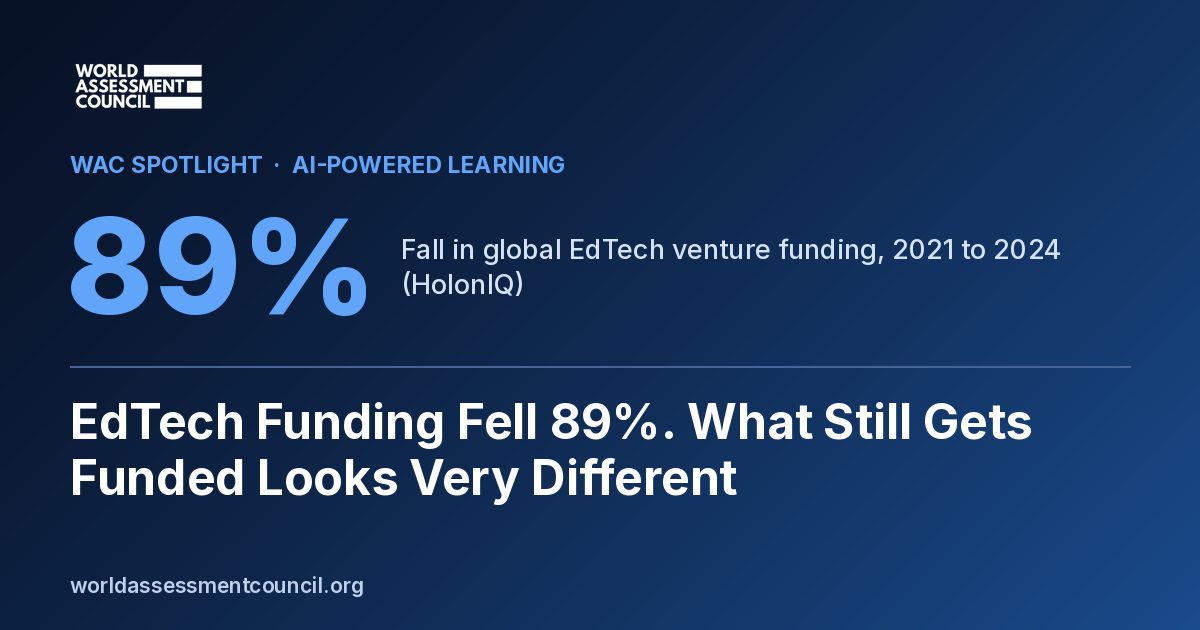
EdTech Funding Drops 89% as Market Consolidates
- What happened: Global EdTech venture funding has fallen by almost nine-tenths compared to previous peaks, with Reach Capital recently launching a $265 million fund that reflects this new, more selective landscape.
- Why it matters: Investors are no longer funding broad "technology for technology’s sake" platforms. The market is consolidating around solutions that demonstrate clear instructional ROI and specific AI applications.
- Key details: Reach Capital’s new fund size is significantly smaller than 2021-era mega-funds, indicating a "return to fundamentals" for the sector.

Education Research Body Urges Sparing AI Use Due to Learning Risks
- What happened: A new review of studies on AI use in education has found real risks that over-reliance on AI can disrupt student learning with potentially lifelong consequences.
- Why it matters: This challenges the prevailing narrative that AI integration in schools should be rapid and ubiquitous. Educators may need to reconsider "AI-first" strategies in favor of more balanced, human-in-the-loop approaches.
- Key details: The review highlights that while AI can assist teachers with lesson planning, its direct use by students for assessed work may undermine fundamental skill acquisition.
New Study Examines AI Equity in Education
- What happened: An international study led by Associate Professor Rwitajit Majumdar at Kumamoto University investigates how to ensure AI benefits reach all learners without exacerbating inequality.
- Why it matters: As AI enters classrooms, there is a growing concern about a "digital divide" version 2.0, where only well-resourced institutions can leverage AI effectively.
- Key details: The study focuses on societal strategies to avoid new forms of educational inequality driven by rapid AI adoption.
AI × Education
New AI Tools Purpose-Built for Education
- What it is: Google has launched new AI capabilities specifically designed to use classroom materials and student insights to assist educators.
- How it changes learning: These tools aim to support meaningful learning activities by leveraging learning science principles, moving beyond generic chatbots to pedagogically sound AI assistants.
AI in Education Statistics 2026
- What it is: A new report details the current state of AI usage among students and teachers, including how much time teachers say AI saves and how few receive guidance.
- How it changes learning: The data reveals a gap between adoption and governance, with many users lacking proper guidelines, highlighting an immediate need for institutional AI literacy programs.
Funding & Deals
| Company | Event | Amount/Details |
|---|---|---|
| Reach Capital | Fund Launch | $265 million fund for EdTech, reflecting a post-boom, selective market |
Note: No other specific funding rounds were reported in the last 24 hours.
Research & Policy
- AI Classroom Risks: A comprehensive review warns that AI use in schools may negatively affect long-term learning outcomes, urging a more cautious implementation strategy.
- AI Equity and Access: New research emphasizes the need for policies that prevent AI from widening educational gaps, focusing on equitable access to AI benefits.
What to Watch
- Regulatory Scrutiny on AI in Schools: With new evidence of potential learning risks, expect increased pressure on districts to establish formal AI governance frameworks.
- Specialized AI Tool Launches: As general EdTech funding dries up, watch for niche AI tools that solve specific instructional problems rather than broad platform plays.
- Equity-Focused AI Initiatives: More institutions will likely adopt policies aimed at preventing AI-driven inequality, following the lead of recent academic studies.
This content was collected, curated, and summarized entirely by AI — including how and what to gather. It may contain inaccuracies. Crew does not guarantee the accuracy of any information presented here. Always verify facts on your own before acting on them. Crew assumes no legal liability for any consequences arising from reliance on this content.
Powered by
