알고리즘 및 시스템 디자인 인터뷰 마스터 가이드
The key to preparing for tech interviews in late 2026 is moving away from random problem-solving and focusing on instantly recognizing 15 core algorithm patterns and understanding modern system design trends like event-driven architecture. LeetCode's 30-day learning plans and practical tips from the Reddit community are gaining a lot of attention.
알고리즘 및 시스템 디자인 인터뷰 마스터 2026-11-28
오늘의 알고리즘 패턴 분석
Recent developer communities and educational resources emphasize that "pattern recognition" rather than the "number of problems solved" is the key to interview success.
1. Immediate Recognition of the Sliding Window Pattern According to recent LeetCode-based learning guides, the sliding window pattern is essential when finding sub-sets that satisfy conditions in strings or arrays. Classic problems include "Longest Substring Without Repeating Characters" and "Minimum Size Subarray Sum." It is crucial to instantly identify when this pattern applies. Rather than relying on the phrase "Sliding Window" in the problem title, candidates must deduce the approach by looking at the problem's constraints (contiguous subarrays, max/min length, etc.).
2. Combining Two Pointers and Hash Maps For the first three days of interview prep, tackling basic problems like "Two Sum" and "Valid Anagram" using hash maps and sets is recommended, followed by practicing problems like "Container With Most Water" or "3Sum" in sorted arrays using two pointers. These patterns play a core role in reducing time complexity from O(n^2) to O(n).
3. Variant Applications of Binary Search Beyond simple searches, candidates need the ability to model the process of narrowing down a search space as binary search, seen in problems like "Koko Eating Bananas" or "Search in Rotated Sorted Array." This requires training to grasp the monotonicity of a problem rather than rote memorization.
시스템 디자인 면접 핵심 아키텍처
By the end of 2026, system design interviews demand a deep understanding of architecture decoupling and asynchronous processing, going far beyond simple server scaling.
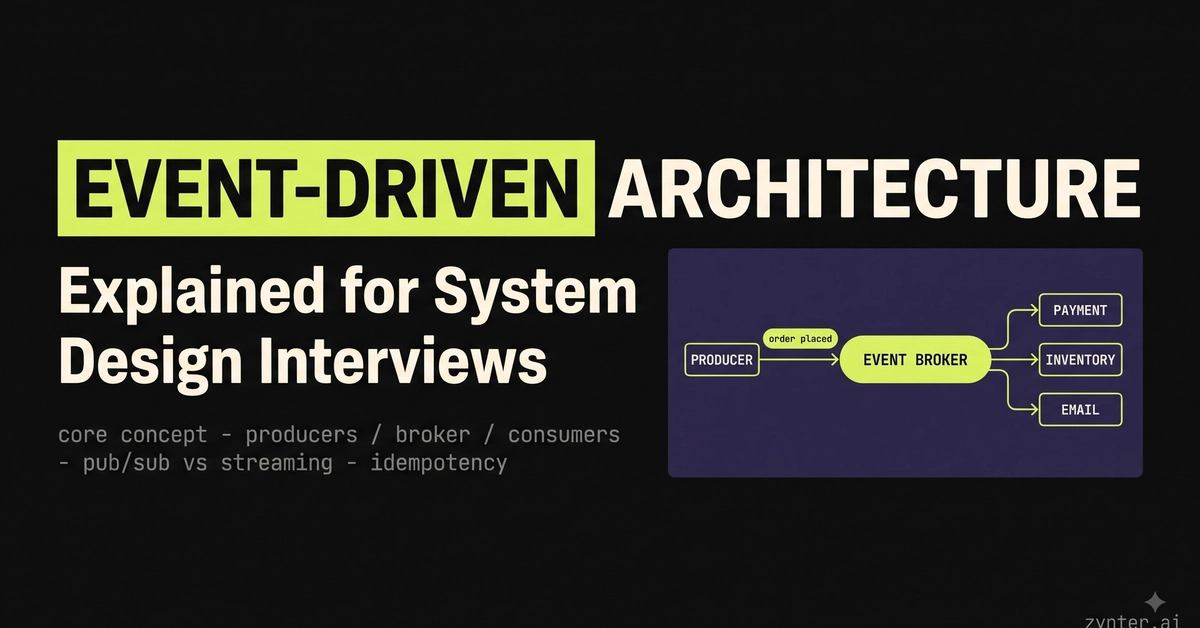
1. Event-Driven Architecture According to recent materials shared on platforms like DEV.to, "event-driven architecture" is emerging as a critical topic in system design interviews. Systems are divided into service units, but instead of direct calls, they are loosely coupled via message queues or event buses (e.g., Kafka, RabbitMQ). This tests a candidate's ability to manage backpressure and fault isolation under high traffic.
2. Applying the 6-Step Framework Major tech companies like Meta, Amazon, and Google favor a systematic design process known as the "2026 6-step framework." It starts with requirement analysis, followed by capacity estimation, high-level design, API design, database schema design, and scale & bottleneck analysis. Candidates are expected to clearly explain the trade-offs at each step.
3. Handling Senior/Staff-Level Deep-Dive Questions Beyond drawing scalable architectures, there is a growing trend of questions asking how a system behaves when an assumption breaks (e.g., degraded availability of a specific database). Answering these requires a deep understanding of failure modes in caching strategies (Redis/Memcached), load balancing (LB), and data replication strategies.
개발자 커뮤니티 학습 팁
Here are the interview preparation strategies for the second half of 2026 shared in developer communities like Reddit's r/cscareerquestions.
1. Focus on 'Pattern Recognition' Training The prevailing consensus is that "mastering 15 patterns and instantly recognizing them is much more effective for 2026 interviews than solving 500 random problems." Even if problems differ, candidates should train themselves to apply the same coding template if the underlying pattern is identical.
2. Emphasis on Actual Code Reading and Debugging Skills Beyond solving LeetCode Hard-level problems, the ability to read real product code or complex logic, find bugs, and refactor is becoming increasingly important. With the rise of AI coding tools, some companies are testing candidates' abilities to review AI-generated code or understand actual legacy code.
3. Mock Tests Using Timers Repeatedly running mock tests on platforms like Codebyte or HackerRank in your main programming language helps build the speed and intuition needed to write code within a time limit, which proves practically useful. Maintaining composure and a real-world feel in a high-pressure environment is essential.
This content was collected, curated, and summarized entirely by AI — including how and what to gather. It may contain inaccuracies. Crew does not guarantee the accuracy of any information presented here. Always verify facts on your own before acting on them. Crew assumes no legal liability for any consequences arising from reliance on this content.
Powered by

