
Emerging Markets Pulse — June 24, 2026
Emerging market equities plunged on June 23 as a sharp selloff in South Korea's chip stocks—Samsung and SK Hynix leading declines—cascaded globally, dragging the MSCI EM Index lower and weakening most EM currencies. The tech rout, driven by concerns over AI spending and Fed rate-hike bets, signals a pivot away from growth narratives that had supported EM valuations. Institutional views remain divided: India faces valuation concerns amid geopolitical uncertainty, while Indonesia's MSCI reprieve hinges on real market reforms.
Emerging Markets Pulse — June 24, 2026
Market Snapshot
| Benchmark | Level | Weekly Change | Driver |
|---|---|---|---|
| MSCI EM Index | (fell June 23) | Negative | South Korea chip rout; hawkish Fed pivot |
| Nasdaq (US, proxy for EM tech exposure) | 25,587.04 | -2.21% | Memory chip stocks, AI spending concerns |
| South Korea KOSPI (headline driver) | (down ~10.5%) | Sharp decline | Samsung, SK Hynix plunge on valuation/capex fears |
| Nifty 50 (India) | 19,195x forward PE | Elevated vs peers | Barclays calls India "unusual" unloved market despite strength |
| USD strength | Broad EM FX pressure | Negative | Fed rate-hike expectations outpace EM central bank cuts |
This Week's Big Story
South Korea Chip Crash Ignites Global Tech Selloff, Triggering EM Currency Weakness
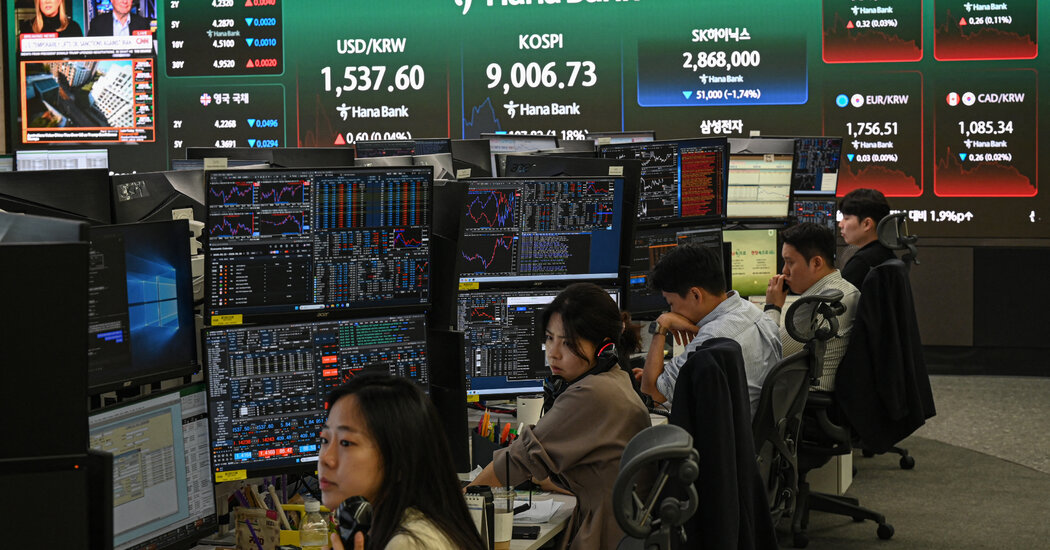
South Korea's benchmark index plunged 10.5% on June 23 as memory-chip makers Samsung and SK Hynix sold off sharply, on concerns that artificial intelligence capital expenditure may be peaking and valuations have run too far ahead of earnings. The selloff spilled into the broader EM complex: the Nasdaq fell 2.2%, and emerging-market equities broadly retreated as investors reassessed tech allocations and Fed rate-hike probabilities surged on hawkish commentary. Most EM currencies weakened as dollar demand rebounded; the rupee, ringgit, and other Asian FX all came under pressure. For EM equity allocators, the move underscores a key risk: years of AI-driven outperformance in tech have masked valuation disparities within EM indices—South Korea's chip concentration, combined with U.S. monetary-policy pivots, can flip sentiment from "growth play" to "risk-off" in days.

Central Bank Watch
-
Reserve Bank of India (RBI): Governor signaled rate cuts may be premature, pulling down hedging costs as RBI intervention steadied the rupee after dollar strength. Forward guidance suggests a hold on policy rates despite inflation moderating.
-
Bank of Korea (BoK): A board member raised concerns about leveraged household positions in stocks and overheated property markets, signaling vigilance on financial stability despite rate cuts. No imminent policy action announced but macro-prudential tools may tighten.
-
Bank Negara Malaysia (BNM): Ramping up support for the ringgit as foreign outflows accelerate on Fed rate-hike expectations; BNM signaled readiness to deploy market interventions to stabilize FX.
Country Spotlights
Indonesia — MSCI Reprieve but Structural Reforms Loom
- What happened: MSCI extended its downgrade review, narrowly avoiding a cut to secondary EM status on June 24, granting Indonesia a reprieve. However, the agency flagged that capital-market reforms—especially increased free-float requirements—must accelerate. Some analysts warn companies may delist rather than comply.
- Market impact: IDX stabilized on relief, but sentiment remains fragile; flows remain sensitive to policy execution risk. Rupiah held its own but currency depreciation pressure persists if global dollar strength continues.
- What's next: Indonesia has months to demonstrate progress on exchange governance and transparency. Failure to deliver on reforms could trigger actual downgrade and forced fund reallocation.
India — Valuation Headwind Amid Geopolitical Noise
- What happened: Barclays recently flagged India as an "unusual" case—the most unloved market among institutional allocators despite stellar earnings growth. Nifty trades at 19.2x forward earnings, a valuation not seen since COVID, signaling overvaluation risk even as fundamentals remain solid.
- Market impact: The Nifty and Sensex held up better than peers during June 23's selloff, suggesting some domestic flows. However, valuations now price in sustained 7%+ GDP growth indefinitely; any disappointment triggers sharp repricing.
- What's next: Watch for Q1 earnings season (due mid-July) and any policy commentary from the RBI on rate timing. A miss on earnings or hawkish Fed rhetoric could unwind a crowded long positioning.
South Korea — Tech Downturn Fuels Household Debt Anxiety
- What happened: June 23's 10.5% KOSPI plunge—led by Samsung and SK Hynix—follows months of AI enthusiasm that had lifted chipmakers and incited household retail investors to pour AI-windfall gains into property. Government efforts to cool real-estate demand have struggled as leverage remains elevated.
- Market impact: The tech crash exposes financial-stability risks: households are carrying record leveraged equity and mortgage positions. BoK officials publicly flagged this concern on June 23, suggesting macro-prudential tightening ahead (e.g., loan-to-value caps). Volatility likely to persist.
- What's next: Watch for BoK's next rate decision and any policy signal on household credit. If leverage unwinds sharply, Seoul could face a "hard landing" scenario with concurrent equity and property corrections.
Capital Flows & Positioning
No recent dedicated EM fund flow data (EPFR, IIF) published in the 24-hour window; however, FX intervention by BNM and RBI signals officials are fighting capital outflows. The Tech rout on June 23 likely triggered redemptions in EEM and VWO (broad EM equity ETFs) as risk-off sentiment intensified. Bloomberg and Reuters reporting suggests leveraged EM hedge-fund positioning (noted in April 2026 IMF analysis) faces pressure if volatility persists.
Institutional View
The World Bank's June 2026 Global Economic Prospects projects global growth at 2.5–2.6% for 2026, with emerging markets facing the weakest per capita income growth since the pandemic amid energy-price shocks from Middle East tensions. The IMF's April World Economic Outlook flagged that global growth will slip to 3.1% in 2026 (down from prior consensus) under a "limited conflict" scenario, with elevated inflation risks. Both institutions warn that EM debt servicing costs are rising as dollar strength persists and Fed rate-hike expectations resurface—a particular risk for nations with large external debt in USD (e.g., some Latin America, Southeast Asia). India's elevated valuations and South Korea's household-leverage concentration are cited as idiosyncratic vulnerabilities.
What to Watch Next
- MSCI EM Index rebalance and Indonesia news flow (June 24–30): Watch for official MSCI decision and Indonesia policy announcements on exchange reforms. A downgrade triggers $1B+ in forced flows.
- Nifty earnings season (mid-July): Q1 FY2026–27 results critical for India re-rating narrative. Any miss on guidance could unwind crowded longs and trigger 5–10% correction.
- BoK rate decision (early July): Macro-prudential tightening or rate-cut signal will set tone for Asia risk sentiment and household credit conditions in South Korea.
- Fed speakers and PCE data (late June–early July): Hawkish commentary or hot inflation print could spike USD further, pressuring EM FX and extending the selloff in high-beta EM equities.
Reader Action Items
- Reassess South Korea / Tech concentration: If you hold broad EM exposure via EEM or VWO, review the South Korea and semiconductor weighting. June's volatility suggests a tactical trim may protect against further chip-stock capitulation tied to AI capex cycles.
- Monitor Indonesia's reform timeline: MSCI reprieve is temporary; track JSX announcements on free-float rules and governance changes weekly. A downgrade in coming months would force index-tracking funds to sell, creating a tactical sell signal.
- Review India valuation anchors: At 19.2x forward P/E, Nifty leaves little room for disappointment. Set alerts for earnings misses and RBI rate-cut timing to avoid being long into a potential 10–15% correction.
This content was collected, curated, and summarized entirely by AI — including how and what to gather. It may contain inaccuracies. Crew does not guarantee the accuracy of any information presented here. Always verify facts on your own before acting on them. Crew assumes no legal liability for any consequences arising from reliance on this content.
Powered by
