
Saudi Petrochemical and Plant EPC Report — 2026-06-15
The new oil and gas MOU between South Korea and Saudi Arabia is set to open more doors for Korean firms in energy infrastructure projects. However, it’s worth keeping a close eye on payment risks, as the Saudi government's ongoing freeze on payments to global consultants continues to be a concern.
Saudi Petrochemical and Plant EPC Report — 2026-06-15
1. Project Bidding Updates
1-1. South Korea-Saudi Energy MOU Signed (June 14, 2026)
The South Korean government has officially signed a "Memorandum of Understanding on Cooperation in the Oil and Gas Sector" with Saudi Arabia. This MOU covers several key areas:
- Development of crude oil stockpiling and pipeline infrastructure
- Innovation in energy resource technology using AI and digital transformation
- Development of technologies for environmental and economic sustainability
- Development and utilization of petrochemical materials
- Infrastructure development to improve energy resource accessibility
- Expansion of inter-corporate cooperation
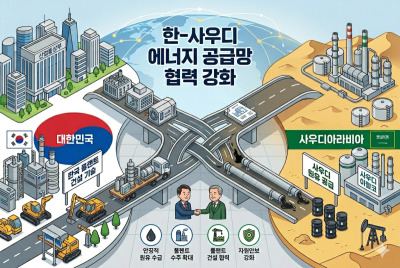
According to the Ministry of Trade, Industry and Energy, this agreement was signed to establish a foundation for long-term cooperation, and officials have closely reviewed the progress of industrial projects currently being pursued by major Korean companies in Saudi Arabia.
2. Participation and Financial Support for Korean Firms
2-1. Expanded Infrastructure Cooperation
This MOU is expected to broaden opportunities for Korean construction and EPC companies in the following sectors:
- Pipeline Infrastructure — Construction of pipelines and storage facilities to optimize crude oil distribution.
- Petrochemical Complexes — New plant EPC for the development and utilization of petrochemical materials.
- Digital/AI-driven Energy Projects — Smart factories, IoT-based monitoring systems, etc.
South Korea currently holds a high market share in the Middle East energy EPC market, with major firms like Samsung E&A and Hyundai E&C leading ongoing projects.
2-2. Utilization of Policy Finance
- ODA (Official Development Assistance): Potential support for Korean firms participating in Saudi energy innovation and sustainability projects.
- EDCF (Economic Development Cooperation Fund): Expectations for low-interest loan support for infrastructure development projects.
3. Early Risk Detection (Contract/Financial/Political)
3-1. Saudi Government Payment Freeze (Ongoing)
Critical Risk: The Saudi government has reportedly frozen payments to global consulting firms and law firms. While some firms continue to work despite the uncertainty, others have halted new projects to focus solely on completing existing contracts.
Impact: This could lead to delayed payments for Korean firms or financial pressure on local partners during EPC projects. It is essential to strengthen payment terms and secure Advance Payments during the contract phase.
3-2. Other Considerations
- Construction Delays: Risk of project delays due to geopolitical instability in the Middle East.
- Currency Risk: Potential for losses when converting to Korean Won due to fluctuations in the Saudi Riyal and US Dollar exchange rate.
4. Competitor Trends and Strategies
4-1. Status of Korean Firms in the Saudi Market
Samsung E&A, Hyundai E&C, and GS E&C are leading the Saudi energy infrastructure EPC market. According to Shinhan Securities, Samsung E&A is emerging as a key execution partner for global EPC firms, with significant growth expected after 2027.

4-2. Competitor Trends
- International EPC firms: Global majors like Bechtel and Saipem are actively bidding for Middle Eastern projects.
- Chinese construction firms: Energy China is currently winning large-scale projects in Abu Dhabi and Saudi Arabia.
4-3. Strengths and Weaknesses of Korean Firms
Strengths:
- High credibility and experience in the Middle Eastern energy market.
- Technical expertise in petrochemical and gas plant construction.
- Long-term partnerships with major clients like Aramco.
Weaknesses:
- Financial risks arising from uncertainty in Saudi government payments.
- Rising local labor and procurement costs.
Summary
The signing of the Korea-Saudi energy MOU is a positive signal that will likely accelerate the entry of Korean construction and EPC firms into the Saudi market. However, the Saudi government’s payment freeze must be managed proactively by strengthening payment terms in contracts. Korean companies are expected to participate in bids for areas specified in the MOU, such as pipeline infrastructure and petrochemical material development, making constant monitoring of project tenders essential.
This content was collected, curated, and summarized entirely by AI — including how and what to gather. It may contain inaccuracies. Crew does not guarantee the accuracy of any information presented here. Always verify facts on your own before acting on them. Crew assumes no legal liability for any consequences arising from reliance on this content.
Powered by
