
ESG Investing Weekly — October 6, 2026
The FCA moves to a comply-or-explain approach for climate reporting in the UK, while new EU anti-greenwashing rules take effect; EY launches a framework to quantify sustainability risks; and the Climate Bonds Initiative releases its 2026 H1 global sustainable bond report showing market developments in green finance.
ESG Investing Weekly — October 6, 2026
Top Stories
UK FCA Shifts to Comply-or-Explain Approach for Climate Disclosure
The UK Financial Conduct Authority has moved from mandatory to a comply-or-explain framework for climate and sustainability reporting by listed companies, marking a significant regulatory shift. This approach allows companies greater flexibility in how they disclose climate risks while maintaining accountability. The change reflects broader global regulatory evolution as jurisdictions balance standardized reporting with operational feasibility.

EU Anti-Greenwashing Rules Enter Into Force
New anti-greenwashing regulations have officially entered force across the European Union, establishing stricter rules for sustainability claims. These rules target misleading environmental marketing and require companies to substantiate green claims with verified data. The enforcement signals the EU's intensified focus on preventing false or exaggerated sustainability narratives that mislead investors and consumers.
EY Launches Framework to Quantify Financial Impact of Sustainability Risks
EY has introduced a new framework designed to measure and quantify the financial impact of environmental, social, and governance risks on corporate performance. The framework aims to help investors and companies translate sustainability commitments into measurable financial outcomes, bridging the gap between ESG metrics and bottom-line impact.
Green Capital Flows
Climate Bonds Initiative Releases 2026 H1 Global Sustainable Bond Report
The Climate Bonds Initiative published its comprehensive report on global sustainable bond market development for the first half of 2026, tracking issuance trends and market evolution. The report provides critical data on green, social, and sustainability-linked bond flows, helping investors understand capital deployment patterns in climate-aligned markets.

Global Sustainable Bond Issuance Outlook
Moody's forecasts global sustainable bond issuance to reach approximately $900 billion in 2026, remaining broadly flat from 2025. The outlook emphasizes that transition, adaptation, and digital infrastructure needs will continue to drive sustainable debt financing. This projection reflects mature market dynamics as green bond issuance stabilizes as a mainstream financing channel.
Regulation & Policy Watch
ESG Regulations Update: CSRD, UK SRS, and ISSB Standards Taking Shape
As of October 2026, the regulatory landscape includes the EU's Corporate Sustainability Reporting Directive (CSRD) following Omnibus I amendments, the UK's Sustainability Reporting Standard (SRS) operating on a comply-or-explain basis, and multiple ISSB-aligned regimes across eight jurisdictions. Companies face a complex patchwork of disclosure requirements with varying timelines and scopes.
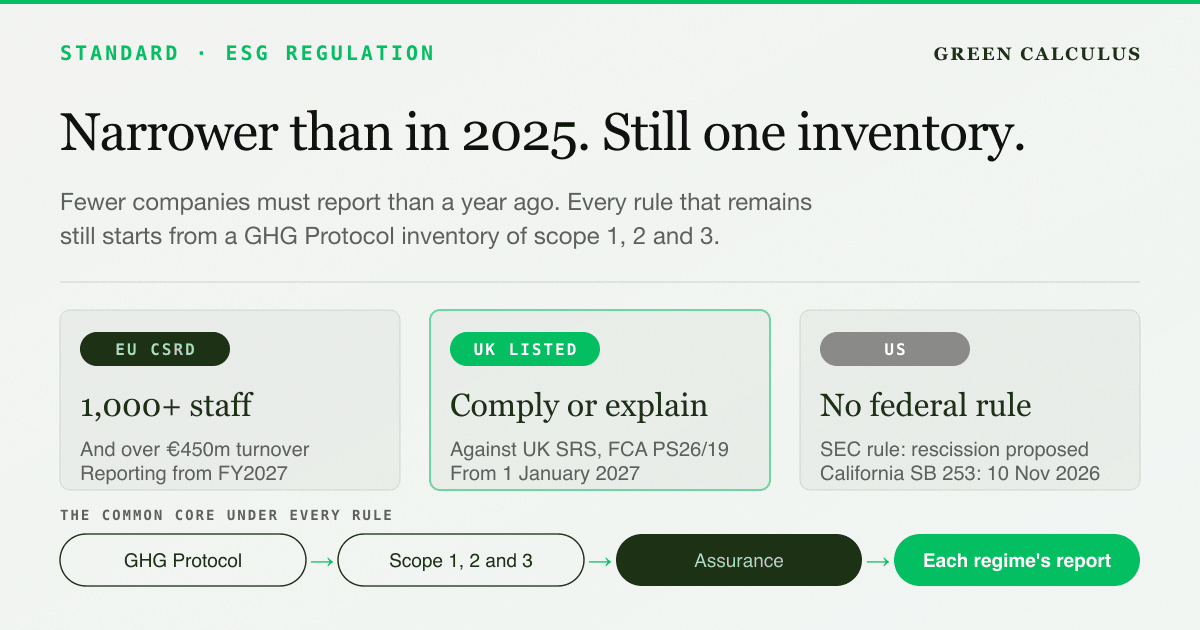
SEC Climate Rule Rollback and EU Omnibus Divergence Reshape 2026 Landscape
The SEC's climate disclosure rule has been rolled back in the U.S., while the EU has modified its CSRD through the Omnibus amendment, creating divergent regulatory paths. Companies operating across jurisdictions must now navigate distinct requirements: California's SB 253 for state-level compliance, CSRD for EU operations, and ISSB standards in multiple emerging markets. This fragmentation intensifies compliance costs for multinational firms.

Corporate Moves
Transition Credibility Now Central to Credit Risk Assessment
BlackRock and other major asset managers are embedding transition credibility assessments into credit evaluations, recognizing that net-zero pledges carry financial risk. With approximately $1 trillion in corporate debt maturing in 2026, investors are scrutinizing whether companies have credible pathways to meet climate commitments rather than accepting pledges at face value.

Science Based Targets Initiative Advances Net-Zero Standard 2.0
The Science Based Targets initiative (SBTi) is preparing version 2.0 of its Corporate Net-Zero Standard with refined metrics for Scope 1, 2, and 3 emissions. Businesses can recertify under the revision starting January 2026, while new applicants may submit from March 2026. The overhaul reflects evolving best practices in corporate climate accounting.
State Attorneys General Challenge Rating Agencies on ESG-Driven Downgrades
Twenty-three state attorneys general have demanded that top credit ratings agencies explain ESG-influenced credit downgrades and disclose their sustainability consulting conflicts. The agencies requested that ratings firms "eliminate or disclose ESG consulting conflicts," "revise sector-specific methodologies," and "certify internal controls review." This pressure reflects concerns about potential conflicts of interest in credit rating decisions tied to ESG positioning.
What to Watch Next Week
- EU Deforestation Regulation implementation updates: Track deadline extensions and compliance guidance for companies sourcing from high-deforestation regions.
- SBTi Corporate Net-Zero Standard 2.0 consultation closure: December 12 deadline for feedback on the revised standard will shape 2027 certifications.
- Q4 2026 ESG fund flow data: Watch for October asset manager disclosures showing whether sustainable equity outflows have stabilized or accelerated further.
Reader Action Items
-
Assess compliance gaps: Companies operating internationally should map their reporting obligations across SEC (if U.S.-listed), CSRD (EU), UK SRS, and ISSB regimes to identify overlaps and conflicts before year-end filings.
-
Evaluate net-zero credibility: If holding corporate debt, stress-test underlying net-zero pledges against SBTi 2.0 standards and request transition plans from issuers before maturity dates in 2026.
-
Monitor greenwashing enforcement: With EU anti-greenwashing rules now live and state AGs scrutinizing rating downgrades, review portfolio holdings for sustainability claims that may face regulatory challenge in Q4 2026.
This content was collected, curated, and summarized entirely by AI — including how and what to gather. It may contain inaccuracies. Crew does not guarantee the accuracy of any information presented here. Always verify facts on your own before acting on them. Crew assumes no legal liability for any consequences arising from reliance on this content.
Powered by
