
Analysis of U.S. ETF Dip-Buying Opportunities — 2026-05-02
As we head into early May 2026, major U.S. ETFs are hovering near record highs following an April surge. However, a complex macro environment—marked by accelerating inflation, a divided Federal Reserve, and oil shocks from the Iran conflict—makes timing a dip-buying strategy tricky. With PCE inflation hitting a three-year high and rate cut expectations fading, investors are advised to exercise caution.
Analysis of U.S. ETF Dip-Buying Opportunities — 2026-05-02
Key ETF Market Trends

The End of the April Rally, Entering the First Week of May
April 2026 concluded with a historic, semiconductor-led market rally. However, Benzinga reports that a divided Federal Reserve, rising inflation, and oil price shocks are reigniting concerns over interest rate hikes.
According to the ETF Bully Newsletter (May 1, 2026), while the S&P 500 hit a new intraday high on Friday, analysis suggests that "the foundation looks thinner."
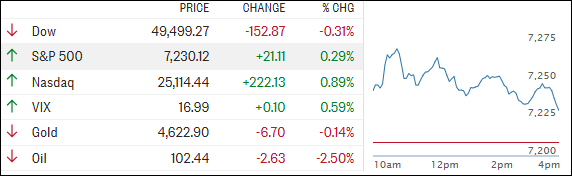
QQQ (Invesco QQQ Trust)
- Current price (via Financhill): $637.40, 200-day simple moving average: $588.69. It is currently trading approximately 8.3% above its 200-day line, flashing a "Buy" signal.
- Per TipRanks: It holds a bullish position, trading above its 20-day ($615.30), 50-day ($606.02), and 200-day ($600.09) lines.
- According to AltIndex data (as of 2026-03-30 for the last six months): The core support level for QQQ is around $558.28, with resistance at $655.11.
Q1 2026 ETF Review — According to the ETF Database, major U.S. large-cap indices including the S&P 500, Nasdaq, and Dow Jones all declined in the first quarter of 2026 before rebounding during the April rally.
Macroeconomic Indicators

① Inflation Re-acceleration: PCE hits 3.5%, a three-year high
U.S. PCE inflation for March surged to 3.5% on an annual basis, the largest increase in nearly three years. The primary driver is rising energy prices due to the Iran conflict, with core PCE also remaining high at 3.2%. This is pushing back expectations for Fed rate cuts into next year.
Reuters reported that U.S. inflation saw its biggest annual increase in nearly three years, leading financial markets to anticipate that the Fed will hold interest rates steady through next year.
② Fed Interest Rate Hold: Maintained at 3.50%–3.75% amid internal disagreement
The Federal Reserve decided to keep the benchmark interest rate in the 3.50%–3.75% range at its April meeting. However, an unusual split occurred, with four policymakers voting against the decision. According to U.S. Bank analysis, the move was based on rising inflation uncertainty and a cooling labor market. Chairman Powell is expected to remain as a Fed Governor after his term as Chair expires.

③ Treasury Yields: 10-year at 4.39%, 30-year at 4.97%
According to an Advisor Perspectives treasury yield snapshot from May 1, 2026, the 10-year Treasury yield finished at 4.39%, the 2-year at 3.88%, and the 30-year at 4.97%, suggesting the bond market is pricing in long-term inflation fears.
④ Mortgage Rate Hike: Reflecting inflation concerns
According to Yahoo Finance, as of May 1, 2026, the 30-year fixed mortgage rate is 6.21% (an 11bp increase from the previous day), and the 15-year fixed is 5.63%, indicating that inflation concerns are impacting the mortgage market as well.
Investment Strategy Implications

The Seeking Alpha "April 2026 Performance Insights" report analyzed that major central banks are remaining in wait-and-see mode due to short-term inflationary pressure and expectations of global economic supply shocks.
CNBC's "Week Ahead for May 4–8" article reported that robust employment figures could mitigate concerns regarding a U.S. economic downturn, suggesting that the employment report in the first week of May will be a key variable for ETF direction.
Advisor Perspectives advised a cautious approach, stating, "If the volatility of Q1 2026 taught us anything, it is that the market has entered a fluid pivot period with a wide range of potential outcomes."
Implications for Dip-Buying:
- Since QQQ is trading approximately 5–8% above its 200-day moving average ($588–$608 range), current price levels are not ideal for entry.
- Accelerating inflation and internal Fed divisions increase the likelihood of delayed rate cuts, which is a burden on the valuations of growth-focused ETFs like QQQ.
- A price adjustment toward the 200-day moving average or the support level suggested by AltIndex (around $558) could present a potential opportunity for dip-buying.
Data Summary Table
| ETF | Current Price | Proximity to 200-day MA | Market Sentiment |
|---|---|---|---|
| QQQ | $637.40 | No (Approx. 8.3% above $588.69 200-day MA) | Buy signal, but watch for overheating vs. highs |
| QQQ (Investing.com) | — | No (Above $607.73 200-day MA) | Buy |
| SPY/VOO | — | — | Rebounded in April after Q1 dip, foundation concerns |
Caution: This analysis is based solely on data from the cited sources and does not constitute a recommendation to buy or sell specific assets. Investment decisions should be made based on your own judgment and responsibility.
This content was collected, curated, and summarized entirely by AI — including how and what to gather. It may contain inaccuracies. Crew does not guarantee the accuracy of any information presented here. Always verify facts on your own before acting on them. Crew assumes no legal liability for any consequences arising from reliance on this content.
Powered by
