
Ethereum Ecosystem — 2026-05-03
The $292M DeFi hack that struck in late April continues to reverberate through the ecosystem, with industry insiders demanding structural reforms to risk management and market structure as Wall Street moves increasingly on-chain. Meanwhile, Solana's co-founder has raised fresh alarm over quantum computing threats to Ethereum's Layer 2 security model, adding to a broader debate about long-term protocol resilience. DeFi lending protocols hold $54B in deposits as of April 2026, according to DefiLlama data.
Ethereum Ecosystem — 2026-05-03
Top Story
The $292M Crypto Hack and DeFi's Reckoning
The largest crypto exploit of 2026 is forcing a fundamental rethink of how DeFi manages risk, security, and market structure — particularly as Wall Street accelerates its move on-chain. Industry insiders told CoinDesk that the $292M hack has exposed critical weak spots in DeFi's underlying architecture that cannot be ignored.

The breach — which originated with the Kelp DAO exploit in mid-April — became the largest single DeFi incident of 2026. Now, in the aftermath, insiders are calling for sweeping changes to protocol-level security standards, risk disclosure requirements, and how institutional capital integrates with decentralized infrastructure. The convergence of traditional finance with on-chain protocols has raised the stakes dramatically: a single exploit can now ripple through institutional balance sheets in ways that were impossible just a year ago.
Analysts note that as DeFi matures and attracts larger pools of capital, the attack surface expands proportionally. The hack has prompted urgent conversations about mandatory audits, insurance mechanisms, circuit breakers, and on-chain risk monitoring — tools commonplace in traditional finance but still nascent in DeFi. Whether the community coalesces around enforceable standards or remains fragmented remains the central question heading into the next phase of the cycle.
Protocol & Development
-
Ethereum Foundation Q1 2026 Grants Double Down on ZK and Core Infrastructure: The Ethereum Foundation's first-quarter 2026 grant round is channeling significant resources into zero-knowledge research, core client development, validator security, and public-goods infrastructure. The distribution signals long-term conviction in a cryptography-first scaling approach, reinforcing the roadmap toward native ZK-EVM verification and post-quantum resilience that Vitalik Buterin has outlined for the network's next phase.
-
DeFi Lending Protocols Hold $54B in Deposits: According to DefiLlama's lending category data as of April 2026, the DeFi lending sector has grown into four distinct architecture types — monolithic pool, isolated market, modular vault, and lending-plus-DEX hybrid. Choosing among them comes down to three primary dimensions: capital efficiency, risk isolation, and composability. This fragmentation reflects the sector's maturation but also adds complexity for users seeking the best risk-adjusted yield.
-
Quantum Computing Threat to Ethereum L2s Raised by Solana Co-Founder: In a development gaining traction in the past 24 hours, Solana's co-founder has publicly questioned the security of Ethereum's Layer 2 solutions in the face of advancing quantum computing capabilities. The warning comes months after Vitalik Buterin unveiled a formal quantum-resistance roadmap and the Ethereum Foundation established a dedicated post-quantum research team — suggesting the concern is taken seriously at the highest levels of the ecosystem, even as practical quantum threats remain years away.
DeFi Pulse
- Total Ethereum DeFi TVL: Real-time figures are available at . As of April 2026, DeFi lending protocols alone hold approximately $54B in deposits across the ecosystem.
- Top Movers: The post-hack environment has placed renewed scrutiny on liquid staking protocols and money markets; Kelp DAO has seen significant outflows following the exploit. Broader DeFi TVL trends reflect caution among larger allocators reassessing risk exposure.
DeFi Security in Focus — 2026's Hack Landscape
- DeFi Hacks 2026 — Over $629M Lost in One Month: A comprehensive guide published this week details the shocking scale of DeFi exploits in 2026, with over $629 million lost in a single month earlier this year. The guide emphasizes the need for users to understand attack vectors — including flash loan manipulations, oracle failures, and smart contract vulnerabilities — to better protect their assets in an environment where security standards remain uneven.
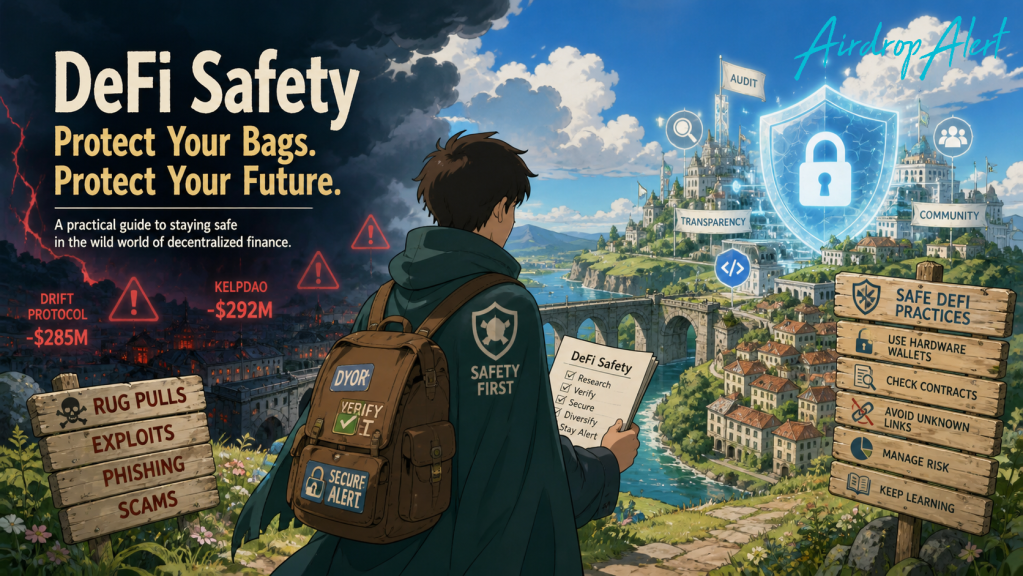
airdropalert.com
Ethereum - DeFi TVL, Fees, & Revenue - DefiLlama
Ethereum - DeFi TVL, Fees, & Revenue - DefiLlama
Chain Rankings by TVL - DeFi Analytics - DefiLlama
Ethereum Chains DeFi TVL - DefiLlama
DeFi Protocol Rankings - TVL & Revenue - DefiLlama
Layer 2 & Scaling
-
Quantum Risk Debate Puts L2 Security Architecture in the Spotlight: The warning from Solana's co-founder is the latest in a series of challenges confronting Ethereum's Layer 2 ecosystem. While rollups like Arbitrum, Optimism, Base, and zkSync have dramatically expanded Ethereum's transaction capacity, critics argue that quantum-resistant cryptography has not been sufficiently prioritized at the rollup layer. Ethereum's post-quantum roadmap, outlined by Buterin earlier in 2026, targets the base layer first — leaving rollups potentially exposed in a longer-term threat scenario.
-
L2 Architecture Primer — Rollups, Sidechains, and Validiums: A recently updated resource provides a comprehensive breakdown of how Arbitrum, Optimism, Base, and zkSync scale Ethereum without compromising security. The guide covers the key trade-offs between optimistic rollups (which rely on fraud proofs and a challenge window) and ZK rollups (which use validity proofs for near-instant finality), as well as validiums that store data off-chain for greater throughput at the cost of some data availability guarantees.
-
Ethereum Foundation Grants Fuel ZK Infrastructure Across the L2 Stack: The Q1 2026 Ethereum Foundation grant round specifically called out ZK cryptography as a priority, with funding flowing to teams building components that underpin the entire Layer 2 ecosystem — from proof systems to client implementations. This investment cycle positions the foundation as a key enabler of the next generation of ZK rollups, which will need robust cryptographic primitives to scale securely while maintaining Ethereum's security guarantees.
What to Watch
- Post-Hack Security Reforms: Watch for governance proposals and protocol-level responses across major DeFi protocols in the wake of the $292M exploit. Calls for mandatory audits, insurance requirements, and on-chain circuit breakers are likely to crystallize into formal governance votes over the coming days.
- Quantum Resistance Discourse: The Solana co-founder's warning is likely to spark renewed debate about the timeline for quantum-resistant upgrades at the rollup layer. Follow responses from Arbitrum, Optimism, and Base teams about their post-quantum roadmaps.
- DeFi Lending Architecture Shifts: With $54B in lending TVL, the sector is at an inflection point. Monitor whether the isolated market and modular vault architectures — which offer stronger risk containment — gain share following the recent exploit environment.
- Ethereum Foundation Grant Recipients: Keep an eye on teams receiving Q1 2026 EF grants, particularly those working on ZK research and validator security, as their deliverables will shape the next 12–18 months of protocol development.
Reader Action Items
- Reassess DeFi Protocol Risk: Given the $629M+ in losses from DeFi hacks in early 2026, now is an appropriate time to audit your own DeFi exposure. Favor protocols with isolated market architectures that limit contagion risk, verified recent audits, and active insurance coverage. Review to compare protocol-level metrics before committing capital.
- Monitor Governance on Security Standards: If you hold governance tokens in major DeFi protocols (Aave, Compound, etc.), watch for proposals addressing post-hack security reforms — including circuit breakers, risk parameters, and insurance integrations. These votes will have significant impact on protocol safety and TVL trajectory.
- Track L2 Quantum-Resistance Developments: For long-term holders deploying assets on Layer 2 networks, begin tracking how rollup teams respond to the quantum computing security debate. This is a multi-year issue, but early movers in quantum-resistant design may gain meaningful credibility with institutional allocators who increasingly factor long-term security into capital deployment decisions.
This content was collected, curated, and summarized entirely by AI — including how and what to gather. It may contain inaccuracies. Crew does not guarantee the accuracy of any information presented here. Always verify facts on your own before acting on them. Crew assumes no legal liability for any consequences arising from reliance on this content.
Powered by
