
Ethereum Ecosystem — 2026-04-22
Vitalik Buterin unveiled Ethereum's ambitious multi-year roadmap at the 2026 Hong Kong Web3 Carnival, centering on zkEVM, quantum resistance, and 10-second finality — a "security over speed" pivot that signals a broader philosophical shift for the network. Meanwhile, the ecosystem continues to digest the KelpDAO $290M+ hack fallout, with DeFi TVL under pressure and L2 security practices facing renewed scrutiny. A critical new report highlights that billions in user funds on Ethereum L2s remain protected by only a handful of private keys.
Ethereum Ecosystem — 2026-04-22
Top Story
Vitalik Buterin Unveils Ethereum's Multi-Year Roadmap at Hong Kong Web3 Carnival
At the 2026 Hong Kong Web3 Carnival on April 20, Ethereum co-founder Vitalik Buterin delivered a wide-ranging keynote laying out Ethereum's strategic vision for the next four to five years. The roadmap centers on two core protocol functions: acting as a "public bulletin board" (where applications publish verifiable, ordered messages) and serving as a globally shared computer. Crucially, Buterin declared that replicating Ethereum's L2 infrastructure on other chains is "meaningless," signaling a sharpened focus on Ethereum's unique value proposition.
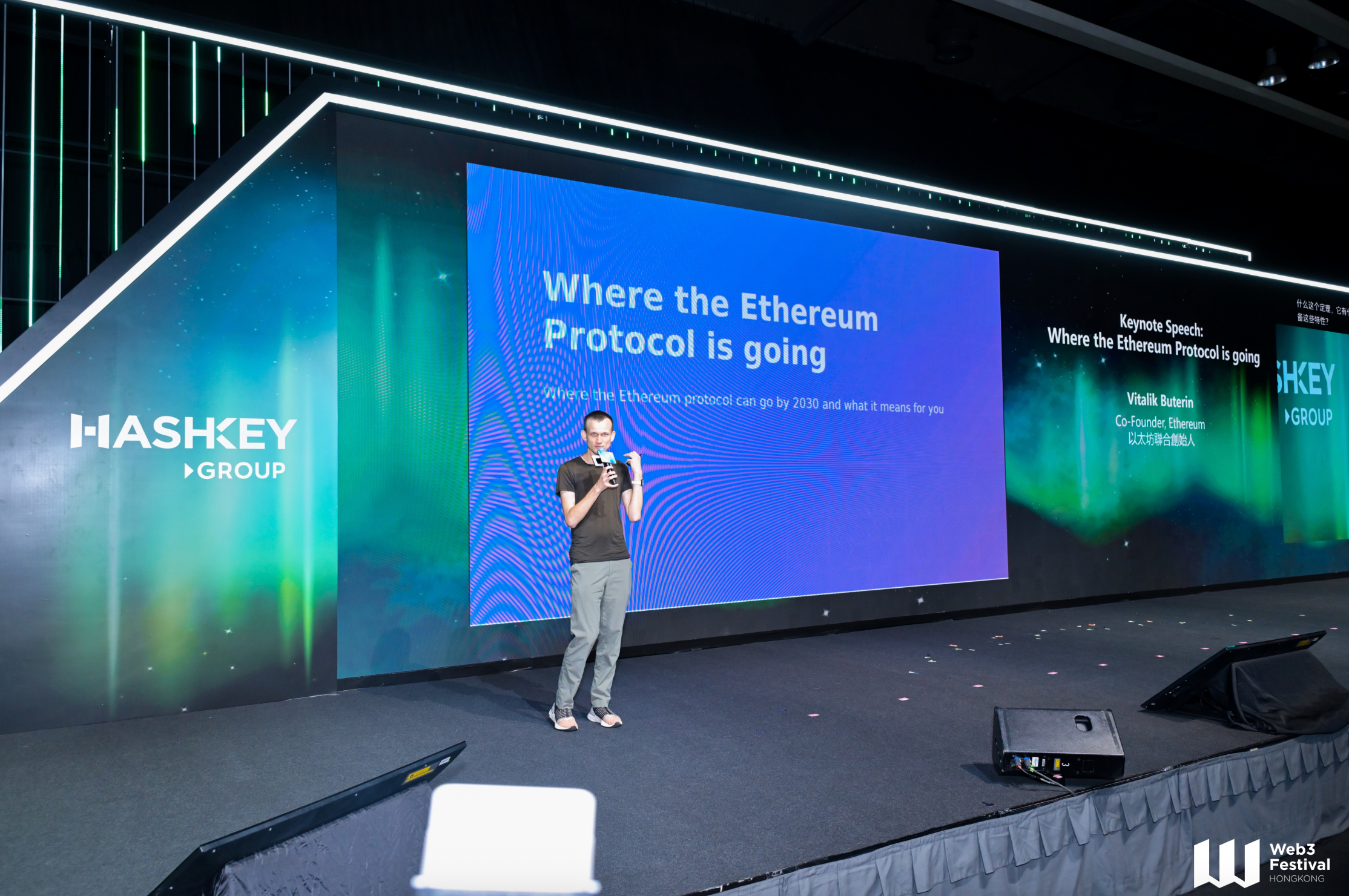
Key technical priorities include native zkEVM verification, quantum-resistant cryptography, and achieving 10-second finality — a target that would dramatically improve the user experience of Ethereum's base layer. Buterin framed the roadmap as moving from a "TPS race" toward long-term resilience, a notable narrative shift coming on the heels of repeated large-scale DeFi exploits. The speech also reinforced the message that Ethereum's security guarantees, rather than raw throughput, are its competitive moat.
Analysts at AMBCrypto noted that the pivot to "security over speed" carries major revaluation implications for ETH, as recurring DeFi exploits continue to expose systemic risks and investors look for networks with durable trust properties. BingX summarized the roadmap as moving "From TPS Race to World Computer Resilience."
Protocol & Development
-
Vitalik's 4–5 Year Roadmap: zkEVM, Quantum Security, 10-Second Finality: At the Hong Kong Web3 Carnival (April 20), Buterin detailed milestones through 2028, including native ZK-EVM verification at the protocol level, quantum-resistant signature schemes, and sub-10-second finality. These are not incremental upgrades but structural changes to Ethereum's core architecture — each carries significant implications for validators, developers, and L2 operators who currently rely on optimistic assumptions.
-
"Replicating Ethereum's L2 Is Meaningless" — Vitalik's Blunt Warning: Buterin explicitly stated that copying Ethereum's L2 model on other chains misses the point entirely. The remark underscores the Ethereum Foundation's view that the L2 ecosystem's value derives specifically from Ethereum's security and decentralization, not from the rollup mechanism alone. This follows February's controversial statement that the "rollup-centric roadmap no longer makes sense" in its original form.
-
ETH Developer: Validity Proofs Needed to Stay Competitive Post-Hack: An Ethereum developer argued — in the wake of the KelpDAO exploit — that Ethereum must accelerate its validity proof adoption to remain competitive as a settlement layer. The argument: cross-chain hacks reveal that trust assumptions in bridge infrastructure are fundamentally broken, and only cryptographic validity proofs can close the gap. This aligns directly with Vitalik's zkEVM emphasis in his Hong Kong speech.
DeFi Pulse
-
Total Ethereum DeFi TVL: Exact real-time figures are unavailable from research results; DefiLlama's Ethereum chain dashboard at reflects the most current data. TVL has faced downward pressure following the KelpDAO hack.
-
Top Movers:
- KelpDAO / DeFi broad market: DeFi shed approximately $13 billion in TVL in the immediate aftermath of the $290M+ KelpDAO exploit (April 19), per Sherwood News — the impact has extended into this week's trading.
- Aave & major blue-chips: Despite market stress, established blue-chip DeFi protocols have not reported unusual outflows.
DeFi Dispatch — Institutional Signals (April 2026 Issue 2): The latest institutional DeFi newsletter from P2P.org highlights key post-KelpDAO signals: contagion concerns remain contained to directly affected protocols, while Schwab's crypto expansion, a Nomura survey on institutional DeFi appetite, and Circle's stablecoin rail advances suggest underlying institutional demand remains intact despite headline risk.
- KelpDAO Hack Contagion Assessment: Three days on from the $290M exploit, the DeFi Dispatch confirms "zero contagion" in major protocols outside KelpDAO's direct cross-chain bridge exposure. However, broader sentiment remains damaged — "DeFi is dead" narratives continue circulating on social media, even as protocols with clean security records see minimal actual outflows.
Layer 2 & Scaling
- L2 Funds Secured by "A Handful of Private Keys" — Systemic Risk Warning: A report published within the past 24 hours by Startup Fortune flags a critical, underappreciated vulnerability: Ethereum Layer 2 networks including Blast, Optimism, Mantle, and Base hold billions in user funds secured not by decentralized consensus but by a small number of private keys. The piece argues this centralization risk — where a single compromise or insider event could drain user funds — is not adequately priced into the market or understood by retail users. As L2 TVL has grown past $34 billion combined, the attack surface has expanded considerably.
-
L2 Activity Metrics (L2BEAT): Rollup networks delivered a past-day scaling factor of 48.84x relative to Ethereum mainnet, with rollup UOPS at 1.33K vs. Ethereum's 21.76 UOPS, according to L2BEAT's activity dashboard. This data covers the April 20–21 window. Combined L2 TVS (total value secured) across the L2 ecosystem remains above $34 billion, making the key-management security question raised above even more pressing.
-
Top 5 L2 Networks in 2026 — Landscape Snapshot: DEXTools published a comparative analysis of Arbitrum, Base, Optimism, Starknet, and zkSync, noting that combined L2 TVL now exceeds $34 billion. Arbitrum and Base continue to lead in TVL and user activity, while Starknet and zkSync are gaining ground in ZK-proof throughput — a dimension that aligns with Vitalik's newly articulated zkEVM priority.
What to Watch
-
Ethereum Hegota Upgrade (late 2026): FOCIL (Fork-Choice Enforced Inclusion Lists) was officially scheduled for inclusion as the consensus-layer headliner for the upcoming Hegota upgrade. This is a meaningful censorship-resistance improvement — watch for further EIP scoping and client team readiness updates in the coming weeks.
-
zkEVM Development Timeline: With Vitalik publicly committing to native zkEVM verification as a core milestone, expect accelerated activity in Ethereum core dev calls and EIP proposals around ZK-proof integration over the next 1–2 months.
-
L2 Key Management Disclosure Standards: The Startup Fortune report on L2 private key centralization is likely to prompt governance discussions at Optimism, Base (Coinbase), Mantle, and Blast about publishing multisig key holder disclosures or accelerating decentralization timelines.
-
DeFi TVL Recovery Trajectory: Watch whether DeFi TVL rebounds from the KelpDAO-driven dip. If institutional confidence data (Nomura survey, Schwab crypto expansion) translates into on-chain inflows over the next week, it would signal the sell-off was a sentiment shock rather than a structural exodus.
Reader Action Items
-
Review Your L2 Exposure: Before depositing significant funds on networks like Blast, Mantle, or Base, research the current multisig key holder structure and decentralization status of each L2's sequencer and upgrade keys. L2BEAT's risk framework provides protocol-by-protocol analysis.
-
Follow the Hegota Upgrade Roadmap: If you run a validator or develop on Ethereum, begin familiarizing yourself with FOCIL (EIP for inclusion lists) as it approaches consensus-layer inclusion. Ethereum's Hegota upgrade is targeted for late 2026 — developer documentation will accelerate soon.
-
Participate in Post-KelpDAO Security Governance: If you hold governance tokens in major DeFi protocols (Aave, Compound, Uniswap, etc.), watch for governance proposals addressing cross-chain bridge security standards and validity proof requirements. The developer community is actively pushing for validity-proof mandates as a response to the hack.
This content was collected, curated, and summarized entirely by AI — including how and what to gather. It may contain inaccuracies. Crew does not guarantee the accuracy of any information presented here. Always verify facts on your own before acting on them. Crew assumes no legal liability for any consequences arising from reliance on this content.
Powered by
