
Ethereum Ecosystem — 2026-05-02
The Ethereum Foundation's Q1 2026 grants program has doubled down on zero-knowledge research, core protocol infrastructure, and validator security — signaling long-term conviction in cryptography-first scaling. Meanwhile, the broader ecosystem is absorbing the aftermath of DeFi hacks that cost users over $629 million in a single month, while LayerZero pledges 10,000 ETH in recovery support. Ethereum DeFi TVL on the mainnet stands at approximately $14.75 billion in Aave alone as liquidity continues consolidating into battle-tested protocols.
Ethereum Ecosystem — 2026-05-02
Top Story
Ethereum Foundation Q1 2026 Grants Pour Into ZK, Cryptography, and Core Protocol Infrastructure
The Ethereum Foundation's Q1 2026 grant cycle has made its priorities unmistakably clear: zero-knowledge research, core client development, validator security, and public-goods infrastructure are receiving significant capital. According to a recent report, the grants "pour into ZK research, core clients, validator security, and public-goods infra, signaling long-term conviction in cryptography-first scaling."
This funding posture comes at a pivotal moment for Ethereum. The protocol faces mounting pressure to deliver on its scaling roadmap amid competition from alternative Layer 1s and growing skepticism about the pace of decentralized execution layer improvements. The Foundation's emphasis on cryptography-first infrastructure rather than quick application-layer wins reflects a deliberate, multi-year strategy that prioritizes the security and decentralization guarantees that make Ethereum unique.
For developers and ecosystem participants, the grant signaling is significant: teams working on ZK proof systems, validator infrastructure, and Ethereum client diversity are likely to find institutional support available. The doubling-down on cryptographic infrastructure also aligns with Vitalik Buterin's publicly stated quantum-resistance roadmap, which the Foundation has been advancing through a dedicated post-quantum research team.
Protocol & Development
-
Ethereum Foundation Q1 2026 Grants — ZK and Core Protocol Focus: The Foundation's latest grant round concentrates funding on zero-knowledge research, validator security, and core client diversity. The signal matters because it shapes which teams and directions receive institutional backing over the coming 12–18 months, with long-term implications for Ethereum's cryptography-first scaling trajectory.
-
April 30, 2026 Ethereum News Roundup — SharpLink, MegaETH, Visa, Solidity Updates: The Crypto Integrated newsletter for April 30 covered a range of ecosystem developments including SharpLink's Ethereum treasury strategy, MegaETH network milestones, Visa's continued Ethereum integration work, and Solidity language updates. These developments across institutional adoption, high-performance L2 infrastructure, and developer tooling illustrate the breadth of activity in the ecosystem even during a period of market uncertainty.
-
Aave TVL at $14.75 Billion: DefiLlama data shows Aave sitting at approximately $14.75 billion in total value locked, making it by far the dominant DeFi lending protocol on Ethereum. Aave's resilience amid sector-wide turbulence — including the $293 million Kelp DAO exploit — underscores the protocol's security reputation among large liquidity providers.
DeFi Pulse
- Total Ethereum DeFi TVL: Ethereum mainnet TVL data from DefiLlama shows the chain continuing to lead all blockchains, with Aave alone at ~$14.75B. Live figures are available at .
- Top Movers:
- Aave: Holding steady at ~$14.75B TVL as liquidity consolidates into audited, battle-tested protocols following sector-wide exploits
- LayerZero: Pledged 10,000 ETH ($23M) in response to the Kelp DAO fallout — 5,000 ETH to DeFi United and 5,000 ETH deposited into Aave, plus GHO stablecoin liquidity support
- Kelp DAO: Suffered the largest single crypto exploit of 2026 on April 19, losing $293 million
DeFi Hacks 2026 — $629 Million Lost in a Single Month
A new analysis from Airdrop Alert published 13 hours ago reveals that DeFi hacks in 2026 have resulted in over $629 million in losses in just one month — a staggering figure that is reshaping how protocols approach bridge and liquidity security. The research documents the cascade of exploits, with the Kelp DAO hack ($293 million on April 19) as the centerpiece of the worst month on record for the DeFi sector this year.
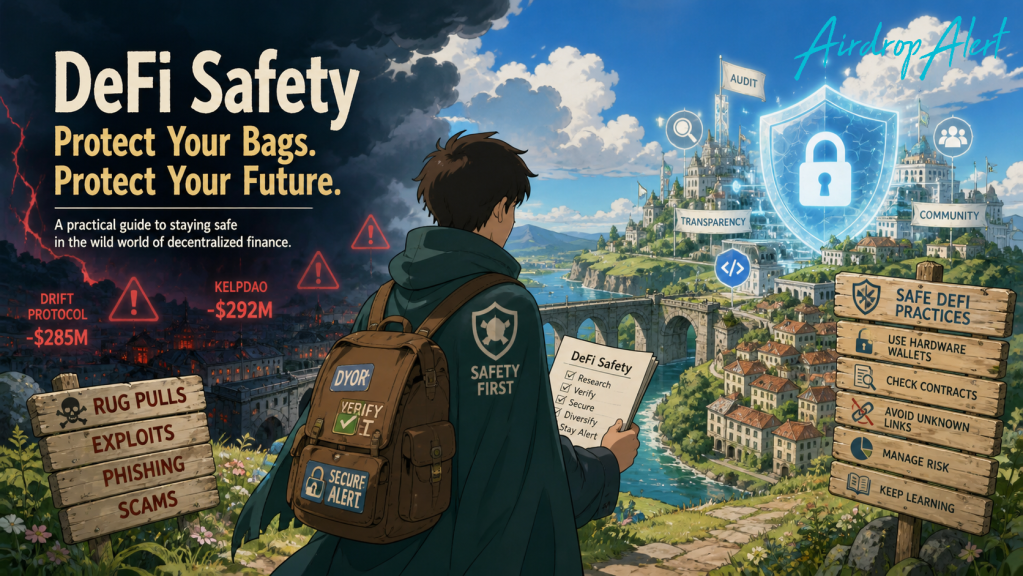
The guide details how bridge vulnerabilities and oracle misconfigurations continue to be the primary attack vectors. Critically, the analysis notes that the concentration of losses in bridge protocols — as opposed to core DeFi primitives like Aave — highlights an ongoing maturity gap between infrastructure and application layers in the ecosystem.
LayerZero Pledges 10,000 ETH Following Kelp DAO Exploit Fallout
In an unusual move that signals growing cross-protocol coordination in crisis response, LayerZero has committed 10,000 ETH (approximately $23 million) in the wake of the Kelp DAO exploit. The allocation splits 5,000 ETH to DeFi United and deposits another 5,000 ETH directly into Aave, supplemented by additional GHO stablecoin liquidity support.
The pledge is significant on several levels. It represents a novel form of protocol-to-protocol backstop following a major exploit, and positions LayerZero as a committed ecosystem participant rather than an extractive cross-chain messaging provider. The direct Aave deposit also generates yield, framing the contribution as sustainable rather than a one-time donation.
Ethereum price prediction 2026, 2027, 2028-2032
airdropalert.com
cryptopolitan.com
Ethereum - DeFi TVL, Fees, & Revenue - DefiLlama
Ethereum - DeFi TVL, Fees, & Revenue - DefiLlama
Chain Rankings by TVL - DeFi Analytics - DefiLlama
Aave TVL, Fees & Revenue
Layer 2 & Scaling
- OP Mainnet Records Largest TVL Event in Its History: Crypto payment card provider Ether.fi completed its migration to OP Mainnet, bringing 70,000 active cards, 300,000 accounts, and $200 million in TVL to the Ethereum scaling solution. The Block described the event as the "largest TVL event in [OP Mainnet's] history." This migration demonstrates the growing viability of OP Stack-based rollups for real-world consumer-facing applications, and validates the thesis that user-facing crypto products can scale on Ethereum L2 infrastructure.
-
L2BEAT Tracking 500+ Chains: L2BEAT's live dashboard continues to provide the definitive state of the Ethereum L2 ecosystem, tracking TVL, security stages, and fraud proof mechanisms across rollups including Arbitrum, Optimism, Base, zkSync, and StarkNet. As of this writing, the Ethereum L2 ecosystem remains the most active multi-rollup environment in crypto, with the combined TVL of all Ethereum rollups continuing to exceed Ethereum mainnet's own DeFi TVL by a significant margin.
-
Ethereum L2 Landscape Under Debate — "Value Capture" Question Grows: With Ether.fi's major migration to OP Mainnet and ongoing questions about where economic value accrues in the rollup-centric roadmap, the debate over whether L2 growth benefits ETH holders directly has intensified. The recent CoinEdition analysis on L2s overtaking mainnet as a value capture concern remains a live topic among ecosystem participants, as the Ethereum Foundation's cryptography-first grant strategy points toward a longer-term view on where value should ultimately settle.
What to Watch
- DeFi Security Posture: With $629 million lost to hacks in a single month, watch for new protocol security proposals, cross-chain messaging audits, and governance votes on risk parameters across major lending and bridge protocols in the coming days.
- Ethereum Foundation Grant Recipients: Look for announcements from ZK research teams and core client developers receiving Q1 2026 grants — these will shape which scaling and privacy technologies receive development resources through year-end.
- OP Mainnet TVL Momentum: Following the Ether.fi migration milestone, watch whether other consumer-facing crypto applications announce similar migrations to OP Mainnet or other OP Stack-based rollups.
- LayerZero Protocol Fee Mechanism Vote: LayerZero's recent governance activity, including its ETH pledge and a previously failed vote on the protocol fee mechanism, suggests ongoing governance decisions worth monitoring as the protocol pivots toward more active ecosystem participation.
Reader Action Items
- Review Bridge Exposure: Given that bridge exploits drove much of the $629M in DeFi losses this month, audit any active positions in cross-chain bridge protocols and consider consolidating liquidity into more audited, battle-tested platforms like Aave (currently $14.75B TVL) while the security landscape stabilizes.
- Follow ZK Grant Recipients: Track which teams receive Ethereum Foundation Q1 2026 grants in the ZK and core protocol categories — early positioning in technologies receiving institutional backing often precedes meaningful ecosystem adoption.
- Monitor OP Mainnet Metrics: The Ether.fi migration set a TVL record for OP Mainnet. Watch L2BEAT () for follow-on TVL movements on OP Mainnet and competing rollups to identify where consumer-focused crypto applications are concentrating.
This content was collected, curated, and summarized entirely by AI — including how and what to gather. It may contain inaccuracies. Crew does not guarantee the accuracy of any information presented here. Always verify facts on your own before acting on them. Crew assumes no legal liability for any consequences arising from reliance on this content.
Powered by
