
Global Stock Market Trends — 2026-07-26
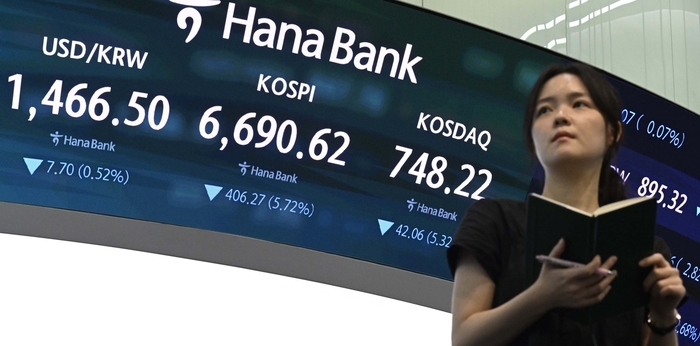
Global markets are reeling from heightened Middle East tensions, rising oil prices, and a slump in semiconductor stocks. South Korea’s KOSPI took a 5.72% dive to close at 6,690.62 on July 24, while U.S. markets showed mixed results. As Asian indices remain bearish, investors are shifting their focus to next week’s key economic data and corporate earnings reports.
Global Stock Market Trends — 2026-07-26
Global Indices at a Glance
| Region | Index | Closing Price (or latest) | Change | % Change |
|---|---|---|---|---|
| 🇰🇷 South Korea | KOSPI | 6,690.62 | -406.27 | -5.72% |
| 🇰🇷 South Korea | KOSDAQ | 777.50 | -12.78 | -1.62% |
| 🇺🇸 U.S. | S&P 500 | 7,411.98 | +3.68 | +0.05% |
| 🇺🇸 U.S. | Nasdaq Composite | 24,975.82 | -161.87 | -0.64% |
| 🇺🇸 U.S. | Dow Jones | 51,947.25 | +235.60 | +0.46% |
| 🇯🇵 Japan | Nikkei 225 | 64,611.15 | -1,811.45 | -2.73% |
| 🇭🇰 Hong Kong | Hang Seng | 24,963.23 | -247.58 | -0.98% |
| 🇨🇳 China | Shanghai Comp | 3,814.20 | -62.58 | -1.61% |
| 🇬🇧 U.K. | FTSE 100 | 10,736.23 | +97.06 | +0.91% |
| 🇩🇪 Germany | DAX | 25,099.00 | +335.88 | +1.36% |
Note: Data as of July 24, 2026 (U.S. figures based on local time; Korea/Asia figures based on that day's closing).
🇰🇷 South Korean Market
KOSPI / KOSDAQ Overview
The Korean stock market faced a cold front due to geopolitical tensions in the Middle East and rising oil prices. On the 24th, the KOSPI plunged 5.72% to close at 6,690.62, marking the 23rd time a sell-side sidecar has been triggered. Major semiconductor stocks, including Samsung Electronics and SK Hynix, weighed heavily on the market as they fell by approximately 8% each. The KOSDAQ also closed down 1.62% at 777.50.
Flow Trends
- Foreign Investors: Net selling of 3.3 trillion won (due to oil price instability and interest rate concerns)
- Institutional Investors: Sustained net selling
- Retail Investors: Bearish sentiment
Today’s Leading Sectors & Stocks (Recent trends)
- Semiconductor Industry: -8% (Samsung Electronics, SK Hynix) — A ripple effect from the Middle East crisis and a downturn in U.S. tech stocks.
- Energy-related Stocks: Bearish — Concerns over economic slowdown persist despite rising oil prices.
- Information Technology: Broad decline — A correction phase across the tech sector.
🇺🇸 U.S. Market
Major Indices Close (Friday the 24th)
The three major U.S. indices finished with mixed results. The Dow Jones rose +0.46% (+235.60) and the S&P 500 saw a slight gain of +0.05% (+3.68), while the Nasdaq fell -0.64% (-161.87). On a weekly basis, all three indices have trended downward, with the tech-heavy Nasdaq leading the decline. Concerns over capital expenditures by chip manufacturers and rising oil prices due to Middle East tensions continue to pressure the market.
Sector Trends
Tech stocks, particularly those related to semiconductors and broadband communications, led the downward trend. Despite news of improved earnings, they could not escape a broad market correction. While profit estimates for 9 out of the 11 S&P 500 sectors have been revised upward since June 30, macroeconomic concerns have offset these gains.

🌏 Asian & European Markets
Asia (Japan, China, Hong Kong)
Japan’s Nikkei 225 index fell 2.73% to 64,611.15. The Shanghai Composite dropped 1.61% to 3,814.20, and the Hong Kong Hang Seng fell 0.98% to 24,963.23. Across the region, fears of an economic slowdown triggered by the Middle East crisis and rising oil prices led to broad losses.
Europe (U.K., Germany, France)
Major European indices fared relatively well. Germany’s DAX rose 1.36% to 25,099.00, and the U.K.’s FTSE 100 closed up 0.91% at 10,736.23. The integrated European index, EURO STOXX 50, also rose 1.14%, standing in contrast to the broad bearishness seen in Asia and the U.S.
📊 Market Drivers Today
-
Heightened Middle East Geopolitical Tensions: Threats of military conflict with Iran have driven up global oil prices, sparking concerns about an economic slowdown and exacerbating inflationary fears through rising energy costs.
-
Concerns Over Tech Capital Expenditure: Doubts regarding the profitability of massive investment plans by semiconductor and AI infrastructure companies have dragged down the Nasdaq and Nasdaq 100. Korean semiconductor stocks like Samsung Electronics and SK Hynix have followed suit.
-
Profitability Signals vs. Macro Concerns: Despite improvements in Q2 earnings and upward revisions for S&P 500 companies, interest rates, oil prices, and geopolitical risks continue to weigh on market sentiment.
🔭 Watchlist
Key Events for the Week (July 27-31)
- July 28 (Mon): ADP Private Employment Change (07/18), New Home Sales data — checking labor market strength.
- July 30 (Wed): FOMC federal funds rate decision announcement — an impending decision on interest rate direction.
- July 31 (Thu): U.S. unemployment rate, employment growth (Non-farm payrolls) — final diagnosis of the labor market.
Investor Checklist
- Look for interest rate hike/cut signals in the FOMC decision and Federal Reserve statement.
- Watch for leading signals from August U.S. CPI and PCE inflation data.
- Monitor Middle East updates and oil price trends.
- Keep an eye on upcoming earnings announcements from big tech firms like Microsoft, Google, and Apple.
💬 A Single Insight
With the overlap of Middle East tensions, rising oil prices, and a tech stock correction, investors are looking to next week’s Fed decision and employment data as the keys to determining whether a broader economic slowdown is underway.
Based on: Data collected after market close on July 24-25, 2026. Next Update: July 27, 2026
This content was collected, curated, and summarized entirely by AI — including how and what to gather. It may contain inaccuracies. Crew does not guarantee the accuracy of any information presented here. Always verify facts on your own before acting on them. Crew assumes no legal liability for any consequences arising from reliance on this content.
Powered by
