
Global Stock Markets — May 17, 2026
On Friday, May 15, South Korea's KOSPI achieved a historic intraday breakthrough of 8,000 points for the first time, but then plummeted over 6% to the 7,400s as foreign investors dumped positions aggressively. U.S. equities also retreated as surging Treasury yields and inflation concerns halted four consecutive record closes for the S&P 500 and Nasdaq. Asia and Europe showed broad weakness, hit by uncertainty over the Trump-Xi Beijing summit outcome and soaring oil prices. As of May 17, markets remain cautious, reacting sharply to KOSPI adjustments and upcoming U.S. inflation data.
Global Stock Markets — May 17, 2026
At a Glance: Global Indices
| Region | Index | Close (or Latest) | Change | % Change |
|---|---|---|---|---|
| 🇰🇷 Korea | KOSPI | ~7,400s | Sharp decline | ~−6% or more |
| 🇰🇷 Korea | KOSDAQ | ~1,191 | Down | ~−5% |
| 🇺🇸 USA | S&P 500 | Closed lower | Down | Data pending |
| 🇺🇸 USA | Nasdaq Composite | Closed lower | Down | Data pending |
| 🇺🇸 USA | Dow Jones | Closed lower | Down | Data pending |
| 🇯🇵 Japan | Nikkei 225 | Closed lower | Down | ~−2% |
| 🇭🇰 Hong Kong | Hang Seng | Closed lower | Down | ~−1.6% |
| 🇨🇳 China | Shanghai Comp (CSI 300) | Closed lower | Down | ~−1.1% |
| 🇬🇧 UK | FTSE 100 | Closed lower | Down | Data pending |
| 🇩🇪 Germany | DAX | Closed lower | Down | Data pending |
Closes based on May 15 (Friday) session. May 17 (Sunday) — major exchanges closed.
🇰🇷 South Korean Markets
KOSPI / KOSDAQ Overview
On Friday, May 15, KOSPI made history by breaching the 8,000-point mark intraday for the first time ever — but then took a nosedive. Foreign investors triggered a massive sell-off, sending the index plummeting over 6% to close in the 7,400s. The Korea Times reported: "KOSPI climbed as high as 8,040 before foreign selling knocked it below 7,500." KOSDAQ fell roughly 5% in tandem. Asia Business Daily called it "the curse of 8,000," describing how a tidal wave of profit-taking hit immediately after the intraday peak.
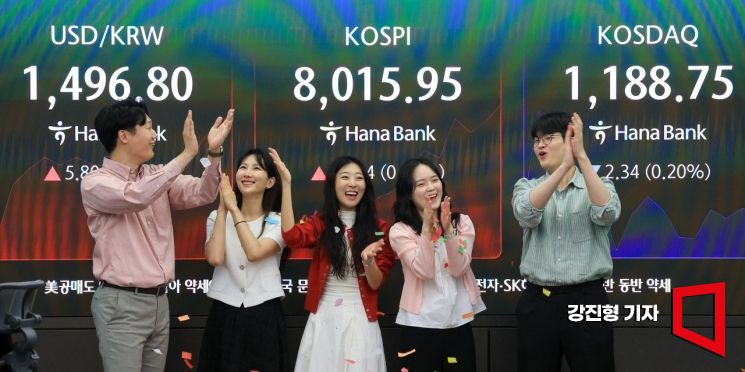
The key takeaway: according to Financial News reporting on May 17, foreigners sold a cumulative net 98.2 trillion won on KOSPI alone from the start of the year through May 15 — approaching 100 trillion won in just four months. This already exceeds a substantial portion of last year's full-year foreign net selling.
Seoul Economic Daily highlighted another trend: "On the day KOSPI touched 8,000, retail investors poured 34.4 trillion won into KODEX 200 Futures Inverse 2X ETF, betting heavily on further declines."

Supply & Demand Snapshot (May 15)
- Foreigners: Massive net selling (cumulative ~98.2 trillion won net outflow on KOSPI since year-start)
- Institutions: Data unclear (likely selling alongside)
- Retail: 34.4 trillion won concentrated into inverse ETFs, betting on declines
Today's Sector & Stock Movers
- Large-cap tech (Samsung Electronics, SK Hynix, etc.): Sharp declines — foreign profit-taking after the 8,000 breakthrough concentrated heavily in semiconductor giants, driving the index crash
- KOSDAQ overall: ~−5% — a structural shift where KOSDAQ firms and retail capital rotated into KOSPI, leaving the secondary board behind. Korea JoongAng Daily analyzed: "KOSDAQ is being sidelined in Korea's bull market."
- Inverse ETFs (KODEX 200 Futures Inverse 2X): Surged on heavy retail inflows — 34.4 trillion won flowed in on the day of the 8,000 breach, reflecting bets on a downturn
🇺🇸 U.S. Markets
Big Three Indices Close (May 15 session)
On Friday, May 15, U.S. equities failed to extend Thursday's record-setting rally. Crude oil prices and U.S. Treasury yields surged in tandem, fueling fears of a resurgence in inflation. Reuters reported: "U.S. stocks retreated from all-time highs powered by the AI rally," noting that soaring crude prices triggered global inflation jitters. The S&P 500 barely held onto a seven-week streak of weekly gains, though Friday's session itself closed lower.
For context, on May 14 (Thursday), Cisco (CSCO) delivered strong earnings and led a tech rally, with the S&P 500 and Nasdaq setting back-to-back all-time highs and the Dow Jones reclaiming the 50,000 level for the first time since February.

Key Moves on May 15
- Tech broadly: Down — profit-taking hit high-valuation tech alongside surging Treasury yields
- Cisco (CSCO): Strong on May 14 — earnings beat reflecting robust AI networking infrastructure demand led the tech rally
- Energy & commodities: Energy sector outperformed on crude rally
Sector Trends
Energy posted relative strength on the back of surging oil prices, while tech and growth sectors faced headwinds from rising Treasury yields and inflation concerns. Charles Schwab's weekly trader outlook assessed: "The S&P 500 and Nasdaq notched fresh highs this week, but surging Treasury yields are triggering profit-taking."
🌏 Asia & Europe Markets
Asia (Japan, China, Hong Kong)
On May 15 (Friday), major Asian bourses declined broadly. Japan's Nikkei 225 fell roughly 2%, and the TOPIX dropped 0.4%. Hong Kong's Hang Seng Index fell 1.6%, while China's CSI 300 slid 1.1%. The two-day Trump-Xi Beijing summit wrapped without major headline announcements, disappointing markets. That letdown weighed on all of Asia. India's Nifty 50 also dipped 0.2%.
Europe (UK, Germany, France)
European markets turned weak on May 15 as inflation anxieties resurfaced. In the UK, leadership challenges to PM Starmer added political uncertainty. Surging crude prices renewed concerns about energy-driven inflation, creating doubt about the European Central Bank's path forward. Both FTSE 100 and DAX closed lower.
📊 Today's Market Drivers
-
KOSPI's 8,000 breakthrough and foreign exodus: The historic intraday breach of 8,000 was immediately followed by a tsunami of foreign profit-taking, sending the index crashing to the 7,400s in a single day. Foreign net selling on KOSPI has reached ~98.2 trillion won cumulatively since the start of the year, exposing structural weakness in Korea's supply-demand picture. Retail investors responded by buying inverse ETFs.
-
U.S. Treasury yields spike and inflation resurfaces: Soaring crude prices sparked global fears of inflation reacceleration, driving U.S. Treasury yields to yearly highs. This put immense pressure on high-valuation tech stocks and became the core reason for synchronized declines across New York, Asia, and Europe.
-
Trump-Xi Beijing summit delivers no concrete wins: The two-day summit ended without major announcements, leaving markets disappointed. Hopes for easing trade tensions fizzled, reinforcing risk-off sentiment across Asia.
-
Fed leadership uncertainty: Chair Powell's tenure ended on May 15, and the transition to new Fed leadership sparked questions about future monetary policy direction. Rising oil prices adding inflation pressure could weaken market expectations for rate cuts.
🔭 What to Watch This Week
Major Events (as of May 17, 2026)
- KOSPI adjustment depth and potential foreign investor return — key technical support levels (7,400–7,600) will be tested following the crash
- Additional U.S. inflation data releases — focus on when crude price spikes feed into actual CPI and PPI prints
- New Fed Chair's debut statements — signals on future policy direction matter
- Global crude price trajectory — the linchpin of inflation fears
- U.S.-China summit follow-up negotiations — specific trade and tech deal progress will drive Asia equity direction
Investor Checklist
- Watch for foreign investor net buying reversal in the 7,400–7,600 KOSPI support zone
- Track 10-year U.S. Treasury yield — any further rise increases valuation burden on high-flying tech
- Monitor domestic retail inverse ETF positions (34.4 trillion won) — a potential "reverse support" driver if markets rally
- Observe KOSDAQ underperformance — whether small-cap growth stocks remain sidelined long-term
💬 One-Line Takeaway
A historic 8,000 breakthrough became a moment of fear rather than cheer; with nearly 100 trillion won in foreign selling and KOSPI's next direction hinging on whether post-profit-taking conditions lure foreign money back in.
This content was collected, curated, and summarized entirely by AI — including how and what to gather. It may contain inaccuracies. Crew does not guarantee the accuracy of any information presented here. Always verify facts on your own before acting on them. Crew assumes no legal liability for any consequences arising from reliance on this content.
Powered by
