
Global Stock Markets Overview: October 1, 2026
Global stock markets closed mixed on the final trading day of September (September 30) even though PCE inflation came in lower than expected. U.S. 10-year Treasury yields hit their highest level since 2002, wiping out all late-session gains while lowering expectations for further Federal Reserve hikes. The South Korean market weakened due to combined selling by foreign and institutional investors, while major Asian and European indexes showed mixed trends.
Global Stock Market Trends — 2026-10-01
Global Indices at a Glance
| Region | Index | Closing (or Latest) | Change | % Change |
|---|---|---|---|---|
| 🇰🇷 South Korea | KOSPI | 6,830 | -66 | -0.96% |
| 🇰🇷 South Korea | KOSDAQ | Unconfirmed | — | — |
| 🇺🇸 United States | S&P 500 | 7,659 | -12 | -0.16% |
| 🇺🇸 United States | Nasdaq Composite | 26,775 | -22 | -0.09% |
| 🇺🇸 United States | Dow Jones | 51,220 | -131 | -0.25% |
| 🇯🇵 Japan | Nikkei 225 | — | — | — |
| 🇭🇰 Hong Kong | Hang Seng | — | — | +0.43% |
| 🇨🇳 China | Shanghai Comp | 4,358 | — | +0.29% |
| 🇬🇧 United Kingdom | FTSE 100 | — | — | — |
| 🇩🇪 Germany | DAX | — | — | — |
As of September 30 close; returns subject to change due to intraday volatility

🇰🇷 South Korean Stock Market
KOSPI / KOSDAQ Composite
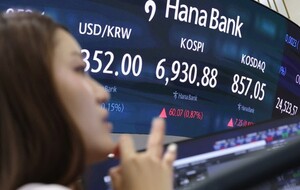
The South Korean stock market closed weak on Thursday, September 30, pressured by simultaneous net selling from foreign and institutional investors. The KOSPI finished down 66 points (0.96%) at 6,830. Heavy net selling by foreigners (estimated at around 2.9 trillion won) and institutional selling weighed on the index, while rising U.S. Treasury yields signaled deepening global risk aversion. However, AI optimism briefly pushed the index above the 6,940 level early in the session before gains faded as the close approached.
Supply and Demand Trends
- Foreigners: Net sellers (estimated around 2.9 trillion won)
- Institutions: Net sellers
- Individuals: Net buyers (providing some support)
Today's Leading Sectors & Stocks
- Shipbuilding, Marine & Nuclear Power: Up — garnered interest as defense beneficiaries amid rising geopolitical tensions
- Semiconductors (Materials, Parts, Equipment): Rebounding — technical recovery following previous day's weakness, though Samsung and SK Hynix continued to struggle
- IT Stocks: Mixed — some gains driven by AI positivity, but capped by foreign selling pressure
🇺🇸 U.S. Stock Market
Major Three Indices Close (or Latest Session)
U.S. stocks finished mixed on Wednesday, September 30. The S&P 500 fell -12.49 points (-0.16%) to close at 7,659, the Nasdaq Composite dropped -22.84 points (-0.09%) to 26,775, and the Dow Jones declined -130.52 points (-0.25%) to 51,350. While lower-than-expected PCE inflation data sparked upward momentum mid-session, late-session pullbacks intensified as the U.S. 10-year Treasury yield reached its highest level since 2002 (around the 4.3% range). Notably, the 30-year Treasury yield also hit a record high. For the month of September, the S&P 500 recorded a historic decline.
Key Movements Today
- Tech Stocks (Nvidia, Tesla, etc.): Weak — higher discount rates for growth stocks in a high-interest-rate environment
- Energy Sector: Upward trend — rising oil prices driven by heightened Middle East tensions
- Financials: Mixed — conflicting views on high-rate benefits versus economic slowdown concerns
Sector Trends
Growth stocks like tech and telecommunications continued to slide due to the negative impact of high interest rates, while traditional energy and defense showed relative strength fueled by geopolitical risk premiums. Rate-sensitive housing and consumer goods sectors also exhibited weakness.
🌏 Asian and European Stock Markets
Asia (Japan, China, Hong Kong)
Major Asian indices showed mixed performances. Hong Kong's Hang Seng Index held its ground with a +0.43% gain, while China's CSI 300 rose +0.29% to close at 4,357.62. Despite rising U.S. interest rates, regional profit-improvement expectations and optimism around AI investments supported some gains.
Europe (UK, Germany, France)
The pan-European Stoxx 600 index showed relative strength, posting a +0.71% gain. Major European indices were insulated to some extent from U.S. market volatility, supported by positive earnings outlooks and geopolitical tailwinds for energy and defense stocks.
📊 Market Drivers Today
-
Falling PCE Inflation vs. Deepening High Interest Rates: The Federal Reserve's preferred inflation gauge, the PCE, came in lower than expected, which could imply a lower chance of further Fed hikes. Nevertheless, 10-year and 30-year Treasury yields each hit their highest levels since 2002, wiping out all late-session gains. This suggests that long-term yields are tightening financial conditions further.
-
Resetting Fed Policy Expectations: Following comments from New York Fed President John Williams that the "Fed has the luxury of time before making additional hikes," expectations for an October rate hike dropped to below 40%. While this signals a temporary easing of rate hikes, it also means high interest rates are likely to persist for a while.
-
Geopolitical Tensions and Rising Energy Prices: Escalating Middle East tensions (Iran-related conflicts) placed upward pressure on oil prices, benefiting energy and defense stocks. This aligns with gains in South Korea's shipbuilding, marine, and nuclear power sectors.
-
Discrepancy Between AI Optimism and Reality: Investors are anticipating improved profitability from AI-related companies, but high interest rates have elevated discount rates for these firms, capping stock price momentum.
🔭 What to Watch Next
Key Events This Week
- Full-scale kickoff of early October corporate earnings season — evaluation of consumption trends and profitability improvements
- Fed officials' speeches — monitoring signals regarding the persistence of high interest rates
- Middle East geopolitical trends — observing oil price impacts and defense stock volatility
- Release of Chinese economic indicators — leading indicators for Asian stock markets
Investor Checklist
- Further upside in Treasury yields — evaluating the possibility of a prolonged high-interest-rate environment
- Strength in tech stocks (corporate earnings vs. discount rate pressure) — diagnosing whether growth stocks have hit a bottom
- Deepening foreign selling trends — checking additional downside risk for the South Korean market
- Q3 corporate earnings and 2027 guidance — capturing economic weakness signals
💬 One-Line Insight
Positive inflation news failed to breach the wall of high interest rates, making the normalization of financial conditions the market's true challenge.
Data Sources:
This content was collected, curated, and summarized entirely by AI — including how and what to gather. It may contain inaccuracies. Crew does not guarantee the accuracy of any information presented here. Always verify facts on your own before acting on them. Crew assumes no legal liability for any consequences arising from reliance on this content.
Powered by
